EL PAÍS offers the América Futura section openly for its daily and global informative contribution on sustainable development. If you want to support our journalism, subscribe here.
Read more Video|De la Espriella bets on better relations between Justice and the Presidency
Two brothers sit in front of the fire, in the still dark sky of Sarayaku. From a small speaker, music in Kichwa plays. There is joy in the air, although silence is kept. From the kitchen, two men carry a large pot with water and guayusa leaves. This ritual space is called Guayusupina: it is where the family gathers at dawn, drinks guayusa, and interprets the dreams they had the previous night.
In Sarayaku, dreams are also a form of knowledge. “The wise people of our community dedicate their lives to interpreting dreams in order to make accurate decisions for their community and territory,” explains José Gualinga, leader of Sarayaku.
From these meetings also arises the agricultural system of Sarayaku. Now, a recent study of mycorrhiza conducted in this territory provides evidence that this form of agriculture does not disturb the underground mycelium networks.
Farming in dialogue with the forest
For Sarayaku’s worldview, their life purpose centers on creating a harmonious language with the forest and its protective beings. This way of understanding the territory is also reflected in their way of farming.
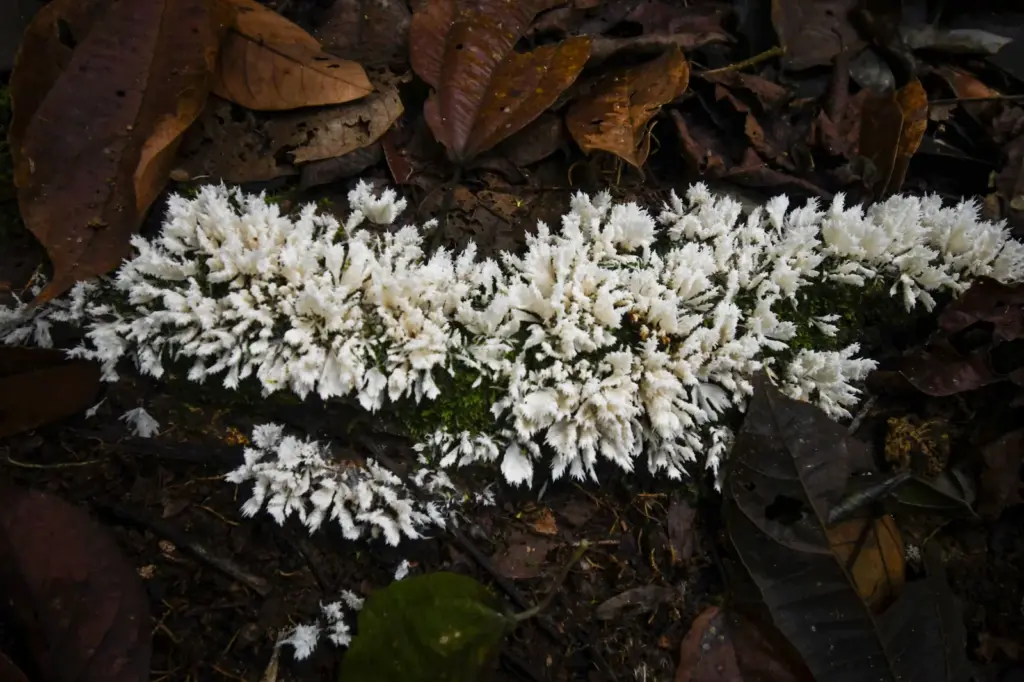
In a study conducted between the Kichwa people of Sarayaku and SPUN (Society for the Protection of Underground Networks) in the Ecuadorian Amazon, the networks of mycorrhizal fungi associated with plant roots were analyzed throughout different agricultural cycles.
The results reveal a remarkable diversity of arbuscular mycorrhizal fungi. This type of fungus forms an association with 80% of terrestrial plants. In total, more than 1,200 species of fungi were identified.
“The diversity of chakras in Sarayaku stands out when compared to another study conducted in the Andean part of Ecuador, where 72 species were recorded in uncultivated soils and 40 in agricultural soils,” explains Adriana, Field Science leader at SPUN.
For generations, the wise people of Sarayaku have spoken of Kawsak Sacha, the living forest, as a territory where everything is connected. In their vision, a network of lianas runs through the forest and links its protective beings; a fabric that is not always visible, but through which these forces can communicate and move.
“It is our way of understanding the territory: one must recognize oneself as equal to the earth. We have connections in our body, reproductive cycles, and also rest cycles,” explains José Gualinga. “That way of looking at the territory is reflected in our agriculture.”
In Sarayaku, there is a rotational system of associated crops, in which the land goes through four cycles: chakra, ushu, purun, and ruku purun. The first cycle is the chakra, a young and diverse garden where cassava, plantain, chili, fruits, sugarcane, and some potato species are planted. Next is the ushu, the adult cycle of the garden, the post-harvest period in which specific species, such as medicinal plants, begin to be incorporated; then comes the purun, when the chakra stops being planted and enters a rest/retirement stage, although some plants continue producing. Finally, there is the ruku purun, where the chakra returns to primary forest. This occurs 15 to 20 years after the last cultivation.
“I believe this agricultural system is successful because it is done on a small scale and in a context of well-preserved forests that help its recovery, as well as being a temporary system that is abandoned when its productivity begins to decline, which prevents crossing a soil degradation threshold,” explains Adriana, Field Science leader at SPUN.
Incandescent threads beneath the forest
The fungi visible on the surface are only the tip of the iceberg. Beneath them, in every cubic centimeter of healthy soil covered with vegetation, there is mycelium, even at great depths. A single spoonful of soil can contain kilometers of hyphae, the filaments that form this extensive underground network.
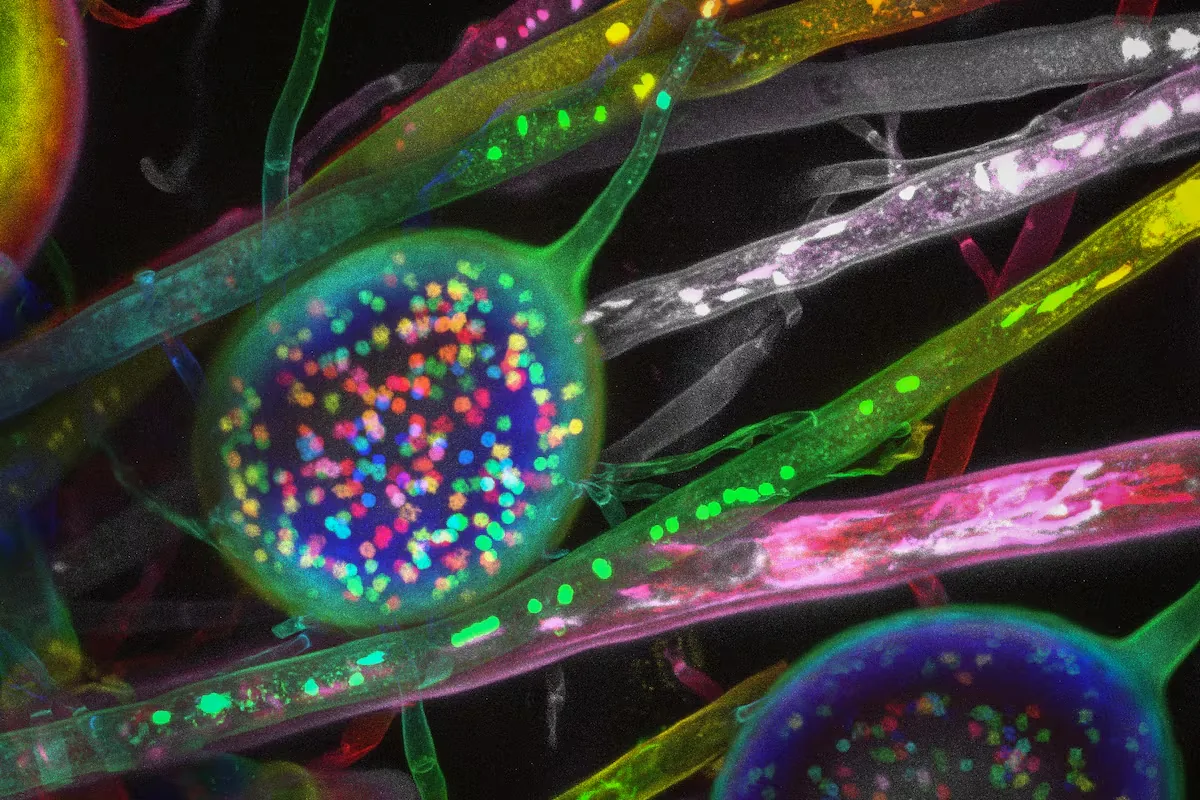
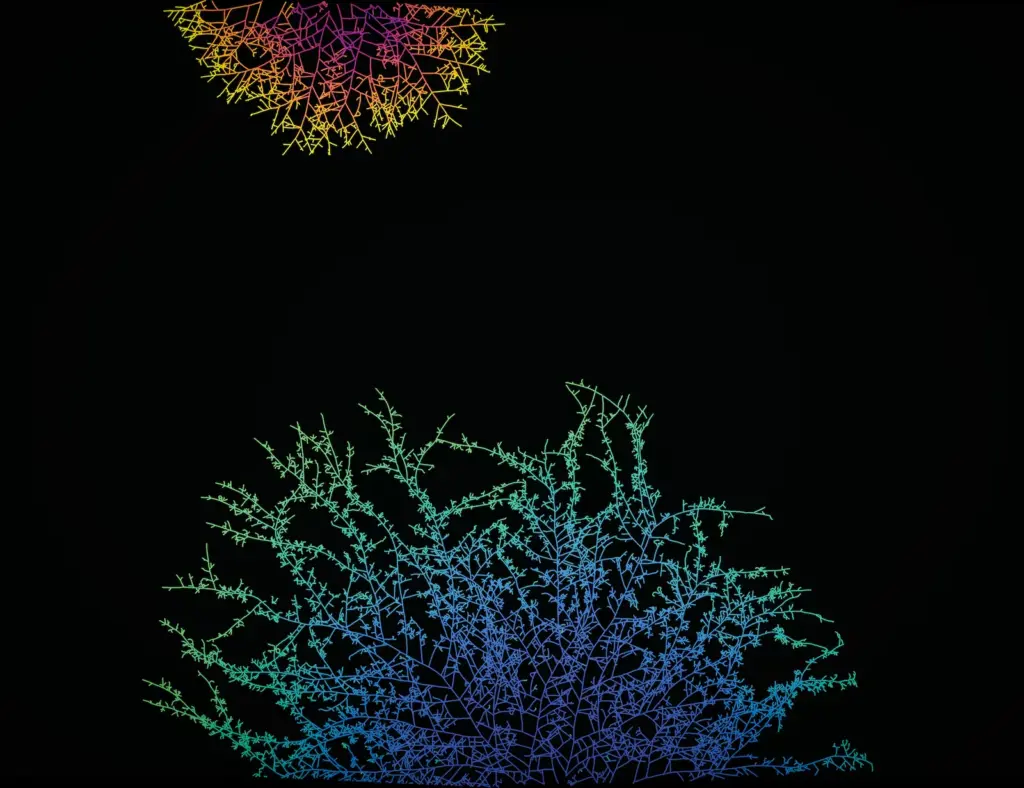
From 60 soil samples and using illumina sequencing techniques, the diversity of these fungi was studied. Mycorrhizal fungi build networks that allow them to collect and exchange nutrients with plant roots. To observe these living networks and the exchange occurring inside them, researchers used a robot designed to perform high-capacity sequential imaging. The system can simultaneously track more than 500,000 fungal nodes and around 100,000 cytoplasmic flow paths within the networks.

“Fungi can be beneficial not only for nutrient exchange but also for protecting plants against pathogens and droughts and helping them reduce stress,” explains Adriana Corrales.
Through this relationship, fungi deliver nutrients to plants and receive carbon and lipids in return. That carbon provides them with the energy necessary to build and maintain their own infrastructure: this extensive network of hyphae that branches through the pores and spaces of the soil.
“Western science is beginning to make visible, with robots and images, what the Sarayaku community has perceived for years: an underground network that connects the forest. Making these connections visible can also be a way to protect them,” says Sabine Bouchat, Sarayaku researcher.
A new pact with science
With the purpose of involving the community in the entire process of research, exploration, and species description, SACI (Intercultural Science) was created, a collaborative project that integrates Western scientific knowledge with ancestral wisdom, especially focused on the defense and conservation of the Amazon.
During the research, many species of fungi, mainly mycorrhizal, were found in the soil samples, leading researchers to believe that there are many species unknown to Western science, although some already have names in Kichwa. Integrating both knowledges allows for a broader understanding of forest life and generates information that can contribute to the creation of public policies.
“The studies conducted in Sarayaku should serve to strengthen the argument to protect our territory,” affirms José Gualinga.
Read more As decorative as practical: the colorful desk lamps that will give personality to your room