




1. Following NASA’s publication of the playlist chosen by the astronauts of the Artemis 2 mission —ten songs that served as their alarm clock during the first days of April—, the role of these songs has been enthusiastically disseminated, with a special preference for Under Pressure by Queen and David Bowie. It’s no surprise, as it’s a track that remains as relevant today as if it had been composed just yesterday. But it wasn’t out of a simple spirit of contradiction that I opted for very different melodies to accompany those extraordinary moments. I preferred, instead, to remember Lua Bonita in the saudade-filled voice of Raúl Seixas, increasingly listened to and loved.
Read more Marc Bassets, new Deputy Opinion Editor of EL PAÍS
It’s a Brazilian song, performed by the rocker with mestizo simplicity, from the depths of the 20th century, with lyrics invented by José do Norte. He, the poet, in love with the Full Moon, as if she were an unhappily married woman, promises to rescue her from the dominion of her husband, the violent Saint George, who in Brazilian mythology completely occupies the Moon’s round glow. The singer’s idea was to equip himself with a ladder to reach her, promising her a sweet life. I don’t know a more beautiful story to speak of love for the unattainable. The mission that the Artemis 2 crew undertook during those ten days was, in its own way, a kind of ladder called Orion, launched to meet Artemis, the Moon. They went there and almost touched it.
2. It was a scientific mission, and it’s clear that what they showed us reveals little of what happened there. To us, the enthusiastic public, they offered the spectacle of craters on the far side of the Moon, the solar eclipse, a floating Nutella can, the news of the broken toilet, and the movements of the happy astronauts, intertwined with each other, four adult twins inside a womb. And also their words: “Good night, Earth,” said Reid Wiseman, as they plunged into darkness. And he added the following: “We are all Homo sapiens.”
Given the events unfolding on Earth in the meantime, both on the side that remained dark and on the illuminated side, it was impossible not to see in the commander’s message a kind of call to humanity. In four brief words, he reminded us that all of us, without exception, are Homo sapiens, all descendants of what at the beginning of the species was nothing more than an insignificant animal, trying to survive among other species, in small, frightened, and fugitive groups, relatives of other ape siblings. On this topic, Noah Harari wrote an admirable summary: “Just six million years ago, a single female ape gave birth to two offspring. One became the ancestor of all chimpanzees, the other is our grandmother.”
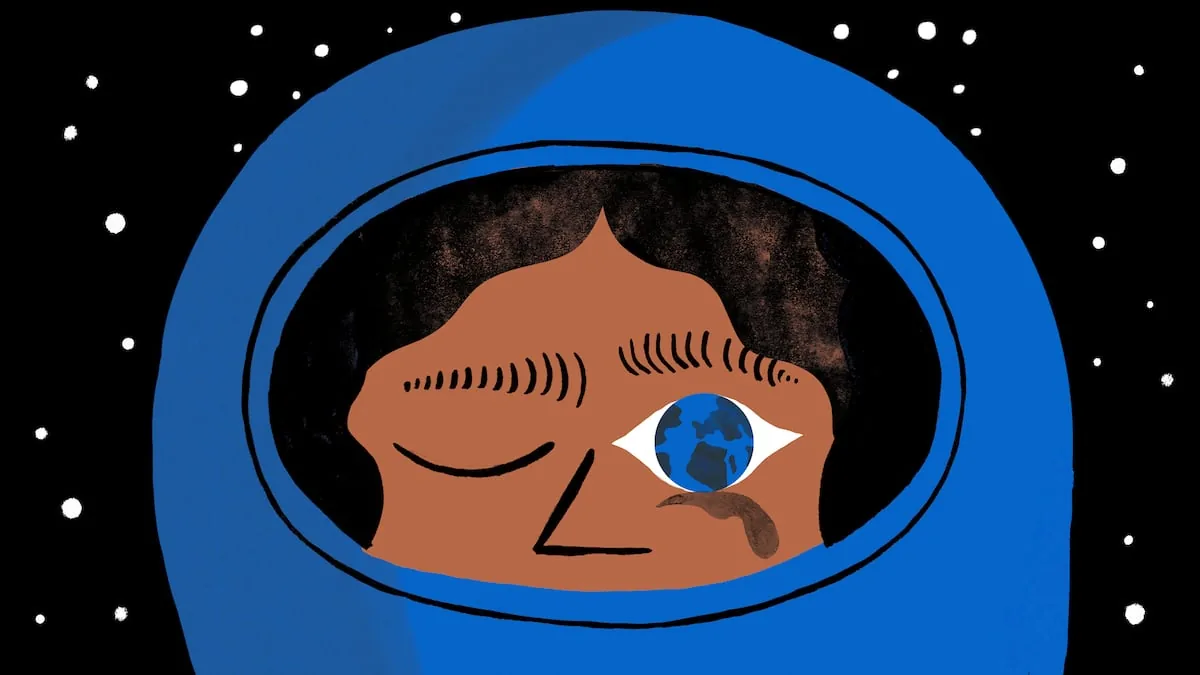
I believe Wiseman’s words will have moved many people across the Earth. At a time when Homo sapiens resembled a technological Prometheus attempting to steal the fire of knowledge, with its metal and cork ladder for the conquest of space, reminding the creature that rose on its hind legs that it still belongs to that ancient species reminds us that humility suits us well. The four astronauts, like Gagarin 65 years before, once again sighted the small blue Earth, miraculously suspended in the midst of darkness. Its surface, full of imperfect swirls like the image of a large cake batter before becoming uniform, mixed oceans, rivers, lakes, large cities, ports, ice, tropical jungles. Seen from afar, one could only think that Earth was fertile, peaceful, an Eden in contrast to the sterility of the cosmos. As Victor Glover, the mission pilot, said: “What we call the universe is a great void, but we have an oasis where we can coexist.”
3. Of course we can, but at this point, it’s worth pausing. If our digital finger were to touch the surface of the Earth on those very days, somewhere in Asia, we would discover that Homo sapiens threatened to infest India’s borders with large numbers of snakes and crocodiles to prevent Bangladeshi inhabitants from crossing the border. Clicking on northeast Africa, we would be informed that Homo sapiens in Sudan was again recruiting ten-year-old children for war, turning them into miniature soldiers. East of Europe, Homo sapiens launched missiles against buildings where Mulier sapiens and Puer sapiens, believing themselves protected by the technological umbrella. They died. A little further south, in the Levant Mediterranean, Homo sapiens, unable to control other Homo sapiens, after decimating an entire population through bullets, hunger, cold, and torture, reinstated the death penalty. It could be by hanging.
4. Speaking of hangings, firing squads, and other more subtle but equally lethal methods, clicking on Southeast Asia, we learned that Homo sapiens keeps thousands of young people crammed into cells, awaiting extermination, as they allegedly did in January. Around 4,000, Junior sapiens and Puella sapiens, await what awaits them without hope. And on Easter Sunday precisely, the day on which, it is said, a certain Homo sapiens, after being brutally murdered on two crossed planks, rose from the dead to say that Homo sapiens is more than that, that it has a divine spark because it finds its fulfillment in goodness and compassion for others, that same day, the Homo sapiens most powerful on the planet, the one with the deadliest weapons and sailing the seas and skies killing whoever it pleases, threatened to wipe off the face of the Earth a civilization of Homo sapiens more than 6,000 years old. To use his exact words, he stated that his enemies would return to the Stone Age. And so on. And meanwhile, in the best of paradoxes, from that same area of the Earth emerged four specimens of Homo sapiens, demonstrating to the world how promising science, technology, beauty, and the word are.
5. I was moved that the Canadian expressed the concept of the otro as few have managed. Jeremy Hanser said, addressing the waiting crowd: “When you look up here, you are not looking at us. We are a mirror reflecting you. And if you like what you see, then look a little deeper. What you see is yourselves.”
And Christina Koch, who claimed her work as a plumber, speaking at the same time as those who want to set the Earth on fire clamored for apocalyptic destruction, defined it thus: “I saw the Earth and all the darkness surrounding it. The Earth was simply a lifeboat floating undisturbed in the Universe.”
I don’t know if those words they said were spontaneous or prepared, what I do know is that they were beautiful and radiated hope in dark times. The truth is that two opposing beings coexist within Homo Sapiens: one that kills and one that saves. This is how the Ape Grandmother gave birth to us, perplexing. People speculate about what Homo cosmicus will be like in a hundred years. Hopefully, it will be an extension of these four astronauts, accompanied by the unsuspecting voice of Raúl Seixas, the Homo miticus who desired the moon as if it were a woman.