









Although in this edition the figures have been less overwhelming than in previous years (with an offer of 105 official concerts—excluding the free ones from the Fringe and those of the cathedral carillon—compared to 128 in 2025), Utrecht remains the ideal setting to take the pulse of the health of early music, whose performers have been breathing life for decades into the most dynamic, nonconformist, and—paradoxically—innovative sector of the classical music field. It is rare for a year to pass without new extraordinary soloists or groups emerging here, destined to perpetuate this kind of creative and investigative effervescence: after all, they are fortunate to explore no less than seven centuries of music, with hundreds of masterpieces still waiting to be redeemed or firmly placed in the canon, while symphony orchestras, opera houses, or traditional ensembles usually concentrate their activity in a much shorter time span, returning again and again to the same repertoires.
Medieval music, for example, is often absent from non-specialized programs, but in Utrecht it has always had a prominent presence and counts on the festival, year after year, with a legion of faithful followers. Since this edition was titled Giving Voice, it seemed inevitable to reserve at least one appointment with the very origin of Western polyphony, and it was extremely instructive, for example, to be able to listen to the four-voice organum Viderunt omnes or another similar organum quadruplum, Sederunt principes, both by Perotinus, performed in three different concerts and in quite different ways from each other. In 13th-century Paris, what Paul Van Nevel has called a “seismic revolution” occurred in Western music as a result of the birth of the first pieces of some complexity for multiple voices. And not only the music itself but also the invention of how to capture and preserve it in writing came to light simultaneously, so it is precisely the way of understanding and transcribing that still incipient notation that can initially give rise to divergent sound realizations.
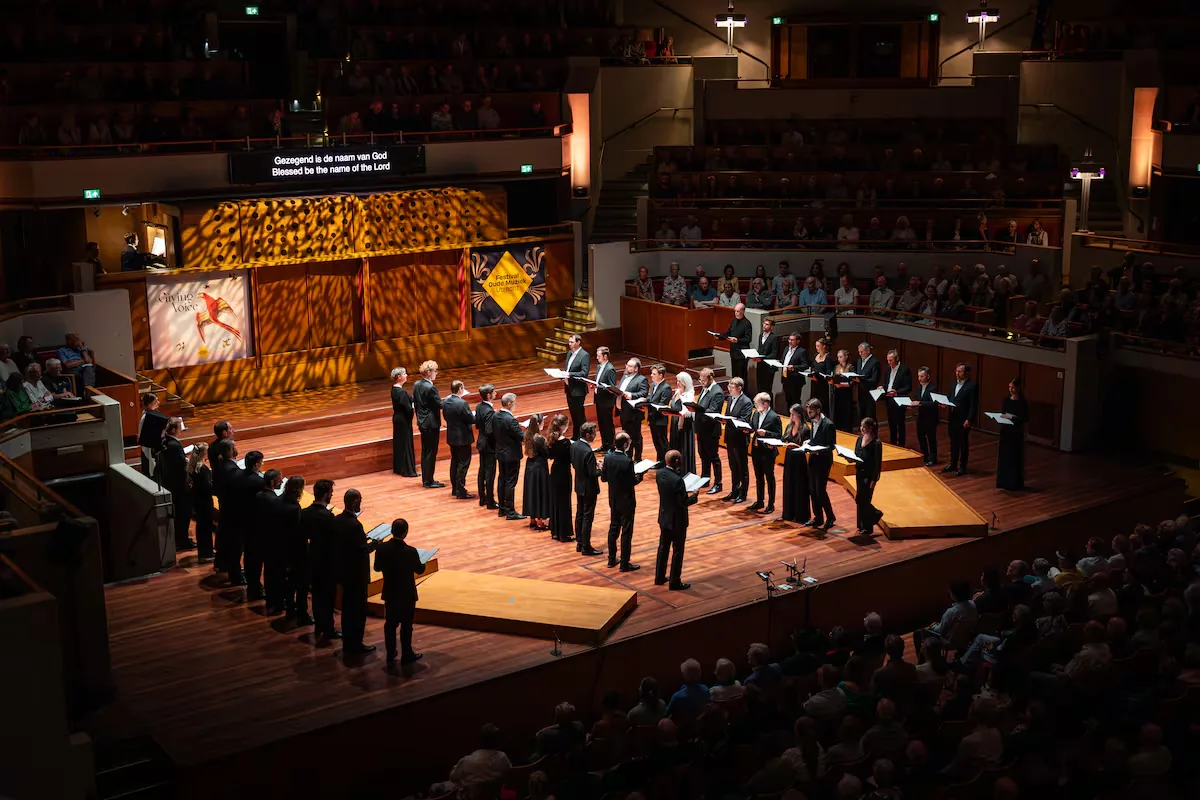
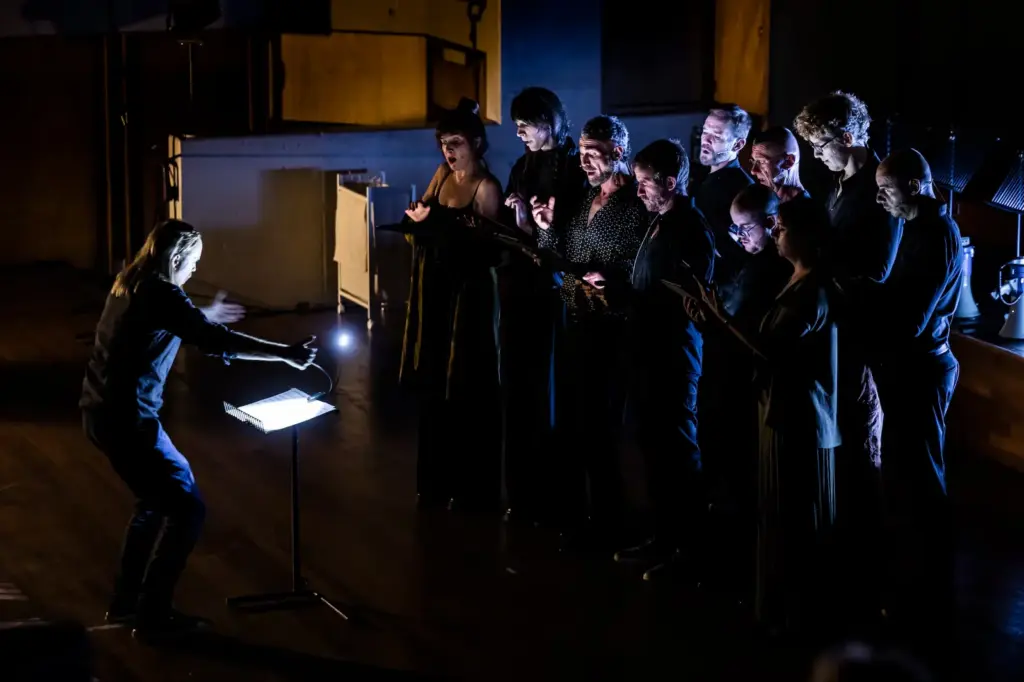
The prologue of the festival on August 28 was precisely entrusted to the very experienced Paul Van Nevel (who seems reluctant to step back, as he announced last year, since he has continued to be present both here and at Laus Polyphoniae in Antwerp leading his historic Huelgas Ensemble). Although his group has undergone many personnel changes during its more than half-century career, the Belgian conductor has always managed to have his singers faithfully embody his sonic ideal of a clear polyphony, sonically aesthetic and controlled at all times firmly by his hands and gaze. The Belgian, who is also a scholar besides being a performer, knows perfectly the sources that document the development of these early rhythmic notations, the theoretical treatises (especially those of Johannes de Garlandia, Jerónimo de Moravia, the English Anonymous IV, and Franco of Cologne, praised as “primus inventor mensurabilis musicae”, a clear proof of the internationalism reigning in 13th-century Parisian music), the first polyphonic musical forms (organum, clausula, conductus, and motet) and the ornamentation techniques used in the musical chapel of Notre-Dame, although putting them into practice leaves a very wide margin of interpretation.
Paul Van Nevel built his program to offer a miniature view of the different compositional and interpretative techniques of the time, from the initial acclamations sung by the women of his group, through Leoninus’s two-voice organum Haec Dies (with tenor Loïc Paulin as a vox organalis with orientalizing inflections and little bells tinkling in the clauses of greater contrapuntal activity), the largely homophonic conducti (Crucifigat omnes and Belial vocatur, from our Huelgas Codex), the rhythmically complex polytextual motets (O Maria maris stella and Homo miserabilis) or the final canon Benedicamus Domino (also from the Burgundian codex), to the crown jewel, Viderunt omnes, the four-voice organum by Perotinus which, with its more than ten minutes duration, left contemporary listeners astonished, who must have perceived this music as a sonic translation of the imposing Gothic architecture surrounding them. Modern minimalism has its roots here, and so it was not strange to perceive echoes of Arvo Pärt or John Taverner in Cum apertam sepulturam: Van Nevel himself even refers to the presence in this 13th-century repertoire of “unceasing, hypnotic, almost fanatical rhythmic models.”
In this concert, his singers were heard for the first time (especially Helen Cassano), for example in O Maria maris stella or in an Agnus Dei, performing a strange ornament vaguely resembling an upper or lower mordent, in a manner that could almost be described as a rapid yip, perhaps a translation of the plica or reverberatio from the treatises of the time. And, as always, the dynamics were calibrated to the millimeter at all times, sometimes like a great very gradual bow, as in the final stretch of the Agnus Dei, translated as a slow descent into nothingness. The singers also constantly changed position, locating and distributing themselves in each piece in different groups and spaces, including the cathedral pulpit. And on this occasion, unlike in Antwerp, Van Nevel conducted all the operations—which were many—seated in a chair, but with the usual authority and energy.
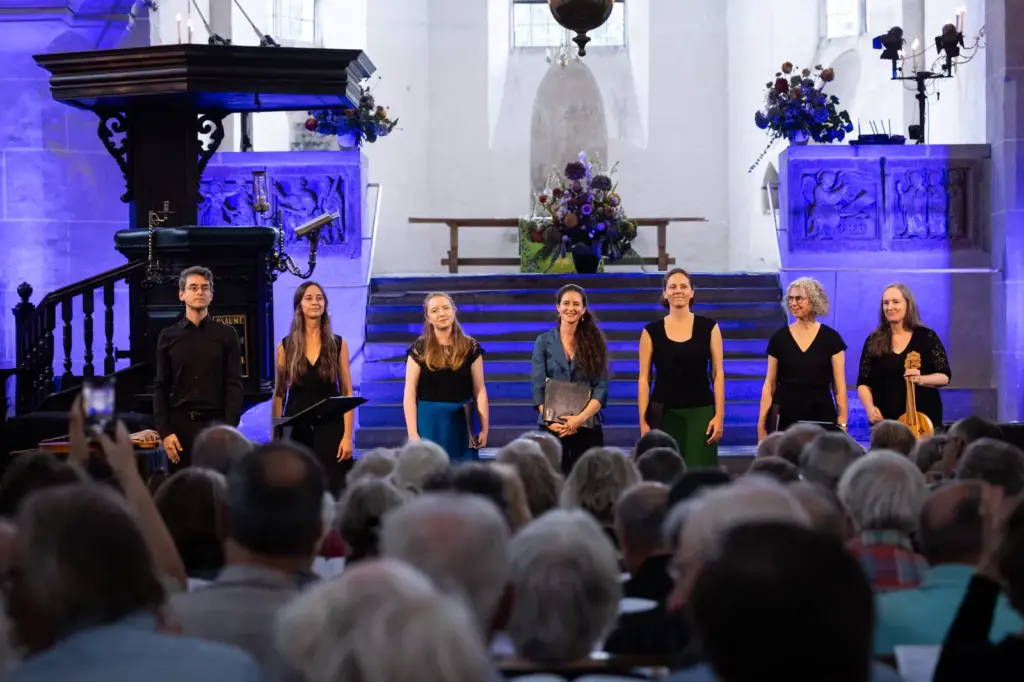
A historic singer of the Huelgas Ensemble who knows the Belgian conductor perfectly, soprano Sabine Lutzenberger, offered this same repertoire with her own group, Per-Sonat, last Thursday at the Pieterskerk. As main differences, she uses only five female voices and does not disdain the use of instruments, her faithful fiddlers Baptiste Romain and Elizabeth Rumsey, even to play the tenor. With two blocks dedicated to organum (“the queen of melody”) and rhythm (“the new star”), everything here was less convoluted, more natural, more intimate, even more democratic if you will, with each of the five singers (besides herself, Hannah Ely, Karin Weston, Katalin Tarnai, and Tessa Roos) indicating to the rest with an outstretched arm the start of a new section as the spotlight passed from one to another. And most notably, her way of interpreting some pieces from the first block reconstructed the use of the original rules and improvisation techniques, alternating between the works of Leoninus and Perotinus transmitted to us by written sources with these improvisatory practices, which for Lutzenberger do not have to adopt orthodox or Eastern turns.
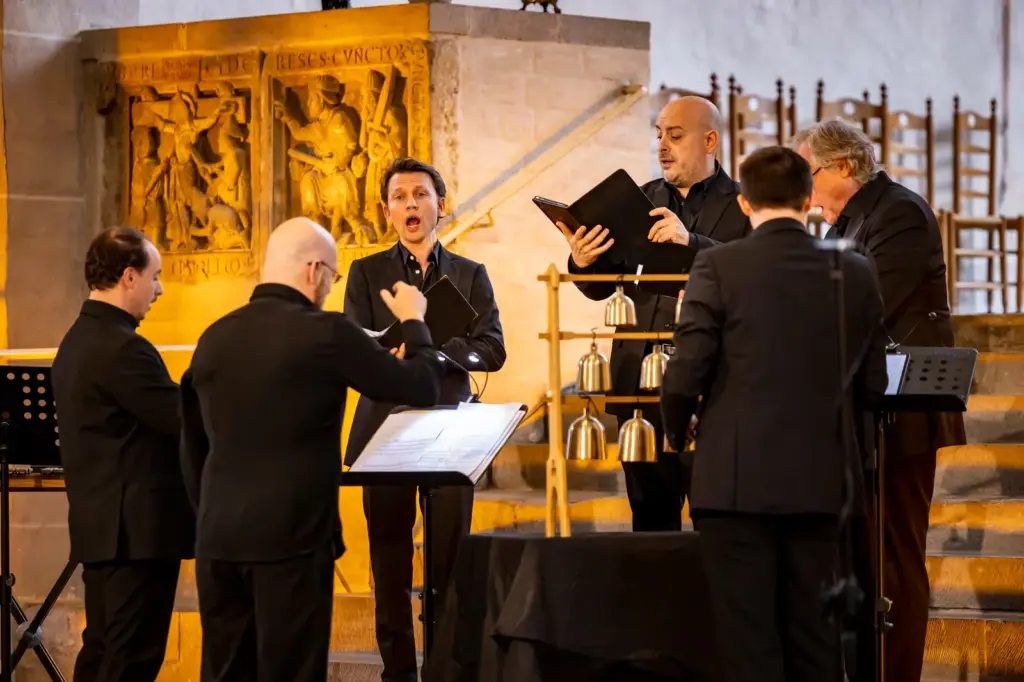
The next day, in the same church, Michele Pasotti took things much further, contrasting the works of Notre Dame (again the organum Viderunt omnes to open the program and the conductus Beata viscera) with a percussion piece by Ron Ford (Luccicare), an original vocal composition (Il Crocomimosa, for voices and glockenspiel) and a work commissioned by the Utrecht Festival to Steve Reich, the imminent nonagenarian, exactly thirty years ago, Proverb, for voices, two vibraphones, and two positive organs. Another former member of the Huelgas Ensemble, Michaela Reiner, was a guest of La Fonte Musica, so the three concerts had more interrelations than were obvious at first glance.
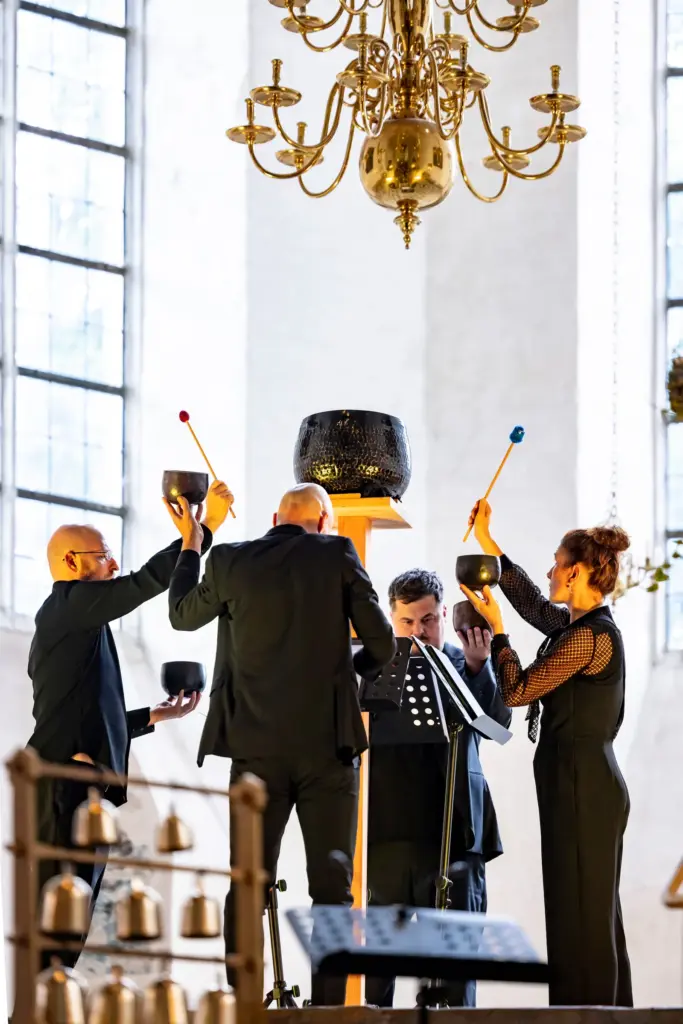
Using the two levels of the Pieterskerk, Viderunt omnes experienced a very different translation from the one heard the previous day, now with five men and a profuse use of bells of different tunings played at strategic moments, in order to reinforce the structural profile of the work, by Henry Reavey. Instruments also played a decisive role in Beata víscera, which began with Alena Dantcheva singing solo from above, in the organ gallery, while in Pasotti’s work the singers were spread throughout the church. Reich’s work, here in its best version, much less simplistic and more substantial than usual, is based on a phrase by philosopher Ludwig Wittgenstein: “What a small thought it takes to fill a whole life!” (hence the title Proverb). Listening to it, paying an undisguised homage to the polyphony of Notre-Dame, it was as if the alpha and omega were shaking hands, despite the nine centuries that separate them. And something similar happened when, with the best imaginable choice, and before the enthusiasm of the audience, Michele Pasotti, La Fonte Musica, and their guests tackled the canon Sumer is icumen in (Summer has come), a 13th-century English piece that is one of the earliest examples of strict three-voice imitative counterpoint, with a text describing the cuckoo’s song (wonderful Gianluca Ferrarini singing its onomatopoeias) and the birth of both foliage and lambs and calves. Anyone unfamiliar with the work, coming from Proverb, could perfectly have thought it was another short piece by Steve Reich: and they would not be far off. Better to listen to this canon now, when summer is—fortunately—already heading towards its final stretch, than when it arrived, months later than it should have.
The medieval offer of these last days was completed with yet another great concert by Ensemble Leones, dedicated monographically on this occasion to the nobleman, diplomat, traveler, poet, and musician Oswald von Wolkenstein. Marc Lewon (who played lute and cittern) always gathers the most suitable musicians, each better than the last: again Baptiste Romain, the prince of current fiddlers, who also played solo with the bagpipe Ich hör, sich manger fröuen lat; soprano Grace Newcombe, who also occasionally played the harp; tenor Korneel Van Neste, with the ideal voice for this repertoire and an incredibly refined sensitivity; and baritone Raitis Grigalis, mainly in charge of the more narrative and less melodic songs, ideal for his smooth and agile voice. The latter two sang a cappella Vier hundert jara uf erd, perhaps the most moving moment of the concert along with Ain graserin durch küelen tou, with Newcombe and Van Neste again without instrumental accompaniment. All, including Lewon and Romain, sang the refrains of the strophic songs, and the fact that the conductor did not play in the last song of the program, Gar wunniklich hat sie mein Herzbesessen, is the clearest demonstration of his lack of desire for protagonism. If 15th-century music were always performed like this, with this freshness, this good practice, and this respect for the sources (Von Wolkenstein’s works are preserved in two manuscripts currently in Vienna and Innsbruck), it would gain legions of followers.
Closing the medieval section, a concert by Dialogos bore the unmistakable stamp of Katarina Livljanić, where recitation (her true specialty), instrumental improvisation (with her faithful instrumentalists: fiddler Albrecht Maurer and flutist Norbert Rodenkirchen), and singing came together, where Clara Coutouly shone brightly, a voice with better technique and quality than the Croatian’s. The program’s axis was the famous Winchester Troparion, which contains simple polyphonic pieces predating those born in Notre-Dame. Livljanić somewhat literaturizes and gives excessive importance to what she does, but her proposal was much less interesting than those already mentioned or the last medieval contribution to the festival program: the second concert of the Sollazzo Ensemble, now focused on the figure of the jester, with music mostly from the Italian Trecento. Their first performance at the festival was discussed in a previous chronicle, more attractive in approach and execution than this other one offered on Sunday afternoon at the Pieterskerk.
Carinne Tinney, Oberto in the new production of Handel’s Alcina premiered this summer at the Bavarian State Opera, proved to be a versatile and multifaceted singer capable of singing in style and with enormous technical proficiency very diverse music. The best was again concentrated in the simplest, like I’ credo ch’i’ dormiva, which they played admirably in two voices, without greater convolutions, Anna Danilevskaia with her fiddle and Mara Winter with her flute, who showed she can play very well when she forgets experiments that lead to a dead end, like the one offered a few days earlier with her group Phaedrus. Jonatan Alvarado repeated, that afternoon in excellent humor, smiling, joking, and with an unusual extroversion in him, although, alas!, without completely leaving the mellifluous and, at times, inaudible singing, as happened at the end of In forma quasi—perhaps wanting to better translate the verse “I’ pur volea dormire, et non potea”—and in his solos in Perche virtù, by Francesco Landini. After losing his way for a time and venturing down somewhat eccentric paths (at the opposite extreme from Marc Lewon and his Ensemble Leones, to understand each other), Danilevskaia seems to be gradually redirecting the course of her group: when the performances are fully up to the exemplary crafting of their programs, we will recover that initial version of Sollazzo, which impressed us so much in its day.
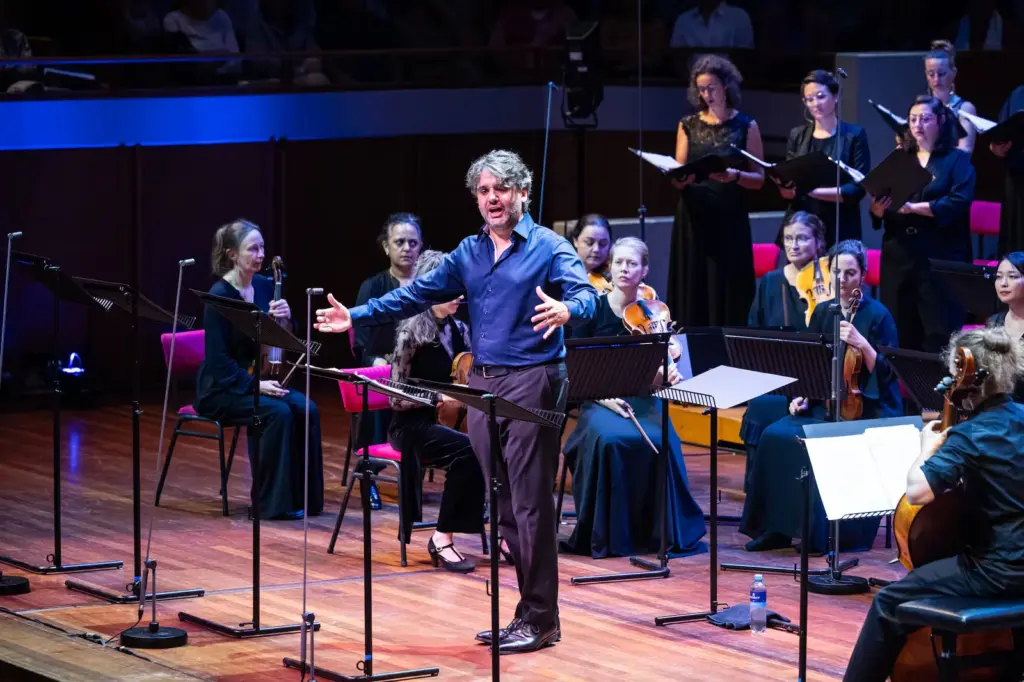
For eccentric, the torture inflicted on us by Björn Schmelzer on Thursday night at the TivoliVredenburg. On paper, the theme was interesting: starting from the recordings of the last Vatican castrato, Alessandro Moreschi, to explore the discomfort his listening arouses today and the drastic change of course driven by the Holy See, which went from supporting a practice for centuries to strictly prohibiting it. But this turned into an intellectualist monstrosity (with baritone Luis Neiva acting as a slow narrator-scientist and calling Flos florum, by Guillame Du Fay, a “monstrously hermaphroditic” piece) whose ultimate purpose was, as we soon discovered, fully self-justifying: criticizing the interpretative ways of Graindelavoix is exactly what Mendelssohn or Stendhal did in their day by ignorantly—also read narrow-mindedly—disdaining the improvisations of the Sistine Chapel choir when they could hear it in situ. “Don’t be ignorant,” the Belgian seems to tell us, “what I do is as authentic as what they did; it’s no use tearing your clothes, because time will prove me right.” But, without entering into debate on his terrain, what reaches our ears is an indigestible sonic mush in which it is absolutely impossible to discern the polyphonic fabric, because the endless melismas, out-of-tuneness, asynchronies, liberties, and vocal outrages of all kinds committed by his singers erased for almost two unbearable hours all traces of the original writing. Amid the chaos, it was sometimes possible to distinguish the extraordinary voice of Spanish tenor André Pérez Muiño. How it is possible to go from singing in Vox Luminis (the maximum and constant effort to build) to doing so in Graindelavoix (the persistent and all-out effort to destroy) is an impossible question to answer.
If a concert with a message, or with the accompaniment of a complementary theoretical apparatus, was wanted, it is impossible to surpass what the group Psallentes and Dutch historian Frits van Oostrom did the next day at the Hertz. Everything revolved around the mystic and visionary Hadewijch of Brabant, contrasted at times with Hildegard von Bingen. Another academic, Veerle Fraeters, read texts by Hadewijch in medieval High Dutch, the members of Psallentes sang them with pre-existing melodies in the manner of contrafacta, since she was not a composer, unlike Hildegard, but “an artist of the word,” as Van Oostrom referred to her, who is writing a book about the Flemish beguine and did not utter a single phrase that was not interesting or devoid of depth: a lesson in conciseness brimming with content and infinitely suggestive. With the word minne, which we can only reductively translate as love, omnipresent (it appears more than a thousand times in her 45 songs), Hadewijch’s texts are uniquely original because she was a visionary outside the official Church and any monastic order (also unlike Hildegard, a woman of power who rubbed shoulders with the most powerful of her time). Hendrik Vanden Abeele introduced, as always, small elements (closed-mouth singing while reciting some poem, slight two-voice polyphony hints, dialogues between blocks) to relieve the possible monotony of monodic music or psalmody (as in Hildegard’s O splendidissima gemma), and the vocal quality and discipline of all Psallentes members were the final icing on a perfect, different, instructive, emotional concert, undoubtedly the fruit of countless hours of work by all involved.
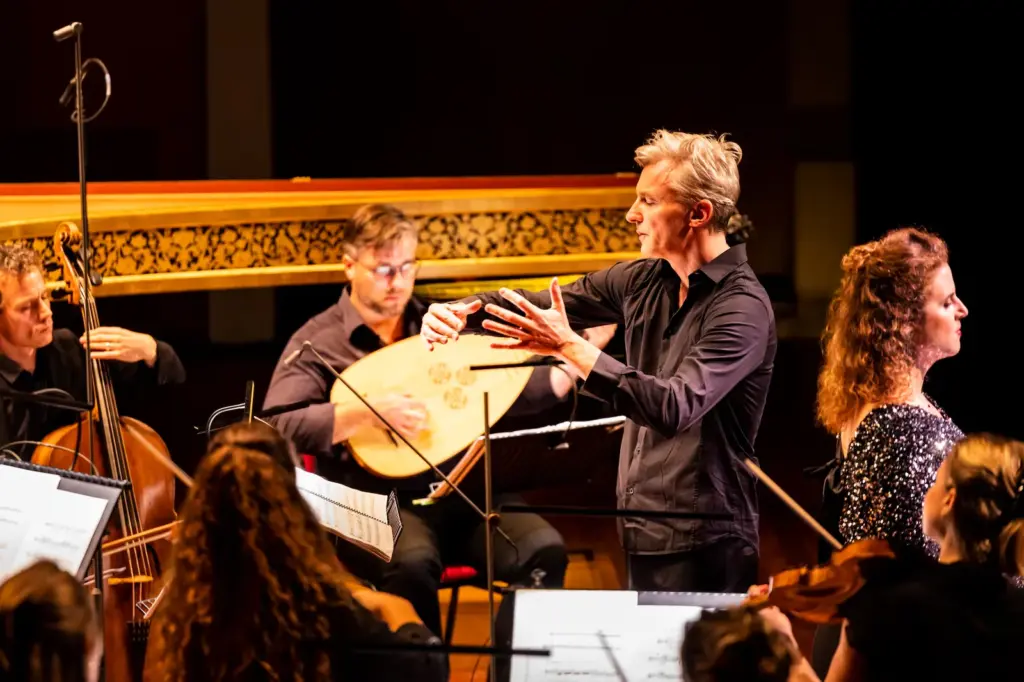
The final stretch of the festival brought four other perfect concerts: on Friday, a nocte temporis gave us an immaculate version of Alcide, an opera jointly attributed to Marin Marais and Louis Lully, although it is unknown what each contributed. Reinaud Van Mechelen’s group, a clear example of a total musician, since he is the best tenor of his generation while also an extraordinary conductor (and does both at the highest level with astonishing ease), has a roster of young musicians of enormous quality, with concertmaster Elise Dupont (who has played here in previous editions as a soloist) and flutist Anne Besson (member of Nevermind), both French, among its ranks. With his own talent, it would be unthinkable for him not to surround himself with top-tier singers, and meeting Sterre Decru (Thestylis), Isabelle Druet (Déjanire), Gwendoline Blondeel (Iöle), and Philippe Estèphe (Philoctète) was a very pleasant discovery, especially in the case of the first, a very young mezzo-soprano with enormous potential. The opera has high-voltage passages, such as the purely instrumental Caprice in the last scene of the second act, the chorus “Divinités des sombres bords” at the end of the third, sung by the superb Namur Chamber Choir, and above all, the long death scene of Alcide in the fifth, further enhanced by Van Mechelen’s exuberant and expressive art.
On Saturday, Le Poème Harmonique offered a more modest concert in length and approach, but one that left no one dissatisfied, covering in just over an hour the evolution of Italian religious music from the humble laudi spirituali with popular inflections by Serafino Razzi, sung a cappella, to Antonio Vivaldi’s Nisi Dominus. Here too there was an orchestra full of young—mostly female—talent, mostly from the prolific French school, with again a special mention for their concertmaster, Louise Ayrton, impeccable in her solos. The great vocal protagonism fell exclusively on Eva Zaïcik, who debuted in Utrecht with this same group in 2019: the predictions made then have been fully confirmed. With sobriety (not coldness), full control of her voice volume, and very careful diction, she moved equally in her simple dialogues with soprano Caroline Arnaud as in the coloratura of Vivaldi’s work, where she reaffirmed her perfect technique. At the helm, as always, a Vincent Dumestre who is not remembered for a concert below the level of excellence. He did not want applause between pieces and achieved it by camouflaging the inevitable tuning of the string instruments with organ improvisations that successively gave the necessary notes to adjust the string tension.
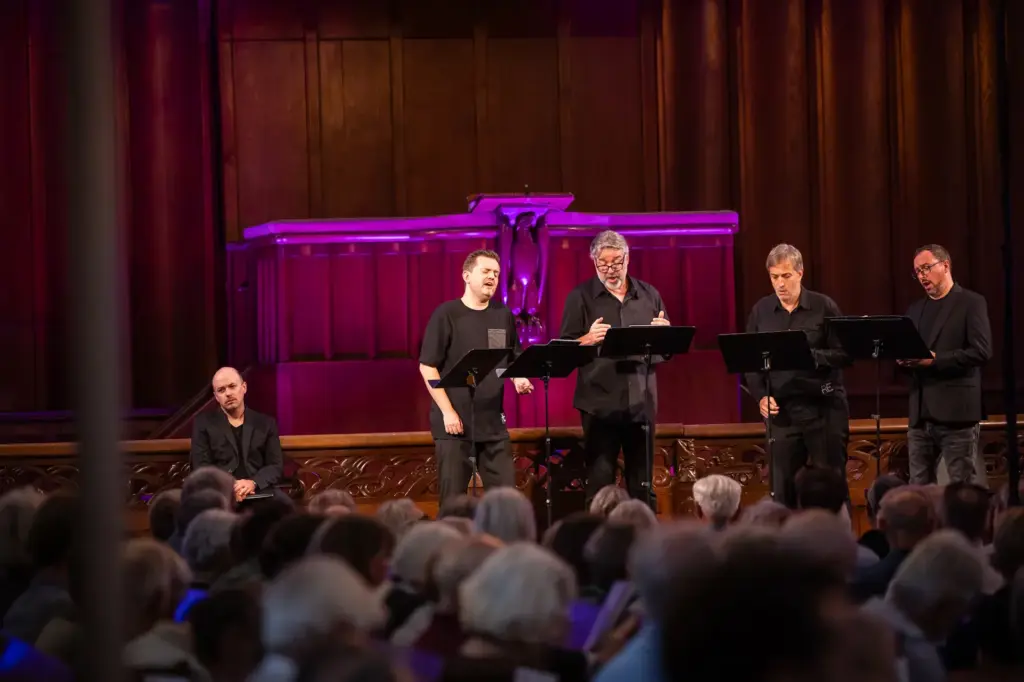
Dionysos Now!, the group led by Tore Tom Denys and which debuted in Utrecht last year, moved both insiders and outsiders in the cathedral on Sunday afternoon with a program whose backbone was Antoine Brumel’s Missa pro defunctis, unjustly little known. With only five singers, no female voices, never doubling a part (one or another member of the group remaining silent depending on the tessitura), the concert had a hesitant start because tenor Jan Petryka, who made such an excellent impression a year ago, seemed clearly unwell, drinking water in large gulps and sweating noticeably, although fortunately he fully recovered shortly after, not without making an enormous effort judging by his expression of relief at the end of the concert. The Proper sections were completed with plainchant, such as the Offertory (sung by Tim Scott Whiteley and Terry Wey) or with music by other composers, such as Pierre Certon’s Gradual or Josquin’s Tract, whose lament for the death of Johannes Ockeghem ended the concert, thus completing a mirror structure, since it had opened with Tous les regretz, a chanson by Antoine Brumel, who is one of the composers cited precisely in Nymphes des bois, Josquin’s funeral lament. Tore Tom Denys dedicated it to the memory of Harry van der Kamp, the great recently deceased Dutch bass with whom he has often sung throughout his career. The memory of his colleague—and the music itself, of course, one of the most moving ever composed—affected him so much that he cried openly at the end, as did the listeners, for whom Van der Kamp has been a familiar figure for decades.
With a similar gesture, the immediately following concert closed, which also closed this edition of the festival, as Lionel Meunier offered, as an encore, the same music Hervé Niquet had performed ten days earlier at the opening concert: the end of Alessandro Striggio’s Ecce Beatam Lucem, in this case in memory of two of the singers who had been part of the group eleven years earlier (and also on the same day, September 11), when they also sang at the TivoliVredenburg, as the highlight of their residency, Thomas Tallis’s Spem in alium. To avoid a sad ending, Meunier recalled the final text of Striggio’s motet: “Haec voluptas, haec quies, haec meta, hic scopus nos hinc attrahunt recta in paradisum” (“This delight, this peace, this goal, this aim leads us straight from here to Paradise”). And everything that happened before had something miraculous, otherworldly. With his usual virtuosity in the use of space, Vox Luminis entered processing while singing the funeral sentences that Thomas Tallis composed after the death of Elizabeth I until forming a double circle on stage. Then sounded, with its members now drawing a perfect circle, Spem in alium, the best 40-voice music ever composed, an unparalleled display of contrapuntal wisdom.
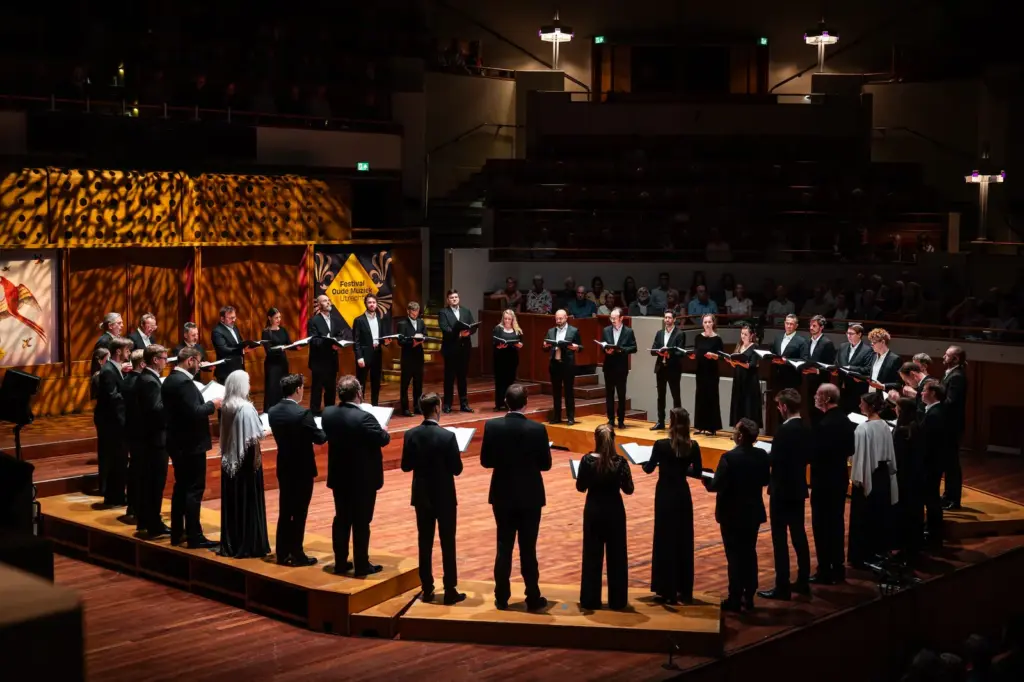
A ten-voice motet by Lassus (Aurora lucis rutilat), another by Thomas Tallis (Videte miraculum), the aforementioned Striggio (which had sounded much more confused and rigid at the opening concert with Le Concert Spirituel and Hervé Niquet), all thematically interrelated, and that other miracle by John Sheppard, Media vita in morte sumus, the antiphon for the Nunc Dimittis, part of whose English text we had already heard in one of Thomas Morley’s Funeral Sentences, preceded a new interpretation of Spem in alium, only now with the singers distributed throughout the hall, at different heights, divided into eight groups, as many as the choirs for which Tallis writes. It was the same music, yes, but the sound result—and the way of perceiving it, therefore—was completely different. Vox Luminis XL sees the virtues of the original group quintupled, because Meunier manages to maintain its identity marks: quality and vocal blend, depth, dynamic control (very gradually decreasing at the end of In media vita), intensification at key moments (“amarae morti ne tradas nos,” also in Sheppard), diction, or, of course, tuning. If a great finale was wanted for a festival titled Giving Voice, there could have been none better or that expresses with greater strength, force, and poetry the almost unlimited expressive power of the human voice.
Thus ends an edition in which there was also a day-by-day tribute to William Byrd in the traditional harpsichord concerts at the Lutherse Kerk, contrasting him with contemporaries (Thomas Tomkins, John Dowland, John Bull, Jan Pieterszoon Sweelinck), predecessors (Antonio de Cabezón), or successors (Jacques Champion de Chambonnières, Johann Sebastian and Johann Christian Bach, and György Ligeti). Especially notable were the Chilean Catalina Vicens, an artist of intimacy; the Spanish Irene Roldán, with absolute mastery of rhetoric; and the veterans Bertrand Cuiller (who faced Ligeti for the first time and seemed possessed by his music) and Skip Sempé, always distant in presence but warm and full of fantasy with his hands. We also admired the infallible virtuosity of flutist Eric Bosgraaf, Patrick Ayrton’s talent for composing music that sounds absolutely Baroque, both in the English and Italian manner, and the musicality of flutist François Lazarevitch, who allowed us to hear music from the recently found manuscript with pieces by Marin Marais for flute and bass. Some inevitable disappointments—few—and many joys in the best imaginable appointment to enjoy the endless richness of early music.
Read more Ramón Espinar, great promoter of the Comunidad de Madrid