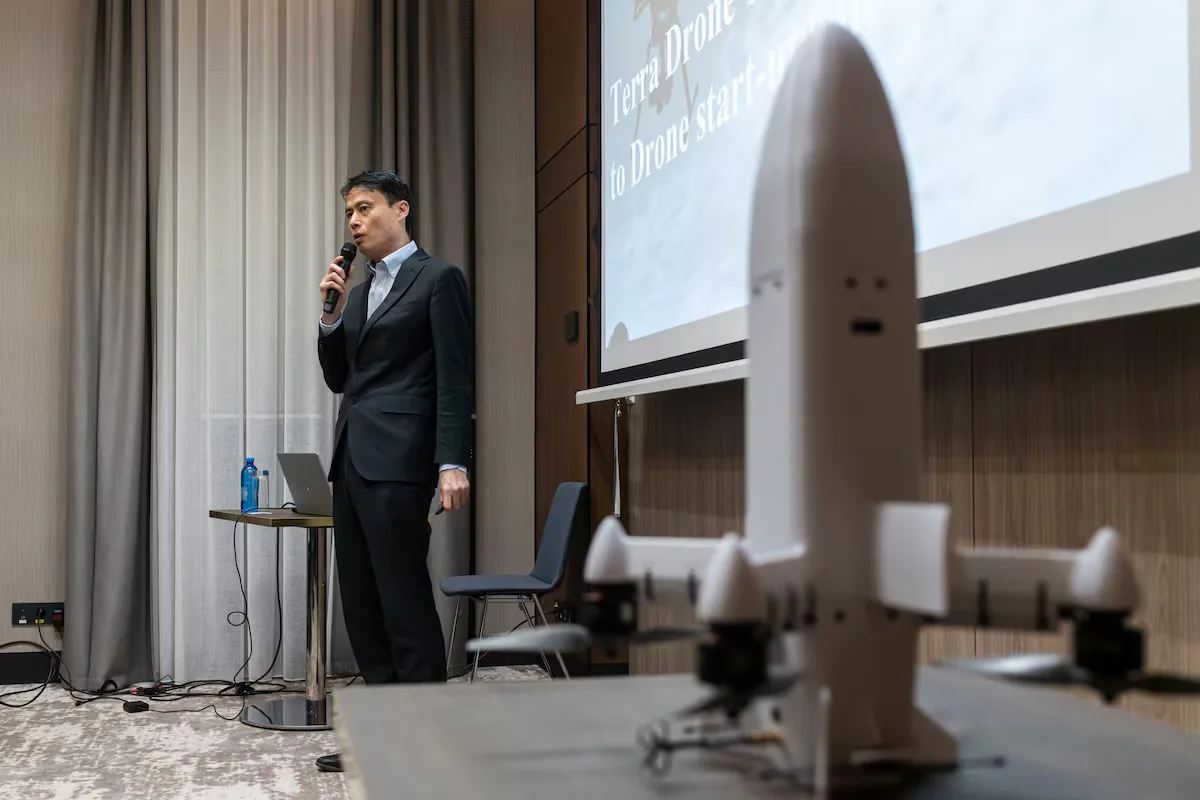
To the inevitable question of what a Japanese entrepreneur is doing in the war in Ukraine, Toru Tokushige, president of the drone manufacturer Terra Drone Corporation, answers with two reasons: a business opportunity nonexistent in his country and the conviction that Japan is an archipelago at high risk of being attacked.
Read more Why AfD’s victory in Germany is a win for Trump’s plan to destabilize Europe
Tokushige, 56, welcomes EL PAÍS in his office in central Tokyo, and throughout the conversation keeps his fingers on the keyboard of a laptop connected to a giant screen. On a map of Ukraine, he points to Kharkiv, 30 kilometers from the Russian border where Amazing Drones, the manufacturer of interceptor drones of which he is already the majority shareholder, is headquartered. Kharkiv, the second most populous city in Ukraine, is a frequent target of Russian Shahed bomb drones, and companies like Amazing Drones change their location every six months.
An engineer from Kyushu University, he worked six years in Silicon Valley and founded Terra Drone in 2016 to manufacture industrial drones that inspect energy and construction infrastructures. Since 2020, the company has been among the top global providers of commercial drone services according to the German consultancy Drone Industry Insights (Droneii). In 2024, Terra Drone began trading on the Growth section of the Tokyo Stock Exchange, a segment dedicated to emerging companies with high growth potential. Before thinking about Ukraine, Tokushige had unsuccessfully tried to offer his technology to the Japanese military.
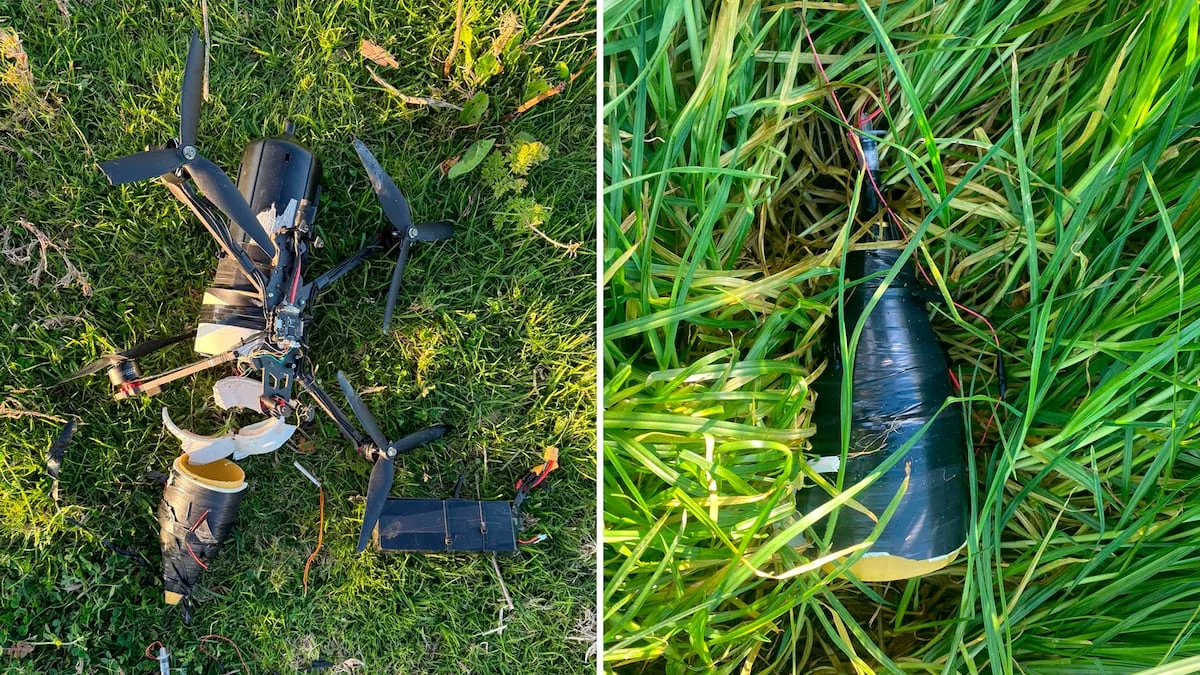
He encountered a complex defense sector, subject to tenders that take years and dominated by giants like Mitsubishi Heavy Industries (MHI). Determined to “find leads,” in September 2025 he traveled to Ukraine to participate in defense product fairs. He found a market saturated with FPV (First Person View) drones, a direct attack vehicle piloted remotely and which some European media define as a “cheap kamikaze.” Tokushige describes them as mass-produced devices, easy to manufacture, assembled with Chinese components. He then looked for a differentiated product and found the Amazing Drones interceptor, a drone designed by Ukrainian engineers and military to shoot down a target in mid-flight. “I was very impressed,” he says. He highlights its low price (about 2,600 euros), and summarizes the lesson the war in Ukraine has left: the one who survives is not the one with the largest army, but the one who spends less on each strike delivered.
With the contribution of Japanese technology, Amazing Drones developed the Terra A1, a short-range rocket-type interceptor with an explosive charge. The announcement of Terra Drone’s capital entry into the Ukrainian company provoked a protest from the Russian Ministry of Foreign Affairs. In a statement, Russia cites “Ukraine’s systematic criminal provocations using unmanned aerial vehicles against civilian sites” and calls the Japanese investment an “openly hostile gesture harmful to the security interests of our country.” It also laments Tokyo’s “unfriendly” policy towards Russia under the new government of Prime Minister Sanae Takaichi and notes: “Relations between our two nations have reached a historic low.” According to the Jiji Press agency, the Japanese ambassador in Moscow objected to the complaint.
On April 28, Terra Drone announced that a Terra A1 drone had shot down for the first time a “long-range unmanned aerial threat” and published a video on YouTube. The infrared camera image shows the pursuit of a device with the delta wing silhouette typical of the Shahed, an Iranian design manufactured in Russia costing about 35,000 euros. That same day, Terra Drone announced an alliance with a second Ukrainian defense technology company, WinnyLab LLC, for the development of a fixed-wing drone called Terra A2. Both the Terra A1 and Terra A2 exceed the Shahed’s speed of 200 kilometers per hour by more than 100 kilometers.
Read more Assaults on journalists in Ceuta: from «traitors!» to «hope you get raped!»
Real-time testing
During his 14 visits to Ukraine in the past 10 months, Tokushige has accumulated numerous air raid alerts on his mobile. “They are daily and come in at two, three, and four in the morning,” he emphasizes, recalling that many times he has had to spend the night in underground shelters. He adds that the frequency of attacks allows real-time testing in a daily combat environment. Drone manufacturers receive constant information from the troops and requests for changes that improve the product in three-month cycles. His plan to optimize the interceptor and enter the international market includes scaling production to 1,000 units per month from the current 100.
Terra Drone is linked to Indra following the 2023 acquisition of Unifly, a Belgian company leader in Unmanned Aircraft Traffic Management that participates in the digital drone management platform (U-Space), in alliance with the Spanish company and Airbus. If Ukraine opened a new line of business abroad, the Middle East war facilitated Terra Drone’s entry into the Japanese market when the Ministry of Defense called an urgent tender to manufacture drones in June. Thirty-eight international companies applied, and in an unusual decision due to its urgency, the Ministry selected four models, including Terra Drone’s proposal. The Maritime Self-Defense Force conducted tests under real conditions, and on August 25, the Acquisition, Technology & Logistics Agency (ATLA) announced the signing of a procurement contract with Terra Drone for mass production of its Terra B1 model.
The contract not only validates Tokushige’s technology but marks a milestone in the usual timelines of the Japanese defense sector, moving from testing to industrial-scale production in a matter of weeks.
Although Japan’s Constitution remains pacifist on paper, in practice the country has an increasingly well-armed military, a budget close to 2% of GDP, and its companies can export lethal weapons. The entrepreneur is in favor of changing the Fundamental Law and cites an argument almost identical to the official stance: “We are surrounded by China, North Korea, and Russia, the most dangerous places in the world. If we do not have means to defend ourselves, we could be easily invaded.”
Read more Morena municipal president and eight others arrested in Puebla for cargo transport theft