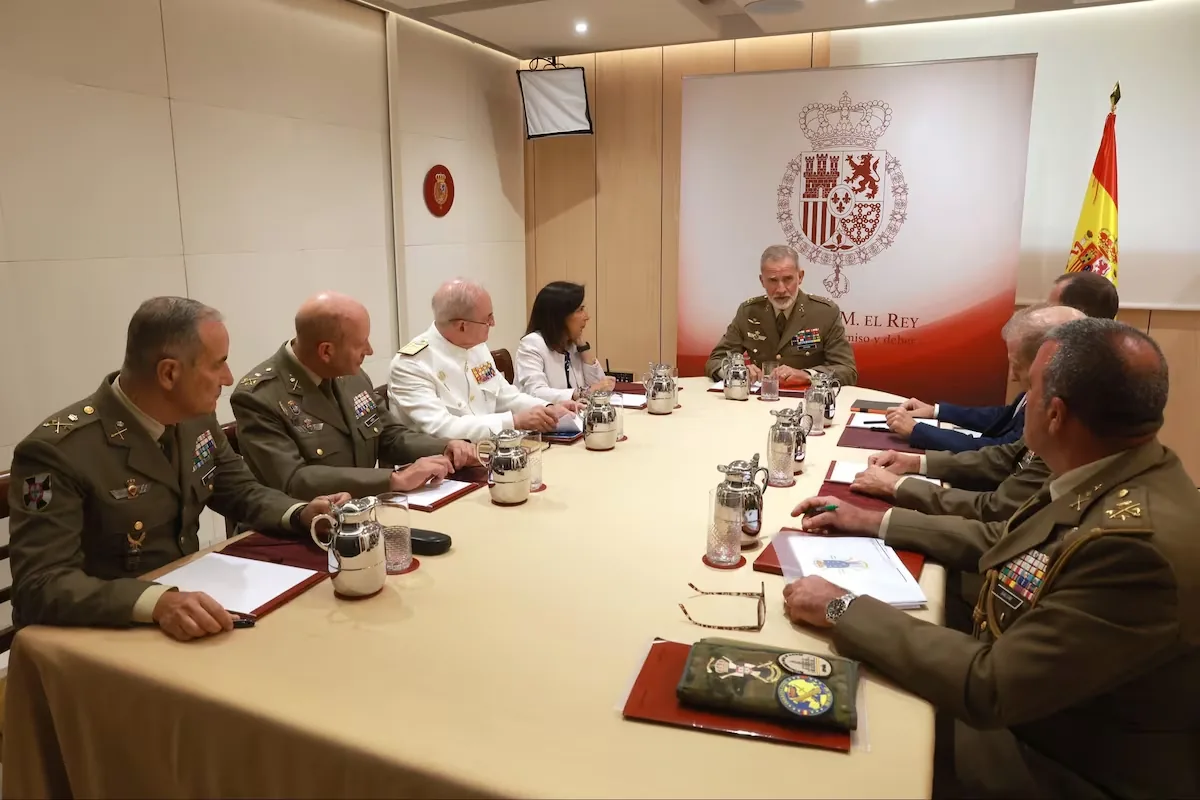
The Royal House wanted it to be known, and that is why it made it public with a photograph, that this Monday it met with the Minister of Defense and the top military leadership to address the situation in Ceuta “from the point of view of defense,” according to the message spread on social media by La Zarzuela. The meeting, presided over by Felipe VI, was attended by the Chief of the Defense Staff, Admiral General Teodoro Esteban López Calderón. The meeting was not on the public agenda of the Royal House nor of Margarita Robles.
The publication of this photograph of the King, in military uniform, with the top military leadership and the Minister of Defense, is a clear internal political gesture, as a message to Spaniards that the head of state is attentive to the defense of the borders, but also externally, including Morocco.
The Monarch’s role in the Ceuta crisis has been the subject of political controversy throughout August. The opposition accused the Prime Minister, Pedro Sánchez, of vetoing a trip by Felipe VI to Ceuta and Melilla that he wanted to make, as explained by Juan Jesús Vivas, the president of Ceuta, after another symbolic meeting with the King in Marivent. After weeks of controversy, in his first interview after the summer, on Cadena SER, Sánchez said that he is indeed in favor of that trip at this time and that it will take place in the coming weeks. This trip will undoubtedly generate tension with Morocco, as the only precedent, in 2007, was when Juan Carlos I, with Zapatero in La Moncloa, visited the autonomous cities.
On this occasion, government sources indicate that La Moncloa was informed of this meeting and frames it within “total normality” as it involves the head of the armed forces. “The king has a special bond with the Army, which he does not have with other branches of the State,” these sources say, insisting that the government views this meeting and its public disclosure favorably. The usual briefings with Sánchez are not usually communicated nor are photographs sent.
Even so, and despite the apparent lack of controversy in this case, the king’s role with increasingly evidently political gestures, such as this one of discussing “the defense” of Ceuta with the minister, now very distant from the rest of the government due to her recent clash with the Interior Minister, Fernando Grande-Marlaska, generates some mistrust within the government.
Various government sources have privately recalled in recent weeks, especially after the controversy over the attempted trip to Ceuta, that the Constitution is very clear in stating that the king does not govern, and his actions must be endorsed by the ministers, who are the sole ultimate responsible for the head of state’s movements and who must account for them before Parliament and the Spanish people.
Read more Abelardo De la Espriella lifts the suspension of permits for carrying weapons in Colombia
The relationship between La Moncloa and La Zarzuela has become very strained recently, especially after the crisis in Paiporta, following the Valencia storm, a trip that the government did not see as advisable but which the Royal House insisted on and which ended with a major scuffle in which Sánchez ended up leaving the area escorted by police after several objects were thrown at him.
At the meeting this Monday, held at La Zarzuela, the nine attendees examined “the situation in Ceuta from the point of view of defense,” according to the Royal House statement. In addition to those mentioned, the Chief of the Operations Command, Lieutenant General José Antonio Agüero; the Chief of the Land Operational Command, Lieutenant General Julio Salom; and the General Commander of Ceuta, Division General Luis Jesús Fernández Herrero, attended.
After the influx of migrants at the end of July, between 70,000 and 80,000 in Ceuta and about 1,300 in Melilla, Felipe VI said he had followed “with great concern and indignation the serious events in Ceuta and to a lesser extent in Melilla,” according to the Royal House.
The same note indicated that the King believes it necessary to adopt “all those measures that convey in a united, clear, and decisive manner to the populations of Ceuta and Melilla the support and affection of the rest of Spain” and assured that “the State must ensure their security and prevent these events – which have also resulted in a sad and tragic loss of dozens of lives – from happening again.”
Read more Declared a large-scale fire in the Madrid municipality of Santa María de la Alameda