









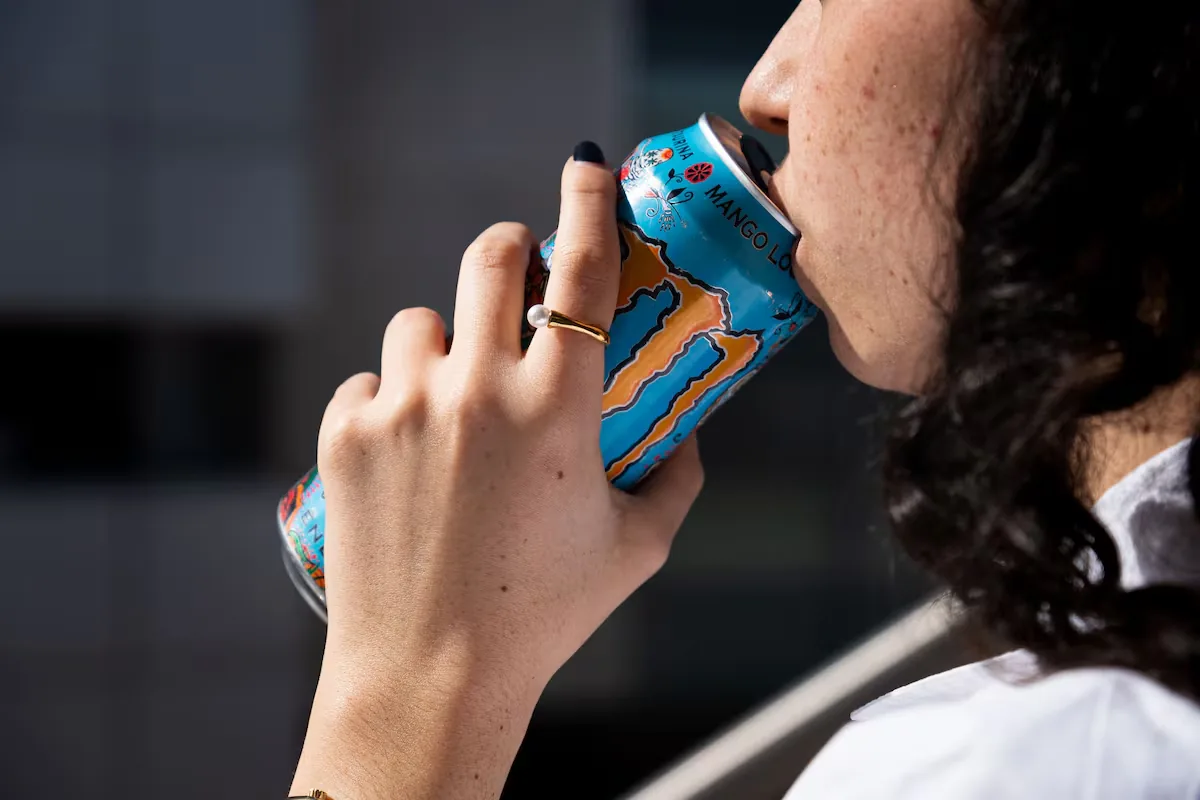
Energy drinks are not consumed for pleasure. They are not served in a balloon glass, with ice and a straw, nor are they sipped slowly and joyfully. In the collective imagination, they are taken directly from the can, in front of the computer, while doing something else. More than a drink, they are a potion, a brew that promises to turn us into a faster and more efficient version of ourselves. They have chemical flavors and absurd names like Focuss Passionate, Absolutely Zero or Lando Norris Zero Sugar limited gold edition. They have been a hit among young men for years. And now they are starting to make the leap to the rest of society.
Energy drink is a commercial term. The technical term would be a drink with a high caffeine content, but of course, that sells much less. This detail exemplifies how the idea we have about these soft drinks is conditioned by marketing. Partly because their origin story is not very attractive either. Energy drinks arose from labor exploitation. In Bangkok (Thailand) in the late seventies, the owner of a local pharmaceutical company created a brew designed to keep workers awake all night working. He called it Krathing Daeng. Red bull in Spanish. Red Bull, in English. “They arrived in Europe in 1987, when Red Bull production began in Austria,” explains Ana Teijeira, a specialist in preventive medicine and public health who has studied the expansion and effects of this product. “What happens is that popularity among teenagers started in the United States in 1997, ten years later.”
The target audience was athletes, but they saw it had greater appeal among teenage boys and recalibrated their strategy. They succeeded by presenting themselves as the fuel for the great male hobbies: playing video games, practicing sports, and getting drunk. And they went all out. Energy drinks became the most advertised food product on streaming platforms. They sponsored sporting events that allowed them to associate their products with values such as energy, performance, adventure, and adrenaline. A 2015 study published in the journal Health Psychology analyzed why these drinks were so successful among men. They found that the more a man embraced ideals of masculinity, the more he believed consuming these drinks made him manly; and the more he consumed them, the less he slept.
But as this demographic group has grown, energy drinks have adapted. They read the signs of the times and began to sell themselves as a tool for efficiency. They expanded their market niche to women, associating in recent years with celebrities like Paris Hilton and Kim Kardashian. They changed the black packaging with fluorescent touches to very cute pastel tones. And they sold themselves (with little scientific basis) as tonics to improve the appearance of skin and hair. They thus began to prepare to make the leap to all population groups.
“Energy drinks are for the 21st century what Coca-Cola was for the 20th century,” explains anthropologist specialized in youth Carles Feixa Pàmpols. “If the brand of the famous secret formula was the symbol of industrial capitalism, the brands of energy drinks (whose formula we also ignore, although it is pure chemistry) are the symbol of post-industrial capitalism.” Because energy drinks not only speak about the situation of young people. Feixa Pàmpols understands the leap these products are making because it is not the first time it has happened. “In both cases, the new generations were the guinea pigs to prestige their consumption and spread it among the population,” he opines.
In his book Acceleration. A social critique of the times, sociologist Hartmut Rosa explained that we live in a “dynamic stability,” which forces us to run more and more and produce more and more, even at the cost of living alienated, to prevent the system from collapsing. In this context, energy drinks become a magic potion, the Super Mario star, which promises to speed us up so that we arrive, perform, and can synchronize with a speedy world.
Read more Zhang Ziyu, the 2.23m Chinese «girl» who amazes at the World Cup and knits stuffed animals
But all this has consequences. Energy drinks are unhealthy products. They can cause arrhythmias, hypertension, insomnia, and nervousness. They also increase the risk of developing diabetes, as a consequence of their very high concentrations of caffeine (a can can have as much as two concentrated coffees) and sugar (which can account for 10% of daily calories in a single container).
“To date, 60% of the countries in the world have implemented some type of regulation on energy drinks,” explains Teijeira, who studied this variability in a study at the University of Santiago. “The most common measures are advertising restrictions, prohibition of sales to minors, and limitation of caffeine content.” In Spain, Galicia banned them a long time ago and the central government has announced its intention to do so, although it does not seem to have support.
But even with bans or limitations, it seems complicated for anyone to downgrade energy drinks from the place they have reached in the youth collective imagination. And from the supermarket stand. “Drugs, both legal and illegal, have always been a rite of passage to adulthood,” reflects Feixa Pàmpols. “In the information age, the old drugs —in our country, tobacco and wine— go out of fashion with hygienist or generational arguments —they are consumed by parents and grandparents—, being replaced by more modern and prestigious products, apparently more harmless, such as vapers and energy drinks. These have higher profit margins for the multinationals that market them, whose side effects they overlook.”
The data seem to support this idea. Alcohol consumption among young people has decreased by three to five percentage points in the last decade, while energy drink consumption has soared by 13%. They represent almost opposite cultural values. Alcohol pursues suspension, abandonment, and loss of control; energy drinks belong to a culture of maximizing the self and efficiency. It would not be entirely fair to say that a substitution is taking place, since many people mix them with alcohol, but a certain paradigm shift is sensed. Energy drinks explain very well the contradictory feeling of an era. As Feixa Pàmpols says, “they reflect the schizophrenia projected onto contemporary youth: healthy life, hygienism, and puritanism versus cult of excess, competition, and productivity.”