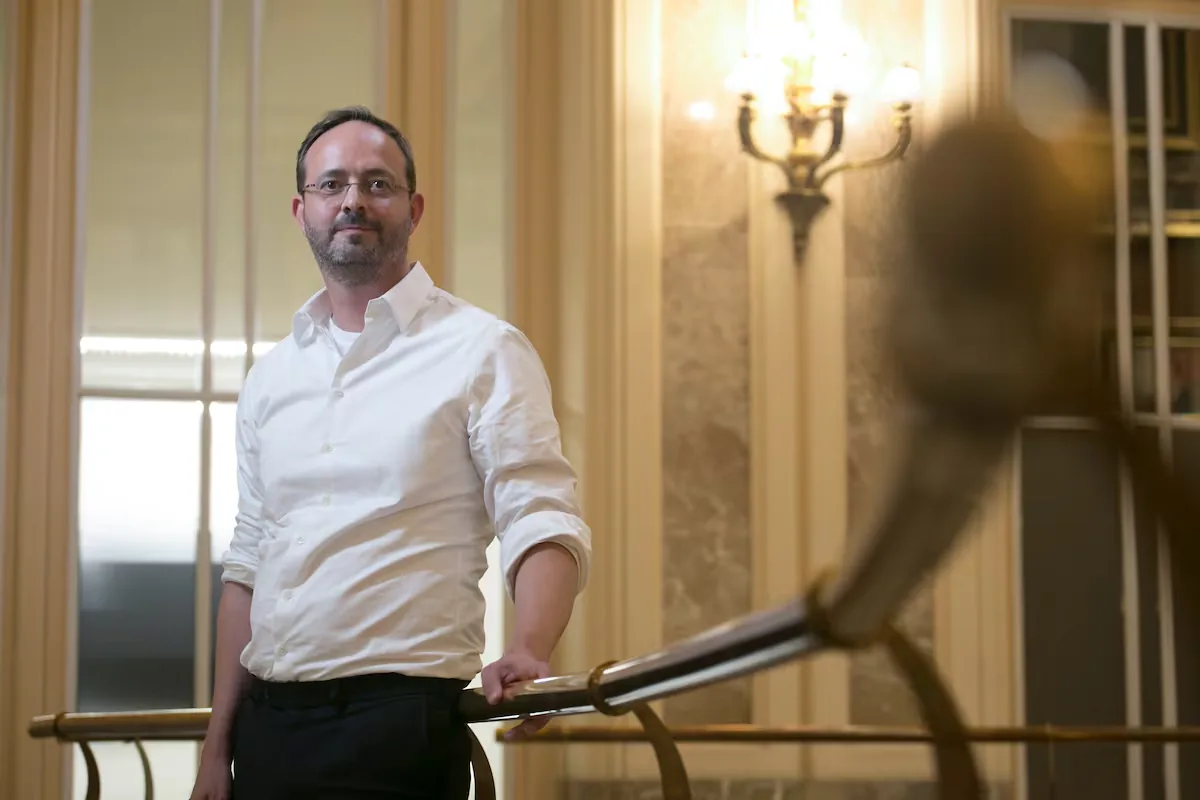
Danish Tue Halgreen has just given Spanish education a historic shake-up with the presentation of the PISA Report, which shows that the country’s results are sinking like those of half the world, to a greater or lesser extent. Halgreen, 50, chief analyst of the largest international assessment, organized by the OECD, appears, however, smiling and relaxed in a room at the Ministry of Education, ready to unravel the keys to the catastrophe during more than an hour of interview.
Read more Frustration and fear of losing other rights among new Spaniards in South America
Question. PISA points to numerous causes of educational decline. If you had to choose the three most important, what would they be?
Answer. The first is related to reading outside of school. We spend more and more time in front of screens, and we maintain the skills necessary to read short texts. But sitting down with a newspaper or a book requires a different skill that must be trained. What we observe is a relationship between the introduction of mobile phones and the progressive generalization of their use, and the decline in skills. We are, of course, talking about a correlation. But the striking thing is that it has happened at the same time in many countries. And the reading skills that are decreasing are precisely those that require reading outside of screens. This is probably the main reason for the drop.
Q. And the other two?
A. We see that the support students receive from their parents is decreasing in many countries, including Spain. And there is a close correlation between that factor and performance. Families can support their children in different ways. One that we see in PISA is simply talking with them about what they have done at school and how they are doing. It is impressive to observe the difference this makes in students’ results. And those parents do not need to be teachers or have knowledge that allows them to help more. It is observed regardless of the family’s socioeconomic and cultural level, even in students from very disadvantaged backgrounds.
Q. And the third cause?
A. Having the right teachers where they are most needed. The shortage of teachers is a problem in many countries. In Spain it is growing and occurs especially in disadvantaged schools, which is exactly where we see that resources need to be strengthened to improve a country’s performance.
Q. Returning to reading, how can children and teenagers be encouraged to read more again?
A. First, by getting the diagnosis right. When we say that reading performance has decreased among 15-year-olds, it is not that they have stopped reading in recent years to devote themselves to something else. In reality, it is something we have been observing for quite some time. The 15-year-old students who now have worse reading performance already showed it when they were younger. We can see it in evaluations other than PISA that were done when they were in Primary school. So one thing we can do is start working with them early. Another thing we know matters is reading books on paper. It may seem obvious when measuring reading skills on that type of medium. But what studies show is that those who read best in digital format are also those who read books on paper.
Q. Whose responsibility is it?
A. On the one hand, we have to think about what we do around our children. Having children see their parents read a book or read books with them is much more effective than if they have the mobile phone in their hand and are told: “Screens are over, put the phone away.” But it is clear that the school has a bigger challenge.
Q. In what sense?
A. Before, you learned to read at school, but when you left you practiced. Now, students read less outside, which implies a greater responsibility for what happens at school. And, in addition, another big change is taking place, which has less to do with mobile phones and more with artificial intelligence and chatbots. If we go back only three or four years, even searching for information on Google involved searching for something. You had to gather fragments of information and decide which pages were more reliable, because you could find contradictory data on different websites. That required very different skills from those needed now, when Google provides you with the answer immediately and in the end tells you: well, if you want to read something else, you can do it at this link. If they are not regularly trained, the abilities to integrate information from different sources and evaluate it critically are lost.
Q. Spain is one of the countries where students use AI the most to study and its report points out that it has no positive consequences. What is happening?
A. It is too early to say exactly what is happening with this technology. It is important to distinguish between what we usually understand by AI, which are chatbots, and are designed to make our lives easier, and artificial intelligence that may be specifically designed to learn. It cannot simply be said that AI is bad for learning. What we do observe is that the first type, the chatbots that many students use, are giving us an experience basically opposite to learning.
Q. Why?
A. Because learning consists of making an effort to solve a problem. Whether it is a mathematical equation, reading a long text, or coming up with ideas for an experiment. What interests us is the process, the challenge, the struggle to achieve it. That is where we learn. The result of the equation solved by the student really does not matter to us, we already know the result. What we want is for them to make the effort. And if the chatbot skips those steps and gives them the result, it is lost. That is why we have to be very cautious. And at the same time, when students respond in PISA that they use AI to help them learn, that is not necessarily bad. It is very important how it is used. And training teachers and schools to know how to use it constructively, helping learning instead of diminishing it.
Q. In Spain, the debate has arisen as to whether the poor results are due to the educational reform implemented in 2020. What do you think?
A. I do not think the debate in Spain or other countries, nor the attention of policymakers, should focus on looking for causes related to national reforms implemented in recent years, because that would be a misdiagnosis. Spain’s results cannot be seen as isolated from the bigger changes we are observing. Doing so would be missing the opportunity to carry out the fundamental changes needed to solve the decline in learning.
Q. Does that not amount to saying that it is not a problem of Spain, an invitation to do nothing?
A. Yes, it is a Spanish problem, in the sense that it can only be solved here. And Spain cannot wait for other countries to fix it. They have to find their own solutions. But the root of the problem is not something specifically Spanish.
Q. Apart from the analysis of causes raised by PISA, will the OECD propose more concrete measures to countries on how to act?
A. As we gather more evidence, we will be able to offer clearer and better recommendations. But I would not wait to have them.
Read more When the public feeds the private: the relationship that is transforming healthcare