








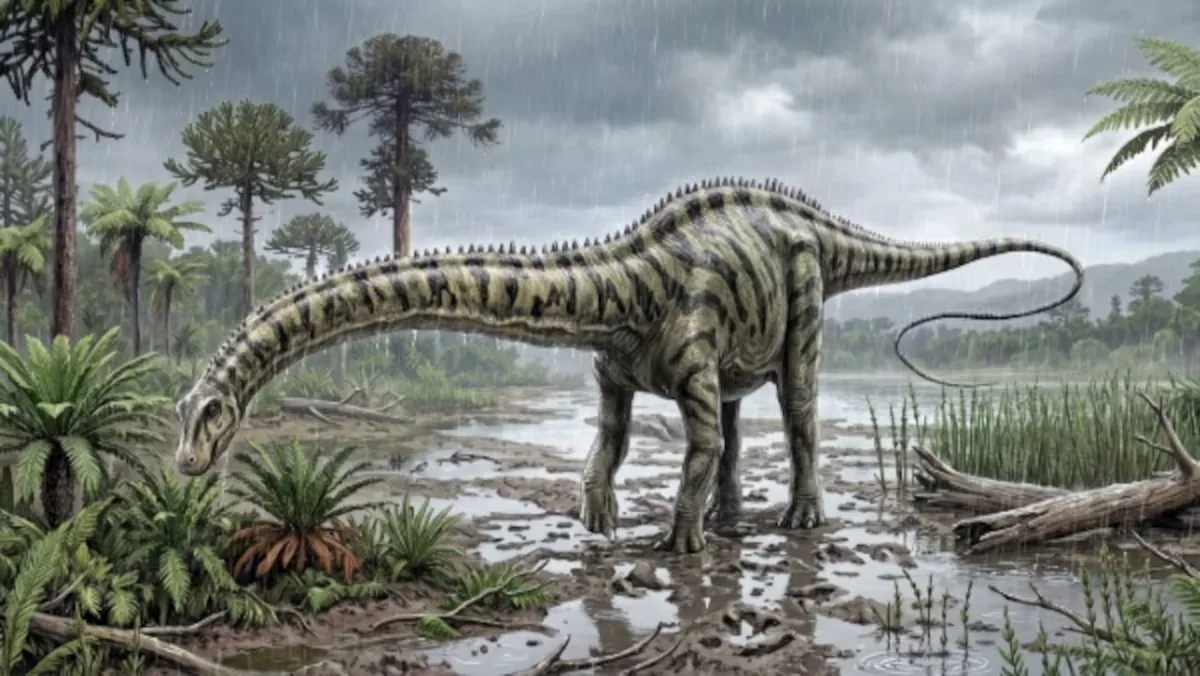
All known diplodocuses ―a 25-meter-long dinosaur that lived about 150 million years ago― come from the same North American site, the well-known Morrison Formation in the western United States. However, the recent discovery of one of these specimens in La Tejería (El Castellar, Teruel), “challenges our understanding of dinosaur distribution during the Late Jurassic,” write the researchers from the Fundación Conjunto Paleontológico de Teruel-Dinópolis in the scientific journal Journal of Vertebrate Paleontology. “The discovery of this sauropod represents one of the most complete diplodocid skeletons ever found in Europe,” they add.
Read more Cell therapies and early diagnosis: keys in the current approach to lymphoma
Specifically, the paleontologists from Fundación Dinópolis found 14 caudal vertebrae (from the tail), exceptionally well preserved, and several V-shaped bones (hemal arches or chevrons).
Sergio Sánchez Fenollosa, author of the article and paleontologist specialized in Evolutionary Biodiversity at the University of Valencia, states that the “discovery was exciting, seeing how the pieces of the puzzle gradually fit together.” He continues: “From the early stages of the osteological study, we observed great similarities with several diplodocine sauropods. Upon examining the anatomy more closely, we began to identify a combination of traits characteristic of diplodocus species. Then, as we conducted different evolutionary analyses, these continued to point in the same direction. With each new result, the picture became clearer: we were looking at a diplodocus.”
The paleontologist adds: “The result of the excavation constitutes one of the strongest paleontological proofs of episodes of dispersal and faunal exchange between both continents across the proto-Atlantic during the Late Jurassic. This finding allows us to better understand the Iberian Mesozoic ecosystems [250 to 66 million years ago] and the diversity of sauropod dinosaurs that inhabited the European Jurassic.”
The Teruel diplodocus lived 150 million years ago, towards the end of the Jurassic period. Its presence in Europe provides convincing evidence that dinosaurs could migrate between North America and Europe, probably crossing temporary land bridges that emerged when the North proto-Atlantic experienced phases of marine regression.
Read more ‘El Pulso’ from ‘Hoy por Hoy’ live, on EL PAÍS
The diplodocus is one of the most recognizable dinosaurs in the world, famous for its enormous length, its long whip-like tail, and its relatively small head. Since its discovery in the United States in 1878 and throughout the early 20th century, replicas of diplodocus skeletons have been exhibited in major natural history museums worldwide, making it a symbol of global paleontology and a highly valued icon of prehistoric life. Its presence in exhibitions and audiovisual productions about dinosaurs has contributed to it being one of the most well-known “terrible lizards” to the general public.
Giant Sauropods
Alberto Cobos, managing director of Fundación Dinópolis, states that the specimen from El Castellar was similar to its North American relatives (Diplodocus hallorum), making it another of the giant sauropods of the Spanish Jurassic, alongside other sauropod dinosaurs from Teruel with very different characteristics from diplodocids, such as Turiasaurus and Losillasaurus, among others.
The discovery also provides new information about the great diversity of dinosaurs existing in the eastern Iberian Peninsula. The area where the specimen was found has yielded numerous dinosaur fossils — including sauropods, theropods, stegosaurs, and ornithopods — suggesting that these ancient coastal environments hosted complex and diverse ecosystems.
The unearthed fossils are displayed in the dinosaur hall of the Aragonese Museum of Paleontology, at Dinópolis (Teruel).
Read more Chess analysis | Gold for Saco Oliveros