








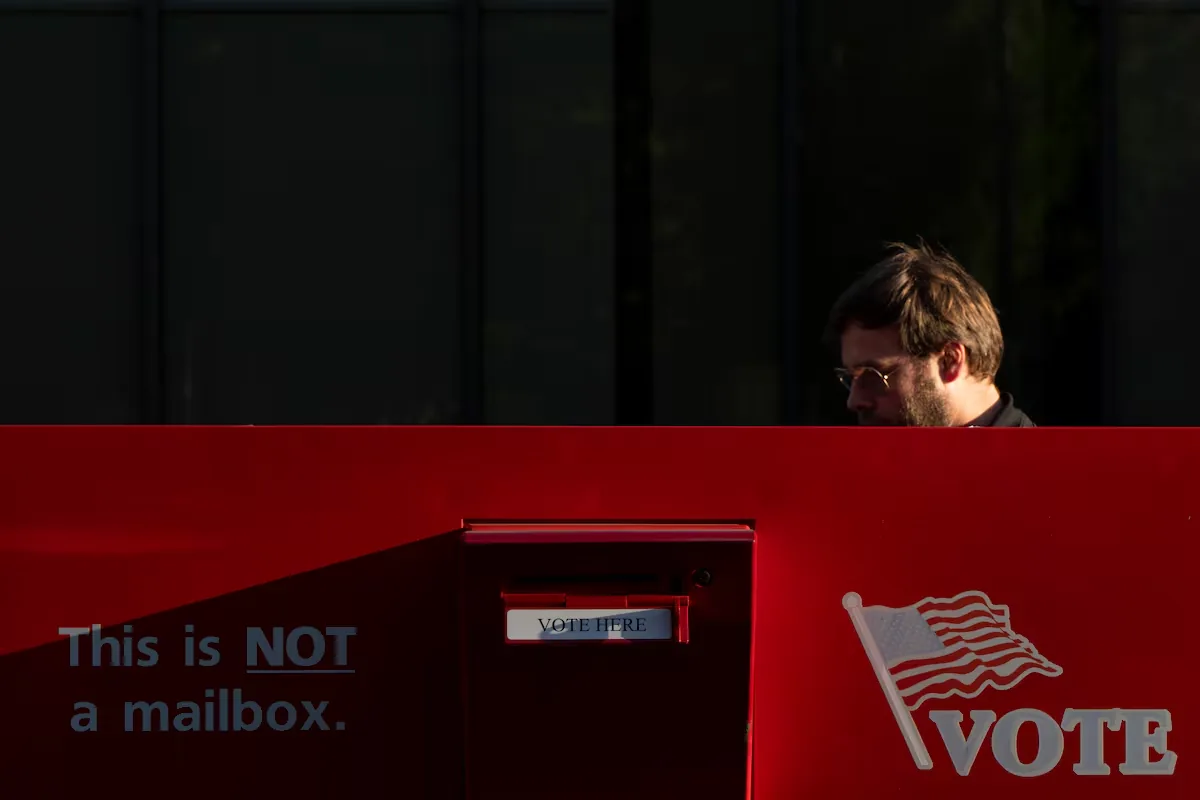
President Donald Trump lashed out this Tuesday, with several unfounded assertions, against the Supreme Court’s halt to his effort to limit mail-in voting in the November midterm elections.
In an extensive post on the Truth Social network, the president launched a specific reproach at the three conservative judges he appointed: Neil Gorsuch, Brett Kavanaugh, and Amy Coney Barrett. “These were not the people I interviewed to serve on the United States Supreme Court.”
Trump’s fury comes after this Court on Monday rejected allowing him to implement parts of an executive order that restricts mail-in voting, which had been blocked by a judge in a lower court. The Supreme Court’s decision is important because control of both Chambers of Congress is at stake in the upcoming elections and because nearly a third of voters cast their ballots by mail.
“Republicans just received another bad decision from the United States Supreme Court, one that took a long time to deliver to the judicial system. And then, partly blamed it on there not being enough time to implement a solution to our completely CORRUPT and out-of-control mail-in voting disaster,” the president wrote, reiterating his frequent baseless allegations against this type of voting process.
The part of the presidential decree at the center of the dispute is related to new provisions for the United States Postal Service (USPS). Federal Judge Indira Talwani, from Massachusetts, had temporarily halted at the end of August the implementation of, for example, the requirement for the USPS to send ballots by mail in an envelope with a special mark and a barcode to track them. She had also blocked the requirement that states notify 60 days in advance if they planned to provide the USPS with a list of eligible voters authorized to vote by mail.
Trump has tried to impose new rules in the electoral process and, after his defeat in the 2020 presidential election against Democrat Joe Biden, has repeatedly and baselessly cast doubt on the integrity of elections in the United States. Numerous studies have shown that it is extremely rare, as the president claims, that a large number of non-citizens have voted in previous elections.
Read more Not all roads led to Rome
The Supreme Court’s decision was announced with a brief paragraph from the majority. “It is unlikely that the Government will prevail on the merits of its challenge to the district court’s preliminary injunction. And the equitable factors applicable to obtaining emergency relief from this Court do not favor a temporary stay,” the majority wrote.
From the way the decision was notified, it was known that conservative judges Clarence Thomas and Samuel Alito dissented and that Brett Kavanaugh, another conservative appointed by Trump, concurred with the majority, considering that election officials do not have enough time to implement the rule “reasonably” before the November 3 elections. Part of the president’s complaint seems to have been specifically directed against that justice.
This ruling on the executive order on mail-in voting represents another major setback for Trump and some of his most controversial measures. The Supreme Court blocked his tariff offensive and his plan to limit birthright citizenship earlier this year. In his post this Tuesday, the president also lashed out again at those decisions: he called the ruling related to tariffs “horrible” and the one related to citizenship a “total disaster for the country.”
Angry, Trump and his Administration have tried to challenge adverse rulings. In the case of tariffs, he has sought other mechanisms to replicate the tariff framework. Regarding birthright citizenship, he signed new decrees that have already been challenged in a lower court and that establish, among other requirements, that federal agencies do not issue or accept documents recognizing certain children born in the United States to non-citizen parents as citizens, and that the Departments of State and Homeland Security deny visas to those believed to be seeking to enter the country to have a child.