

The Colombian Aerospace Force has announced that a team of its rescuers arrived at the location where part of the remains of the aircraft that crashed last Sunday near Chocó were found, but did not find either its five occupants or their bodies, an announcement that raises hope of finding them alive. In an interview with Caracol Radio, General Luis Miguel Díaz Ríos, head of Combat Air Command Number 5 and who leads the operation, specified that a new team is heading this Wednesday to another point in the mountainous area, where there were also remains of the aircraft.
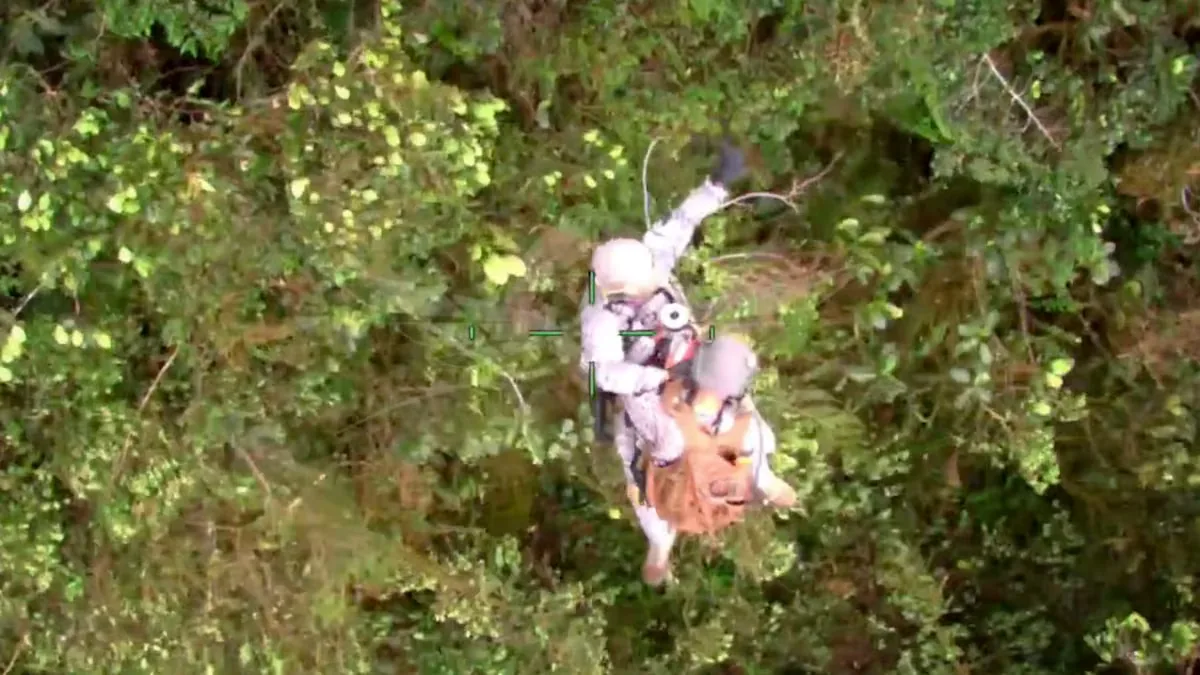
Ríos recounted that rescue efforts are being carried out by air, in helicopters, and that neither the Army nor members of the Indigenous Guard have been able to reach the crash site by land. He specified that the teams must climb mountains with slopes of up to 60 degrees of inclination, which makes progress a very difficult task. He clarified that the helicopters have also not found conditions to land, and that the rescuers who reached the remains did so by descending vertically by ropes from hovering aircraft. The Air Force team had to spend the night at the site due to the impossibility of being picked up during the night.
Díaz confirmed that there are remains of the aircraft in two places located near the Tatamá National Natural Park, on the borders with the Indigenous Reserve of Tarena, in the department of Risaralda. He explained that they chose to start at the point that seemed to have greater visibility compared to the other, but once on the ground, they found that the dense Andean forest in the area prevented seeing the other remains. It is at that second point where the main fuselage of the aircraft is presumed to be. From the air, they have preliminarily identified that the passengers are not at that second point, something they seek to verify.
The search operation for the occupants of the aircraft with registration HK-4985 continues in a rugged and difficult-to-access area, located approximately 2,700 meters high.
A UH-60 Angel helicopter enabled the insertion of a Recovery team… pic.twitter.com/fWCVj0aeom
— Colombian Aerospace Force (@FuerzaAereaCol) September 16, 2026
The rescue efforts have been complex not only due to geographical conditions but also climatic ones. The area is one of the rainiest zones in Colombia and borders Chocó, one of the places with the most precipitation on the planet. For that reason, on Sunday, when the search was activated after the disappearance report, the search efforts had to be suspended that same afternoon. Commander Díaz has clarified that they have taken advantage of the favorable conditions in recent hours. “The intention is to take advantage of this weather window we have, which is clear, to be able to carry out insertion and extraction maneuvers.” This Wednesday, they will replace the first group with other rescuers.
“That fresh team, which did not spend the night at the site, will enter that point where there are other remains,” detailed the commander, who reiterated that “they have all the capabilities,” as they are trained in combat search and rescue. “They have the equipment for the terrain conditions and for the climatic conditions present in this area (…) And they are even prepared in case they have to spend the night at the point, as happened yesterday,” he indicated.
The female passengers on board the aircraft have been identified as Yuliza Figueredo Rodríguez, radiologist doctor; Perla Constanza Álvarez, deputy manager of Medical Agreements at Colmédica; Sandy García, nurse; and María Guzmán, doctor and auditor of tutelas at Colmédica. The four had traveled to Condoto, in Chocó, to provide medical care to the population affected by the earthquake. They were accompanied by pilot Mehmet Cankaya, a Turkish businessman who arrived in Colombia 11 years ago, and who for years had made his personal small plane available to the Colombian Civil Air Patrol, a private non-profit organization dedicated to bringing health services to excluded and impoverished populations, and who had coordinated this joint medical mission.