







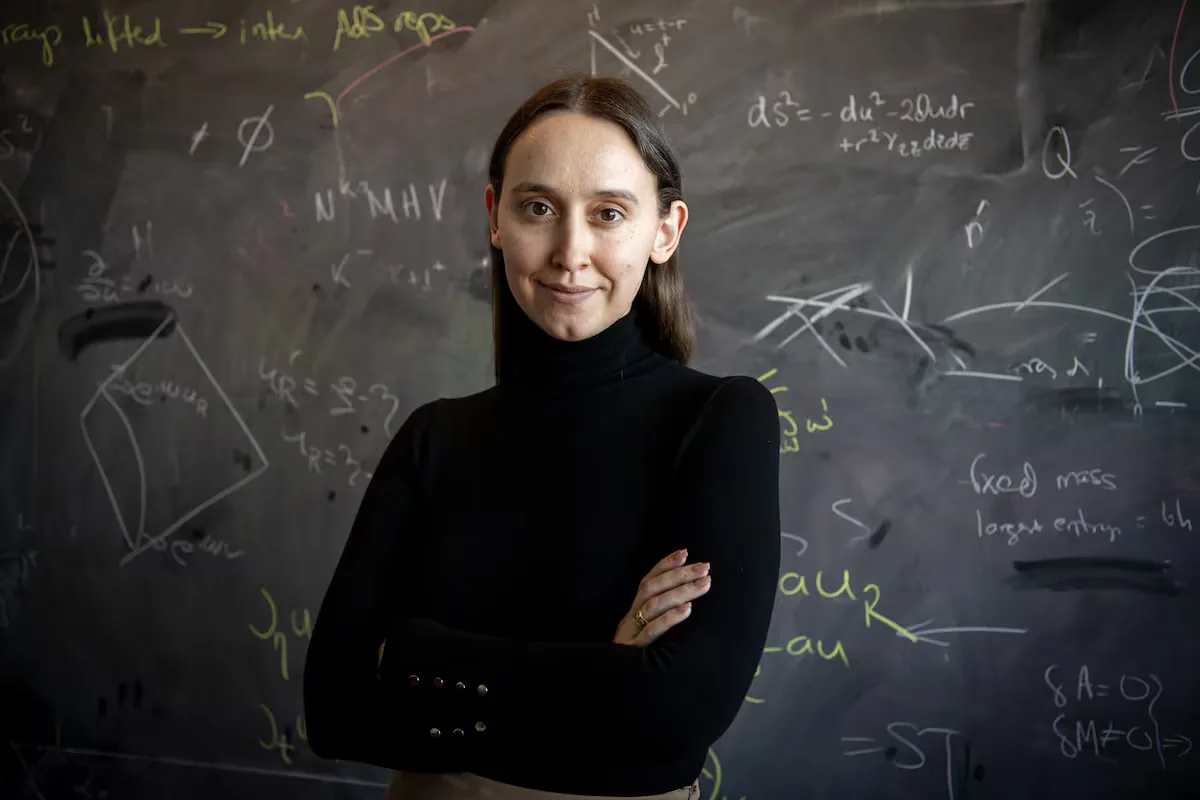
She doesn’t speak Spanish; but Sabrina González-Pasterski is proud of her Cuban roots. “Although the Spanish part is something I would like to change.” Growing up with the close experience of a migrant family is just one of the many things that has led this American physicist (Chicago, 33 years old) to observe the universe with a different perspective. She built her own plane (and learned to fly it) at 14 years old. “As a child, I was interested in engineering, the limits of what was possible to do. Later I learned to appreciate the impossible, the complexity of trying to understand the structure of the universe,” she explains.
Read more Shakira’s moment of truth: the latest masterstroke of a limitless artist
Her path then led her to study at the Massachusetts Institute of Technology (MIT) and to be one of the first women to graduate in physics with the highest possible score. Gradually, she directed her steps towards high-energy physics and, at 22, wrote an article on gravitational memory and black holes that was shortly after cited by Stephen Hawking.
She now works at the Perimeter Institute for Theoretical Physics in Canada, on something called celestial holography that could change the way we understand the universe. In her field of study may lie the key to reconciling the two great theories of physics: Einstein’s general relativity and quantum theory. Both work to explain part of the universe, but are incompatible with each other. “What I want right now is to leverage artificial intelligence (AI) to be more than just a machine of answers, to build a representation of physics knowledge that allows us to discover new connections between theories and formulate new questions,” adds Pasterski, in a video call interview with EL PAÍS.
Question. I feel like starting with a somewhat strange question. Is that what we see behind you a pinball machine?
Answer. Yes. Among all my work, I also make time to have fun. In recent years, many startups have emerged that apply artificial intelligence to physics. And I wanted to make my contribution. That’s why I thought of using a small robot, placing an animatronic figure on top, and giving it access to a kind of physical brain based on the knowledge system we are developing at the institute. The idea is to turn it into a robot that represents a physics researcher. But I do it just as trolling, for fun.
Q. Is it the spirit that led you to build a plane at 14 years old, still there?
A. My family is a bit strange. I asked for a flying broom and they gave me a Cessna plane [laughs]. I suppose I was a somewhat spoiled child, in a good way. My parents didn’t have great resources, but they were always willing to invest in anything that could help me learn. It was also very important to meet Jamail Larkins, who encouraged me to train to fly planes in Canada, because it was allowed there before the United States. When I was in that environment, I discovered it was possible to assemble your own plane from a kit that came half-assembled by the manufacturer. And I did it.
Q. Has that experience helped you in your career as a scientist?
A. A lot. To begin with, it helped me get into MIT, where I met researchers in the field I work in now. But it is also true that there is a big difference between building a plane and observing it from afar to understand why it flies. When you build something, the important thing is that it works. As a physicist, on the other hand, you want to understand the laws that govern the system. I think an important part is precisely knowing what you need to understand and what you need to simply make work. It’s interesting, especially now, with the rise of artificial intelligence, to be able to move between those two extremes: understanding physics and building tools that represent it.
Q. As a theoretical physicist, the first discovery that gave you relevance was the spin memory effect, related to gravitational waves, disturbances in gravity that propagate through space and time.
A. The equations of physics tell us how a system evolves from a given state. When an object accelerates, it emits radiation. In the case of gravitational waves, that radiation can leave a permanent mark: if we observe the system from very far away, masses can experience a permanent relative displacement after the wave passes. That displacement is what we call the gravitational memory effect. It is a mark in space-time.
Q. Is the spin memory effect also a mark?
A. It is something similar, but it is related to angular momentum [a measure of the rotation of a celestial body with respect to a given axis]. Gravitational waves produced, for example, after the merger of two black holes, can cause the loss of angular momentum of the system itself and that is a signal we are able to see from very far away. That is, we can extract information about what has happened in a gravitational system from the radiation we observe at a great distance.
This relationship is universal and the most fascinating thing is that it can be reached from different mathematical perspectives. In physics, we often try to discover which mathematical structures are universal and then check to what extent we can generalize them. But, in this case, we have an observable mark and we look for the general mathematical structures that explain it.
Q. Does this effect bring us closer to a quantum gravity theory that unifies the two great theories of physics, general relativity and quantum theory?
A. The spin memory effect alone does not provide us with a quantum gravity theory. But it is part of a research path that tries to describe quantum gravity. One of the ideas we are exploring is that a quantum theory of gravity should have a holographic description, that is, a description in two dimensions. And the symmetry structures we study are an important piece to understand how that holography could work in a flat space-time.
Q. Celestial holography is the field where you have been focusing your research for years. Does it mean the universe could be a hologram?
A. Not exactly. The analogy that the universe is a hologram may sound very good, but it is misleading. Celestial holography is a useful way to mathematically describe the universe. It tries to develop a holographic description of gravity in a flat space-time like the one that approximately describes our universe. The idea is to study whether the physics of gravitational processes can be encoded in a theory that fits into the so-called celestial sphere, that is, the surface we imagine when looking in all directions of the sky.
Q. What are the main obstacles right now to unify quantum mechanics and general relativity?
A. It depends on the approach you take. In our case, one of the problems is that we understand very well certain parts of the duality, but it is difficult to build a complete and concrete formulation in a flat space-time. In general, whatever perspective we adopt, we continuously face the question of what we can really calculate and whether the theory we are studying can describe the real world.
Q. Are we closer to an answer?
A. I don’t think it’s something that one person will solve. I would like to contribute to building the infrastructure we need to explore mathematically consistent theories. That’s why I’m working with people from different areas, from AI experts to mathematicians, to build the tools that allow us to study which physical theories are possible and how they relate to each other.
Q. Has your unconventional path helped you approach these complex problems with a different perspective?
A. Now I think it is especially useful. We are entering an era where artificial intelligence tools allow us to ask questions about the universe that are one level above traditional scientific questions. But I worry that academic research is left out of that process, that AI takes over everything. I think my experience, where engineering and physics coexist, can help me find answers to these questions.
Q. Do you fear that if we leave everything in the hands of AI we will lose all that research that does not lead to new technologies or that does not produce tangible benefits?
A. The value of physics is not only to produce new technology. Even if someday we come to better understand quantum gravity, it is likely that knowledge will have no direct application. For me, physics is about understanding. It is not simply that a machine gives you an answer or that someone calculates something you need for an application. We want to understand what the simplest descriptions of a theory are, what we can deduce from them, and how far they take us.
Q. Some media have called you the new Einstein or the Latin Einstein. Are you comfortable with that label?
A. For a while, I was quite uncomfortable with that kind of publicity. I don’t think it’s an appropriate comparison. But now I’m more willing to accept that attention, to take advantage of the hype to get physicists and other researchers involved in developing the new tools that are transforming science. We are at a moment where we can build really interesting things and we need the scientific community to be part of it. Before, I was embarrassed to be called that. Now I think, whatever, let’s have some fun and get attention.
Read more This is how the Community of Madrid manipulated the waiting lists in Public Healthcare