




Illustrator Raquel Córcoles (Moderna de Pueblo) invited singer Russian Red (Lourdes Hernández) last June to her podcast Moderneces to talk about the crisis of turning 40, an age the performer of Cigarettes reached last year. During the conversation, which touches on motherhood, childbirth, and the guest’s low tolerance for blood, a concept still unknown to many people suddenly appears, despite existing for decades: “I am a free bleeder,” Hernández reveals, to which her interlocutor reacts with surprise: “I thought it didn’t exist, that they would be women dancing naked under the moonlight.” Both refer to menstruating people who do not block or collect menstrual flow; that is, they bleed without using products.
Like Hernández, who in the interview says she started practicing free bleeding seven years ago thinking “let’s see what happens,” other women have voluntarily stopped using menstrual products at some point in their lives. In 2022, Spanish researchers from different universities presented a study titled Use and perceptions of reusable and non-reusable menstrual products in Spain, detailing that, of the 22,823 menstruating people who participated, 3.7% did not use any product for menstrual retention; that is, they practiced what is known in English as free bleeding. Among the reasons for not using tampons, cups, pads, and other products monthly is also menstrual poverty (12.1% of participants in the study reported “financial problems in the last year always or often”).
Those who voluntarily forgo these products, even having access to them, have their own reasons for doing so; understanding these is easier if you start from this premise: no free menstruator [adapted use of menstruant] is the same as another, none tells another how they should menstruate, and ultimately, as in any other aspect of their lives, each person does what they can and what works best for them.
View this post on Instagram
“When I started, I didn’t know what I was doing,” says one of the best-known free bleeders in Spain on the other end of the phone. It is Leticia Chamorro, a menstrual educator from her Instagram profile (@vaginas libres), followed by 27,300 people, and author of the guide Vaginas libres, published in 2025. Chamorro says she had already read an article about Lauren Wasser — the model who in 2012 lost her right leg after toxic shock from using a tampon — that Sunday in “2013 or 2014” when her period came in her shared apartment, changing everything: “I lived with two women and none of us had a panty liner. All the markets in the area were closed, so I decided to stay home, rolled up a piece of paper, and placed it in my underwear,” she recalls.
That afternoon more things happened in the intimacy of Chamorro’s house: “First, I discovered I wasn’t bleeding constantly and then, one of those times I went to the bathroom, I realized that, when doing a couple of pelvic floor exercises, a drop of blood fell.” After that discovery came the big question: “Did I just menstruate voluntarily? And if I did it at this moment, can I do it throughout my entire menstruation?” Chamorro wondered. This reflection was the origin of her research on the conscious retention of menstrual blood, which she has since explained to her community on social media, as well as in her book.
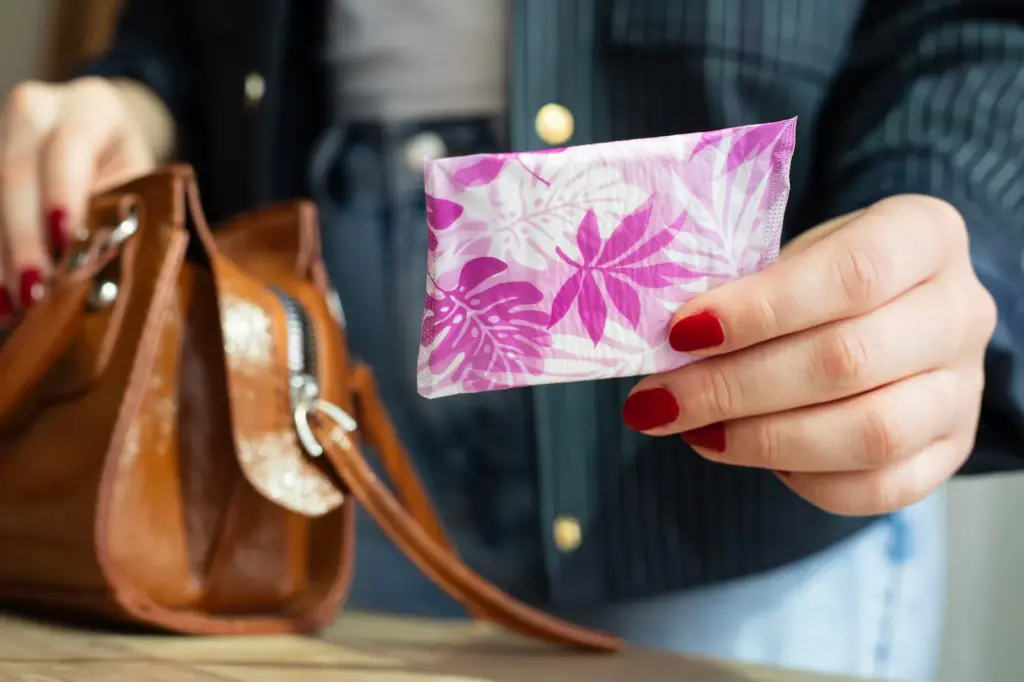
For Ona, a 31-year-old artist living in Maresme (Barcelona), giving up menstrual hygiene products was less experimental and more out of necessity. After leaving home, she says over the phone, she stopped being able to buy them “because they were very expensive.” She was 16 years old. “I spent a year using toilet paper to put in my crotch during bleeding days,” she explains, and ended up realizing she no longer needed them: “Intuitively, my body already knew when I had blood. To avoid staining myself, I would go to release it in the bathroom.” For Ona, free bleeding came without knowing it was a practice, something other women also did: “I didn’t even know the pelvic floor existed,” she confesses.
Read more Shakira’s moment of truth: the latest masterstroke of a limitless artist
View this post on Instagram
Besides the circumstances that led each of them to free bleed, there is another difference between the two women: their environments. Chamorro says she was already working as a flight attendant, traveling the world on a plane attending passengers and giving safety instructions, when she decided to give up menstrual aids; she explains that it was essential for her to prioritize herself first: “At 49,000 feet, if blood escapes and you stain yourself, you stay like that because there’s nowhere to go to change. It has never reached my pants because I have always prioritized myself: before my passengers arrive, I go to the bathroom, release what I have to release, and then do my pelvic floor exercises to be able to discharge everything that doesn’t fall by its own weight and thus avoid involuntary discharges at moments I can’t control,” she summarizes. In Ona’s case, the artist, who lives “in the middle of a forest, in a community with more people,” has also had difficult moments, though for other reasons. She still remembers when she worked in the field and a boss prevented her from moving a few meters away to release blood because “she had to produce.” “So I pulled my pants down in front of him and let it go,” she recalls.
“Rural spaces tend to be quieter, slower spaces. In contrast, a city space is faster, more immediate, here and now,” says Esther de la Fuente from the Yo y mi vulva office in another phone conversation. “I can have a lot of bathrooms available, but if my head is doing 50 other things at once, I won’t remember to ask myself what sensation I have in my vagina and vulva at every moment, nor worry about whether I have to go to the bathroom,” reflects the physiotherapist with a master’s in Pelvic Floor and also a sexologist.
View this post on Instagram
De la Fuente, who has occasionally practiced free bleeding, also has her own experience on the matter: “I have realized that at home I am able to do free bleeding, without leaks, but when I go to work, it is very difficult for me to do because I am not connected to any sensation of my body.” According to the expert, to practice complete free bleeding “a very high level of body awareness is needed.” And she explains: “We have been educated to put something on, whether a pad or a tampon, and get through the day. And if possible, not to remember that you have your period. That’s why, even if you have a little pain, you are educated to take some kind of drug not to feel, to be the same as the rest of the time. When we have been menstruating for years, reaching that body awareness seems impossible.”
“With the period, it’s the same as when you need to go to the bathroom and hold it in. It happened to me without anyone explaining it to me. So I think unconsciously we can reach free bleeding,” summarizes Ona, who hasn’t thought about using menstrual aids for a long time: “Now I’m surprised when someone asks me for a product for the period,” she says. But De la Fuente clarifies: “Here it comes into play how much each of us bleeds. For those with endometriosis or adenomyosis, it will be very difficult to practice because pain and the amount of bleeding come together. These are people who tell you: ‘Then I would have to be in the toilet all the time.’” “Free bleeding is a way of bleeding, of reconciling with the body, of increasing sensations, but maybe it’s not for everyone, or maybe it’s not for all the time,” warns the expert. The physiotherapist also points out that, although she doesn’t believe you can “control as such” what comes out of the cervix because the vagina doesn’t have a sphincter — unlike the urethral and anal ones — “you can control the sensations”: “As you practice, you realize that, depending on the sensation you feel, you have more or less time to go to the bathroom.”
For both Chamorro and Ona, life is better now that they practice free bleeding. And despite the initial reactions when telling about it, between disapproval — “Don’t be cheap and spend money on tampons,” the first thing her best friend told her very early on — and disgust, they agree that they have made the right decision: “I don’t carry tampons or pads around the world: I go to the bathroom, release, and continue; there is no greater empowerment than having control over my body,” says the educator. Meanwhile, the artist relates: “The first year was frustrating because I was connecting with that message of precariousness. After that year, when I consciously stopped buying those products because I didn’t need them, it was amazing: living my life without thinking about whether my period was coming was very liberating.”