







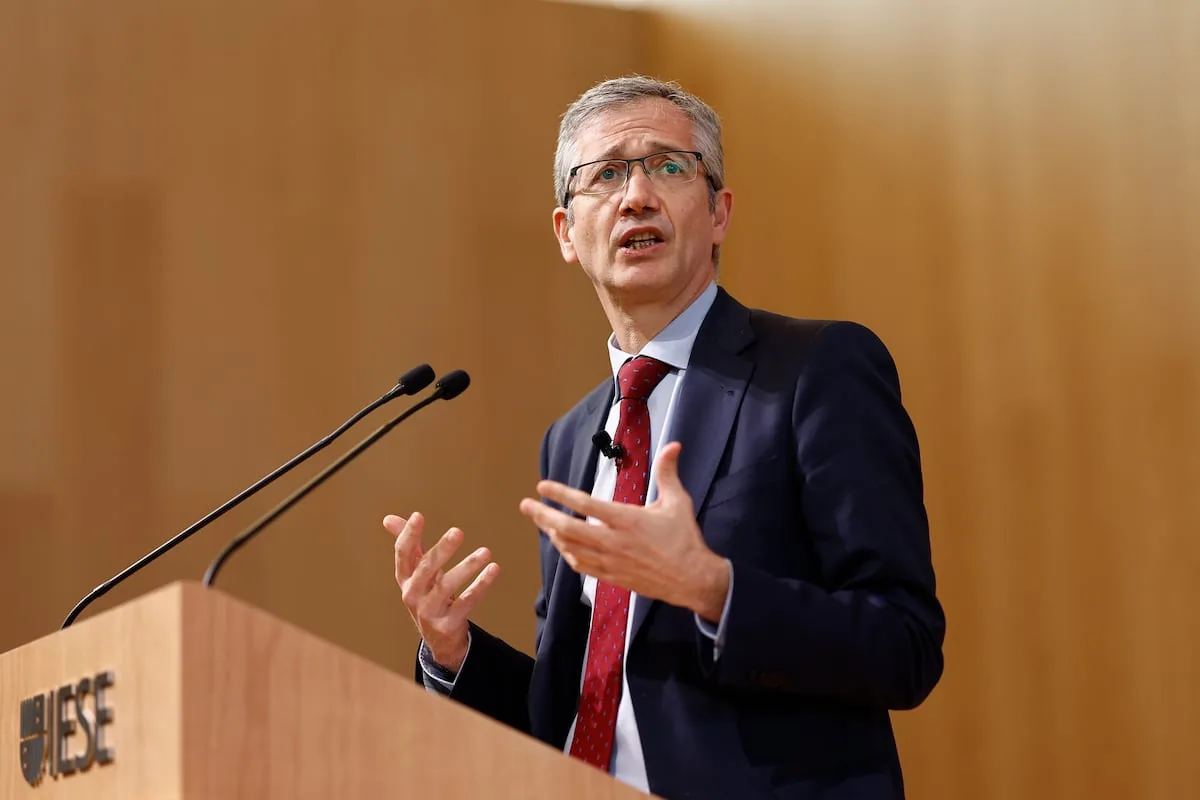
The former governor of the Bank of Spain and current general manager of the Bank for International Settlements (BIS), Pablo Hernández de Cos, is the most qualified candidate to chair the European Central Bank (ECB) when Christine Lagarde’s term expires next year, according to a survey among economic experts from the London think tank Omfif, reported by the Financial Times newspaper. The Spanish central banker would, according to the survey, have a slight advantage over the German Joachim Nagel.
Read more We all want ‘Pe’
According to the panel of 20 experts, which includes commercial banking executives, economic policy makers, asset managers and central bankers, De Cos is the highest rated in the categories of monetary policy training, ability to reach consensus, European credentials, and ability to convince third countries. Nagel, current president of the Bundesbank, would be superior in financial market knowledge, leadership and crisis management.
In addition to De Cos and Nagel, the survey also asked about Klaas Knot, former governor of the Dutch Central Bank; Isabel Schnabel, current member of the ECB’s executive board; and François Villeroy de Galhau, governor of the Bank of France, who will leave his post in June.
Christine Lagarde’s term expires in October 2027, but speculation about one of the most powerful positions within European institutions has been ongoing for several months. In fact, the first moves have already been registered within a puzzle that combines technical capacity and experience with power balances within the EU. Former Economy Minister Luis de Guindos will hand over his vice-presidency to Croatian Boris Vujcic in just over a month, on June 1. A carousel of changes arrives in 2027, with the renewal of three other of the six members of the Central Bank’s Executive Board, including its chief economist, the Irishman Philip Lane, in June 2027. The president will leave her post on October 31 and at the end of the year it will be time to replace the German Isabel Schnabel.
The European political calendar may alter these deadlines and, in fact, Villeroy de Galhau’s sudden departure from the Bank of France, a year before his term ends, will allow Emmanuel Macron to appoint his successor before next year’s presidential elections, in which the far-right is the favorite. Financial Times reported this February that Lagarde could also leave the presidency early to give Macron the option of agreeing with the other European leaders (fundamentally, with the German Friedrich Merz) on the succession at the ECB.
Read more Paz Vega and Orson Salazar separate after 25 years together
In this regard, the Spanish Government has not hidden its willingness to gain weight in the institution. “Spain wants to play a leading role in the new Executive Board when vacancies are renewed, and we will work for it,” said the then Minister of Economy, Carlos Cuerpo, two months ago. Luis de Guindos’ departure means that Spain no longer has a representative on this council, the ECB’s main governing body. De Guindos himself, the outgoing vice-president, has publicly shown his support for De Cos’s candidacy.
From a technical point of view, De Cos, head of the BIS, an institution that groups and coordinates the policies of central banks worldwide, has the approval of academia and the market, as indicated by various surveys; the latest from the Financial Times in January. However, the decision will largely depend on political balances; the ECB presidency has so far been held by a Dutchman, two Frenchmen and an Italian. It has never fallen to a German, and now Berlin, although it already holds the presidency of the European Commission through Ursula von der Leyen, has two candidates for the ECB: Nagel, president of the Bundesbank, and Schnabel, whose proposal, however, raises some regulatory doubts given that she already holds a position at the bank, which expires shortly after Lagarde’s replacement.
Beyond political balances, and within the eternal debate among central bankers between hawks (supporters of more restrictive monetary policies that contain inflation at the risk of harming activity) and doves, De Cos would represent the role of a moderate dove, clearly softer than Schnabel, Nagel or Knot but more orthodox, according to his public statements, than Villeroy de Galhau. Vujcic’s election for the vice-presidency has not given many clues: he comes from a Southern European country but has a reputation as a moderate hawk.
Read more Ya Vagabonds, the fine rain of contemporary Irish folk