



Something important has happened in the world in recent weeks. While President Trump sinks into contradictions and bravado in his undeclared (and therefore illegal) war with Iran, generating a significant toxic effect in all European countries, Viktor Orbán’s crushing defeat in Hungary and his illiberal project could be setting the hands of history’s clock to a new beginning. In this sense, Hungary joins Poland in the record of elections marking the collapse of illiberal governments in two highly relevant countries, which in itself is great news. In these defeats of the most reactionary right, there is a significant tactical shift by progressivism, which was already weakened: it opted, with vigor and success, to defeat the greater evil, converging with the center-right (even with democratic conservatives like Péter Magyar in Hungary after a period of wandering when he was a member of Fidesz), which should serve as a lesson for fatigued lefts (like the Chilean ones) that, due to their own exhaustion, not only struggle to achieve majorities but also shrink. If this is a new beginning, proof of it is the spectacular retreat of Italian Prime Minister Giorgia Meloni, who distanced herself from the United States and its war in Iran (“it’s not our war”), announced the suspension of the defense agreement with Israel, came out to support Pope Leo XIV after another Trump bravado, which earned her a rupture of relations with the President of the United States. On the occasion of the dispute over Greenland provoked by the White House, even Marine Le Pen, the French far-right leader, reaffirmed her sovereignist stance, openly disagreeing with the US administration.
It is true that in none of these episodes were progressivism and the left protagonists: that is the level of weakness that has been reached, and it has everything to do with their own language and project, as well as with the abandonment of their natural electorate, manual workers and the popular world. It is also true that this weekend’s Bulgarian legislative elections resulted in a pro-Russian prime minister as the winner and, therefore, without affinity for the European Union and its defense of liberal democracies. But the hypothesis is there: a possible turning point that does not mean always triumphing everywhere, but merely opening a dike in this long two-decade period of growing disaffection with representative and liberal democracies, both in Europe and the Americas, whose erosion was successfully interpreted by the radical and ultra-right. Until now. The inflection hypothesis should alert the Popular Party and its leaders when converging so easily in autonomous agreements with VOX, as in Extremadura: there could well be another path for the development of the Spanish right, as the Italian case and, perhaps, the French case clearly show.
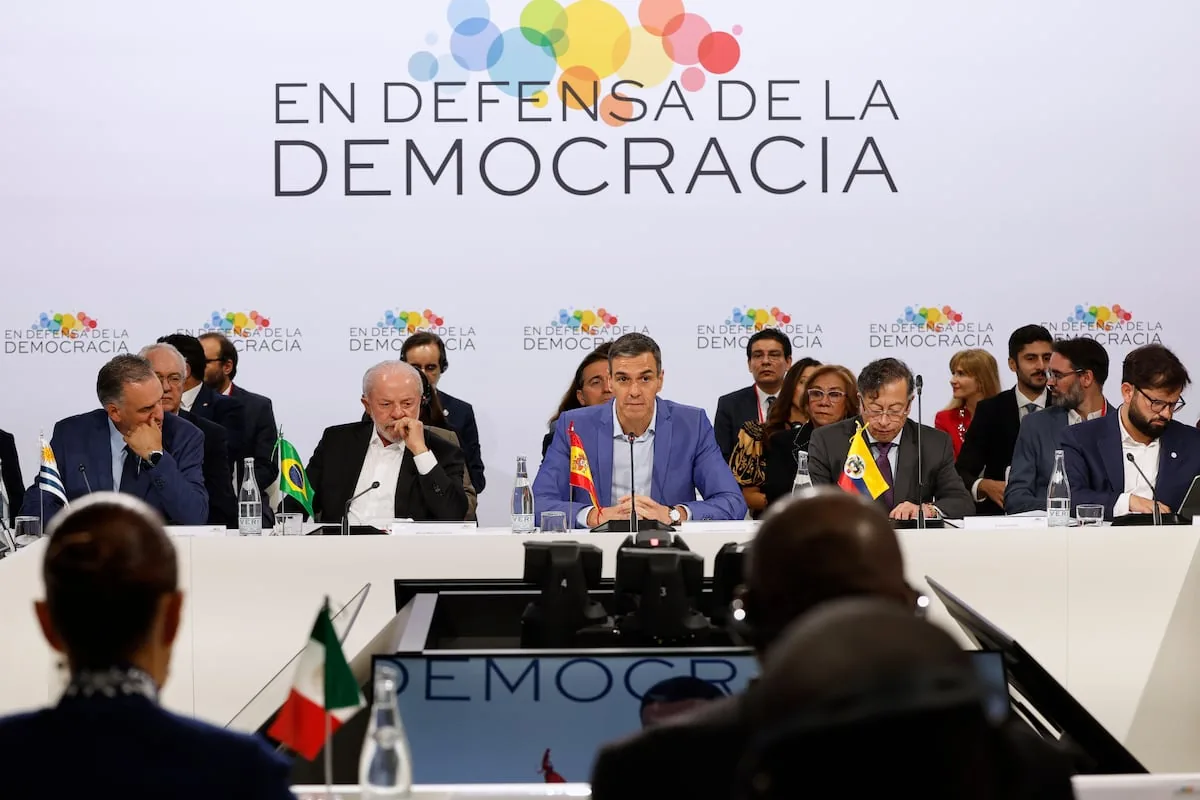
The progressive summit (Global Progressive Mobilisation) that took place in Barcelona could not have come at a better time, with a high attendance of heads of state, government, and leaders of all kinds of center-left and left parties from all over the world. This crowded gathering alone is enough to assert that the summit was a complete success, whose leitmotif in its fourth version was very simple: “In defense of democracy.” The combination of a Trump in flames, Pedro Sánchez’s notable prominence in the international arena, and the end of Orbán made it possible for a spirit of optimism to emerge in global progressivism for the first time in many years: it is merely a new state of mind, not a fully formed subjectivity, which is no small thing. To gauge the success of this summit, it is important to note that progressivism had become a dirty word, and through this summit, it is being reclaimed: it is possible that this reclamation coincides with the beginning of the end of the left, and therefore with a moment of openness to think about a new era of reforms, definitively leaving behind the era of rhetorical (and not theoretical) revolutions. At this summit, for the first time, different things were heard: from “we cannot go to sleep every day waiting for a president’s tweet” (Lula) to former President Boric’s meaningful statement that “democracy is not a natural state of affairs.” It sounds trivial, but these are not common words: they articulate realities and a state of the world.
How can one not see that, until now, the language of the left was transforming into a dead language, somewhat like Latin, which is only quoted by scholars and not by living people, where the repetition of formulas and words sounds increasingly ancient, alien to reality, without the possibility of coinciding with the common sense of real people? How can one not notice that equality does not produce passion, but rather appeals to an impossible act of imagination, where it is easier to observe inequality than to imagine an egalitarian society? How can one not take seriously what is a crisis of the left’s economic project, which no longer has to do with a society different from capitalism, but with reforms of the capitalist system through a welfare state that is not easy to defend in times when individual merit has value and paying taxes is resisted?
Read more Nothing is too big for Victor Wembanyama, dazzling and record-breaking in his NBA playoffs debut
All these questions remain open, though less open than before: not because answers have been provided, but because they are being formulated by progressives themselves.
Given the definitive abandonment by the Frente Amplio of populist and illiberal adventures like the Venezuelan and Nicaraguan ones, or the path traced by Podemos in Spain, of the Sao Paulo Forum that no one remembers, and so many other things (like the Puebla Group), its immersion in global progressivism and the Socialist International should translate into separate paths with Chilean socialism for a couple of years, to then converge into a single force. What is strange and annoying about the Frente Amplio is its inability to justify such a pronounced shift: in a report today, a Socialist Party leader commented that “these kids don’t usually ask for permission, nor forgiveness.” That is the gap that needs to be overcome in Chile: there is a deep socialist antipathy towards the Frente Amplio, and in this new left, on its way to becoming “progressive,” there is still a desire to leave behind 30 years (actually 24) of humiliating center-left governments… for not having been sufficiently left-wing.