









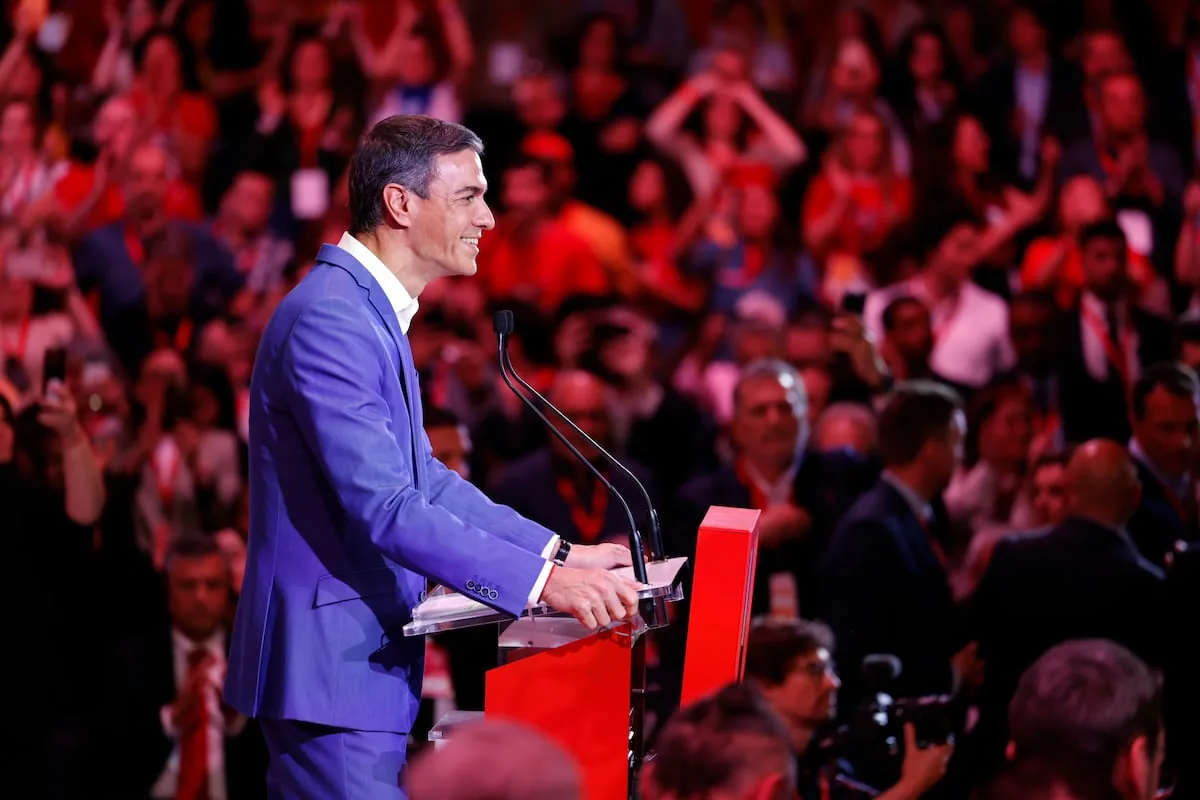
The PSOE would win the general elections if they were held today, according to the April CIS barometer, published this Monday. The study gives the socialists the highest estimate since the July 2023 elections, 36.4% of the vote, 4.6 points more than in March, which places the PSOE 12.8 points above the Popular Party, which loses three tenths compared to the last study and would remain with 23.5% of the votes.
Read more The war in the Middle East spurs Kurdish diplomacy in Madrid: “We are caught in the crossfire”
The CIS places Vox in third position with 14.7% of the votes (almost two points less than in March) and also predicts a fall for Sumar, which drops from 7.1% to 5.8% in voting intention. Alvise Pérez’s party, Se Acabó La Fiesta, also loses almost half a point and falls to 1.7%.

Pedro Sánchez (PSOE) is the preferred political leader to be Prime Minister at the moment for 31.3% of citizens; he is followed by Alberto Núñez Feijóo (PP), preferred by 9.9% of Spaniards, and Santiago Abascal (Vox), who has the support of 7.4%. There is 23% of the citizenry who indicate that they do not want any of the current leaders at the head of La Moncloa.
Despite the registered support, the current Prime Minister, Pedro Sánchez, does not inspire much confidence in citizens. When asked about this aspect, only 10.1% say that the head of the Executive inspires them with “a lot of confidence”. 26.7% state that they have “quite a lot of confidence” in the president, and there is 20.5% and 41.4% of the citizenry who, respectively, feel “little” or “no confidence” in Sánchez’s work. The confidence registered for the head of the PP is lower: 46.6% say that Alberto Núñez Feijóo does not inspire them with “any confidence”, 35% say “little”, 14% state “quite a lot”, and only 3.2% express that Feijóo inspires them with “a lot of confidence”.
Read more Government and ERC turn to economic sectors to gain Junts’ support for the investment consortium
The fieldwork for the April barometer, which includes 4,020 interviews, was carried out in the first days of the month, when the trials for the Kitchen case and the Koldo case began. On the one hand, the Audiencia Nacional began to judge the Kitchen case, the alleged parapolice plot organized to steal sensitive documentation for the party and its leaders from former PP treasurer Luis Bárcenas in the midst of the investigation into the Gürtel case and the party’s slush fund; and, on the other hand, the Supreme Court began hearings for the Koldo case, the case investigating whether the former minister and former number two of the PSOE, José Luis Ábalos, along with his man of maximum confidence, Koldo García, enriched themselves through the purchase of masks at the worst of the pandemic. Also during those days, the agreement of the parties to the left of the PSOE to run together in the Andalusian elections on May 17, led by Antonio Maíllo.
Ministers’ Evaluation
The study by the institute directed by José Félix Tezanos asks citizens if they know the members of the Council of Ministers. The least known minister is the Minister of Education, Milagros Tolón, whom 88% of respondents say they do not know. She is followed by Elma Saiz, government spokesperson and Minister of Inclusion, Social Security and Migration. On the other side is the second vice-president, Yolanda Díaz, whom 96.5% of citizens say they know.
It also asks for an evaluation of each of them, and only four approve. The best rated is the First Vice President and Minister of Economy, Carlos Cuerpo, who receives a 5.93 out of 10, followed by the Minister of Defense, Margarita Robles, with a 5.33; Pablo Bustinduy (Social Rights, Consumer Affairs and Agenda 2030) with a 5.27, and Ernest Urtasun (Culture), with a 5.05. The worst rated minister in the Government is Fernando Grande-Marlaska, whom Spaniards give a 4.06 out of 10.
Read more Progressive optimism and dead language