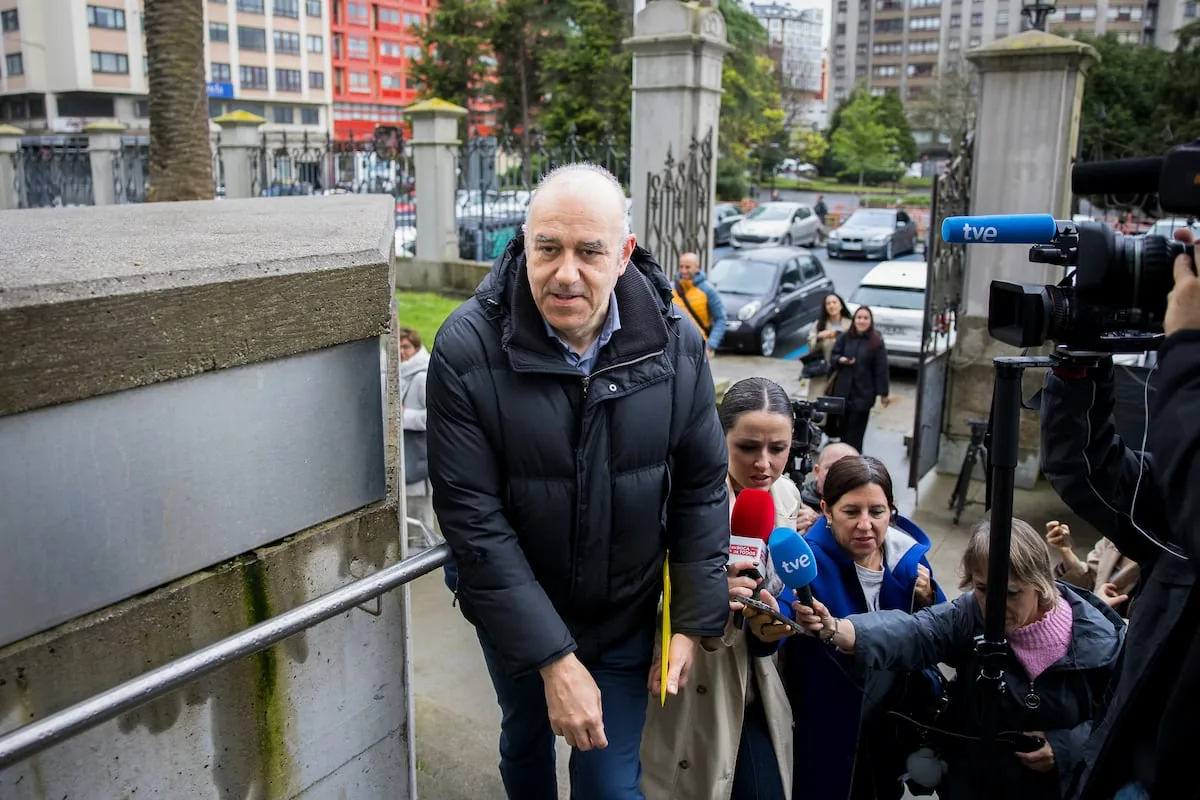










Manuel Reija, the lottery vendor who is on trial in A Coruña accused of keeping a Primitiva lottery ticket worth 4.7 million, was unable to explain on Monday during his testimony the two critical points of his version of what happened 14 years ago. The man, who faces a six-year prison sentence request for fraud or misappropriation, maintains that on July 2, 2012, he found the ticket on the counter of his lottery office when he was alone in the premises, and that he neither knew who it belonged to nor tried to obstruct the search for its owner to claim the fortune himself. However, he was unable to answer questions from the prosecution about the peculiar movements recorded by his shop’s machine, which checks prizes and validates new bets. And he claimed not to remember well the insistent letters he submitted to Loterías del Estado to have the prize paid to him.
Reija says that day he was “in shock” when he discovered that the ticket was awarded a “top-tier prize,” which is what appears on the machine’s screen when the amount of money is “significant,” he explained. He felt “frustrated,” he assures, “for not having the person in front of me to give them the good news.” He admits that the ticket in question was mixed with others and that he passed all the papers through the device. Both the Public Prosecutor’s Office and the private prosecutions have reminded Reija that this terminal recorded movements that dismantle his version of being alone.
Before the big prize, other bets were checked with unique combinations that played with the bettor’s date of birth and were later validated for the following week’s draw. This fact is, for the police, proof that Reija was facing the defrauded customer when he checked if the ticket had a prize. “That’s a lie,” he states. “I absolutely did not have anyone in front of me.” He argues that he attended to other people afterward and that those bets could be theirs and not the ticket owner’s, although he has not been able to explain how they could have repeated the same number combinations as him: “I just know I keep serving people, I have no idea.” He was shown a photo of whom the Public Prosecutor’s Office and the police consider the legitimate owner of the prize, but the accused said he did not know him.
Reija has also insisted that he did not intend to claim the prize, despite submitting four written requests to the State Lottery and Betting Society (Selae) for it. He claims that the first request, in September 2012, was made to prevent the prize from expiring and its owner, if they appeared, from losing it. Selae denied it, explaining that a “finding procedure” first had to be initiated, meaning a public appeal in search of the lucky winner. He says he doesn’t remember the other three requests, from January and February 2013, very well. “It’s possible,” he admitted about those writings, then arguing that he sent them “not with the intention of collecting” but to clarify the finding procedure, because he “had no clue” what it was and it sounded “strange” to him.
According to his version, after finding the winning ticket, he continued working until two in the afternoon and then went to the Selae delegation in A Coruña, which is managed by his brother Miguel, accused of concealment and participating in the plan to keep the ticket. He told him and his sister Belén, who also works for Selae, what had happened and returned to the lottery office in case the ticket owner came back. “Unfortunately,” he lamented, no one appeared to claim it.
In his testimony before the court, the lottery vendor, a member of a family linked to gambling since his grandfather’s time and with over 35 years of experience, appeared nervous, forgetful, and even uninterested and uncommunicative with his brother Miguel, then the Lottery delegate in A Coruña, regarding the development of the matter in the months following the incident. He doesn’t even remember the exact moment he learned the prize was 4.7 million euros. He has repeated several times that he did not take advantage of Miguel’s position to try to hinder the search for the money’s owner and claim it himself. “There was no regulated procedure” to act in such a situation, and both, he argues, made decisions “on the fly.”
Read more An Education official resigns after publishing a book with denigrating descriptions of teachers