









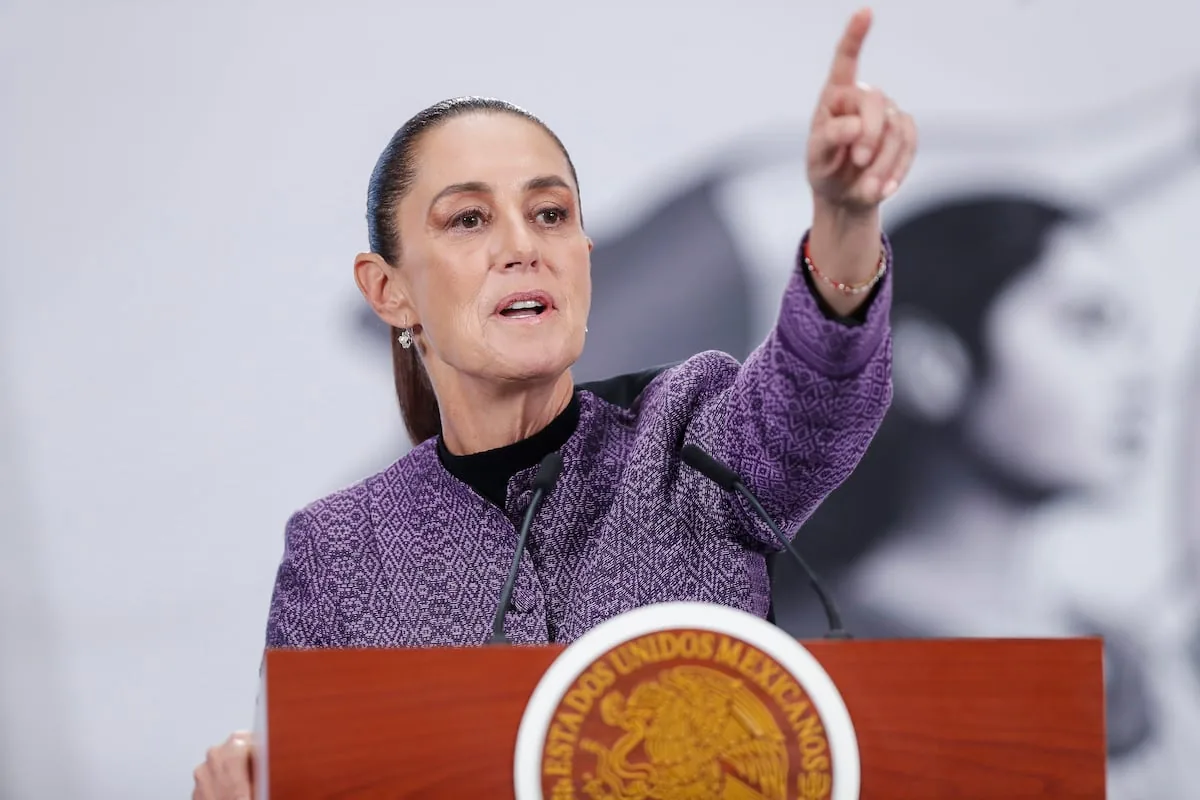
The issue is not to criticize or stop criticizing Claudia Sheinbaum’s administration. What is at stake is why? Criticize it to show the weaknesses and contradictions of a movement that has taken political control of the country? To prevent this control from becoming monolithic? To wear down its image and promote alternation? To prevent changes that affect the interests of those who criticize?
Read more A weakened Arsenal meets Atlético in the Champions League semifinals
Whatever the reason, and except when done dishonestly, all are legitimate; but it should be noted that the critic must be aware of the implications and their ultimate consequences.
Three factors, it seems to me, should condition the standpoint from which we defend or criticize. First, we cannot forget that we are in a race against time regarding discontent or, worse, social instability. In 2018 the bulk of the population demanded change and López Obrador undertook it, with successes and failures, with his virtues and limitations. After 20 years of scarce growth and worse social distribution, the country needed a turn because no society can survive indefinitely ignoring the demands of the popular and majority sectors. Some progress has been made in that direction, but the demand persists and we see it every day in the street protests by neighbors without water, communities fed up with insecurity, discordant unions, rebellious farmers and transporters, and a long etcetera. If we do not resolve it, the obvious outcomes would be repression or chronic destabilization. That is, the reasons why the 4T came to power remain present.
Second, we may like the 4T Government very much or very little, but at this moment Mexican society has no political alternative that meets the challenge. Most of the population dissatisfied with the system still sees this movement as an ally for their interests. Morena governments are achieving a reduction in poverty and inequality in terms that had not been obtained by the PAN and PRI administrations of recent decades. Could it do better? Without a doubt, and criticism should be aimed in that direction. What is clear today is that no other political force has a comprehensive or consistent proposal in this regard. A hypothetical return to a party that does not make the effort to build a response to this problem would be a leap into the void.
Third, changes in the economy and global geopolitics place Mexico in a different situation than it was during the neoliberal governments. The context is different. No one knows how the anti-globalization revisionism sweeping the planet will end, but it is evident that extreme vulnerability has become an immense risk for the country. Paradoxically, the 4T has a proposal closer than the opposition to the new priorities: formation of the internal market, reduction of dependence in strategic areas, and a State with greater room for maneuver (political and social) to pilot the storm.
Read more Swim to die on a red card
We can focus unilaterally on the shortcomings, errors, and contradictions of the 4T. But the rot of many trees in that forest should not prevent us from seeing the whole forest. Or, as the classics said, we cannot throw the baby out with the bathwater. The Government has managed to move the pendulum in favor of a better distribution which, I insist, today is the top priority; it has begun to reduce crime after several decades of unstoppable growth (the number of intentional homicides today is half of what we suffered in the last years of Peña Nieto’s Government or the first of López Obrador); for the first time the State has the firepower, the cadres, territorial presence, financial and intelligence instruments, and the strategy to begin to professionally combat drug cartels; tax collection has taken a substantive turn, a chronic problem of the Mexican Government, and today it is more than double that of 2018 in real terms; Claudia Sheinbaum is leading a quiet but profound reform to modernize, digitize, and make public administration more efficient. Other changes will take time to be noticed but are underway (the public health system, among others).
In its first six-year term the 4T made serious mistakes, some are being corrected and others are not. The current one is not exempt from faults either. It was a process of trial and error, subject to improvisations and full of resistance and wear, and today it tries to build its second floor. But the truth is that the changes described above represent tectonic shifts in Mexican society, as urgent as they are complex, on which previous governments had failed or done very little.
Criticism that allows the ruler to validate and correct, assume errors, warn of risks, and enrich diagnoses and solutions is essential. But that which, without having an alternative in sight nor doing anything to build one, produces holes in the boat is obviously harmful and irresponsible. Without a doubt, there are reasons to criticize the current version of the 4T, but before trying to shoot at its waterline, one should assess what we have to replace it or worse, what version of the 4T itself could emerge if it is defeated.
Read more Former senior officials place Aldama embedded in Transport during Ábalos’ tenure