









“The potato thing is a bit crazy. In fact, it’s the biggest headache we have when making our tortilla. Depending on the time of year, we change varieties: we use Monalisa from Segovia from September to the end of the year. From January, we use the Voyager variety and hope it lasts until summer…”, reflects Xan Otero, owner of La Falda and La Lorenza restaurants in Madrid. Not all potatoes are the same, neither in composition, shape, size, or color, nor are all suitable for everything. According to data handled by the Ministry of Agriculture, Fisheries and Food, there are about 150 cultivated varieties in Spain, known as seed potatoes, although far fewer reach the final consumer and are not always well identified. “The truth is that, although producers send them with all the information, it is true that at points of sale, customers are not usually offered the advice that, for example, is given with tomatoes or other fruits. There is a tendency to believe that, because it is a basic food, it doesn’t have much value, but it is a vegetable grown in the earth, which, like others, overcomes certain climatic crises and is a great food,” says Nuria Cobas, one of the managers of the Segoviana de Patatas company.
Furthermore, Canadian historian William H. McNeill argued that the potato was one of the great hidden engines of world history, with an impact comparable to that of technological or military revolutions. His central thesis appears clearly in his 1999 article How the Potato Changed the World’s History (How the potato changed the world’s history) and in earlier works since his 1947 doctoral thesis. He held several key ideas about this tuber at decisive moments: in the Andean highlands, the potato was the main energy source for the Inca empire and its predecessors. Thanks to its high caloric yield and techniques such as chuño —a potato naturally frozen and dehydrated using ancestral Andean techniques, such as nocturnal freezing and daytime sun, typical of Peru, Bolivia, and northern Chile—, which could be stored for years, it was possible to maintain armies, fuel large projects, such as roads, agricultural terraces, or monumental architecture, and collect taxes in the form of food and redistribute them from imperial warehouses. McNeill asserted that without the potato, a stable imperial civilization would not have been possible in an environment as harsh as the Andean one.
He also highlighted another great moment, already in Europe, between the 18th and 20th centuries, when it fed a large part of the population because it produces more calories per hectare than cereals, is cultivated in cold climates and poor soils, and reduces the risk of famines. This allowed many countries to sustain large armies, industrialize, and colonize and dominate much of the world between 1750 and 1950. The potato “allowed a few European nations to impose their dominion over most of the world,” said McNeill, who always defended the idea of how an apparently humble food can reorganize entire societies.
It satisfied hunger. Researcher Amaia Ortiz Barredo, head of the Plant Production and Protection department at Neiker (Basque Institute for Agricultural Research and Development), explains this in a written document, where she also places, according to several historical documents, the entry of the potato into Spain in 1570, through explorers from South America, mainly from the Peruvian highlands. “In just 50 years, it was already circulating through different European points. Between 1596 and 1620, exhaustive botanical descriptions had already been made to document its morphology and promote its consumption, fundamentally for animal feed and even ornamental purposes.” Human consumption, she assures, received its definitive boost from the hand of the Inspector General of Health in the Napoleonic era, Antoine‑Augustin Parmentier (1737‑1813), a French agronomist, nutritionist, and pharmacist who will be remembered for discovering the nutritional value of the tuber and realizing that it was a highly appreciated product in some German towns.
Ortiz Barredo recounted this in her inaugural lecture at the Royal Basque Society of Friends of the Country (RSBAP), an institution that researched agricultural techniques and the potato as a food crop, in addition to playing an important role in its dissemination in the Basque Country and other parts of Spain. Through his publications and activities, Parmentier promoted the cultivation of the potato as a nutritious alternative to other traditional crops, especially after the famine crisis that affected Europe in the 18th century. It was a high-yield, resistant, and nutritious food. Its ability to adapt to different climates and terrains made it an attractive option for improving food security.
Ortiz Barredo has dedicated years to the study of the potato and the development of new varieties, such as the beltza —purple in color, “with high antioxidant content and greater nutritional value than the white one,” she explains— or edurne —“with smooth skin, which adapts very well to all types of climatic conditions, with very good yield”—. Both are versatile in use: they serve for both frying and boiling.
View this post on InstagramA post shared by NEIKER (@neikerbrta)
Which are the best for each use?
The Neiker researcher summarizes it as follows: “For frying, you need it to have dry matter, less water so it absorbs less oil, and to be firmer and more rigid. The industry, for example, for making potato chips, requests these varieties because they are crispier,” explains Ortiz Barredo, who clarifies that potatoes generally consist of 80% water and 20% dry matter. “Frying potatoes have 1% or 2% more dry matter,” she specifies. This group would include the Agria potato, “yellow in color, which turns golden and doesn’t fall apart,” says Juana Calvo, one of the managers of A Casa de Pataca in Ourense, who also advises frying with the Kennebec variety. “Many of those who win tortilla contests in Spain use that one.”
On the other hand, for boiling, white potatoes with more dry matter are used more, “so that, when cooking, they break down a little and create a more consistent, thicker broth,” says Ortiz Barredo, who also clarifies that this is a matter of taste, as she prefers boiled potatoes to remain rather whole. For this purpose, varieties such as Spunta, Red Pontiac, Kennebec, and Monalisa usually work well.
View this post on InstagramA post shared by A Casa da Pataca (@acasadapataca)
The trend, driven by consumers who are guided primarily by sight, is towards perfect, soil-free potatoes. “A potato cannot be perfect, which is why there is so much waste, because many are discarded. They also tend to be washed, and that removes the protective layer. The imperfection of the potato doesn’t mean it’s bad, but rather that it came out of the earth that way,” adds Cobas, from Segoviana de Patatas. Ortiz Barredo also corroborates this, stating that Neiker receives more and more requests to create varieties —it’s worth remembering that the development of a new potato, from the cross between male and female parents until it is published in the BOE, takes about eight years— uniform in size and shape and “with thin skin, because the rougher ones are harder to clean, and consumers, when they buy potatoes, want them without soil.”
She also discovers another preference related to changing consumption: “Now, a lot of pre-cooked potatoes and varieties more adapted to industrial uses are consumed, as well as those prepared in microwaves, which are smaller tubers, of the garnish type, three or four centimeters in diameter, that do not disintegrate as easily.” This last group includes the Monalisa, Lady Claire, or Amandine varieties.
Main potato varieties for consumption
1
Monalisa
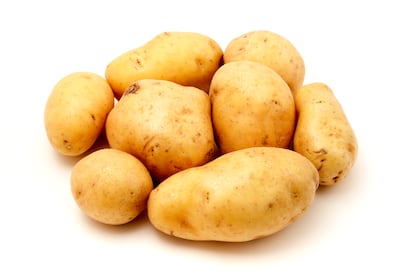
It comes from the Netherlands. It is an all-rounder potato, as it has different uses in cooking: for frying (absorbs little oil and turns golden), for boiling (maintains its shape and does not fall apart easily), in tortillas, stews, and casseroles, as well as in purees and gratins. Oval and quite regular in shape, it is medium-sized, with yellow, thin, and smooth skin, and light yellow flesh. It is semi-early, as it is planted in spring and harvested in summer or late summer —early varieties are harvested in spring and late varieties in autumn—. It has low water content and high starch; it is semi-waxy, firm but slightly floury.
2
Agria
Despite its name, its taste is not sour. Of Dutch origin, it is oval, though it can also be somewhat elongated, medium-large in size, with rough skin between yellow and light brown, and intense yellow flesh. It has low water content and a high percentage of starch. It is a floury and compact type of potato. It is the queen of frying —it turns crispy on the outside and creamy on the inside—; it is also used for poaching and in tortillas. It is the most used in hospitality and in the potato chip industry. It is not advisable for salads or long cooking times.
3
Kennebec
It is the most representative potato of Galicia, associated with the Protected Geographical Indication (PGI) Patata de Galicia. Semi-early, of American origin. An oval, large tuber, with shallow eyes, pale yellow skin, and white flesh. Its culinary quality, as described by agricultural engineer Fernando Pastor in a study on certified seed potato varieties, is good, being widely used for making English-style potato chips. A potato with a lot of personality, with low-medium water content and medium-high starch, with a firm and floury texture. When fried, it turns golden, and when boiled, it maintains its shape. Highly appreciated: in addition to frying, it is used for boiling, in ‘cachelos’ (boiled potatoes), with Galician-style octopus, or in salads; for stewing, roasting, and baking.
4
Red Pontiac
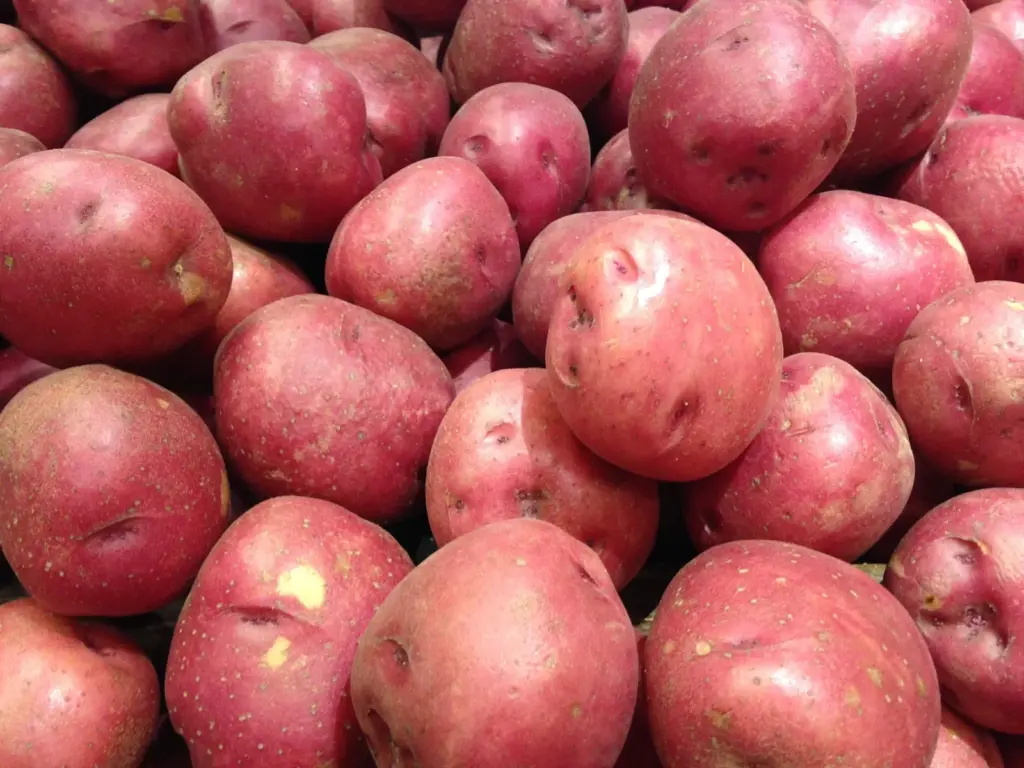
Of American origin. Semi-early. Round in shape, medium-large size, dark red skin, and white flesh. This variety is a mutation of the old Pontiac variety, also American, specifies Pastor, who warns that, due to the depth of its eyes, it is difficult to peel. Its preservation is medium, and its culinary quality is good. Its water content is medium, as is its starch level, which tends to be low. It is waxy and maintains its shape well when boiled, making it suitable for steaming or boiling, as well as for salads and side dishes, roasts, and stews. It is not recommended for frying, as, having less starch, it becomes less crispy.
5
Ágata
It is an early variety from the Netherlands, one of the most common in Spanish consumption, especially as a washed potato. Oval and quite regular in shape, medium size. Light yellow, smooth, and thin skin. Pale yellow flesh, with shallow eyes, which facilitates peeling. It has a medium-high water content and a low-medium starch level. It is waxy, with firm cooking. It is especially suitable for boiling and steaming, and for salads, potato salads, side dishes, and stews. It tends to darken, so it is not recommended for frying. It is easily found in supermarkets.
6
Spunta
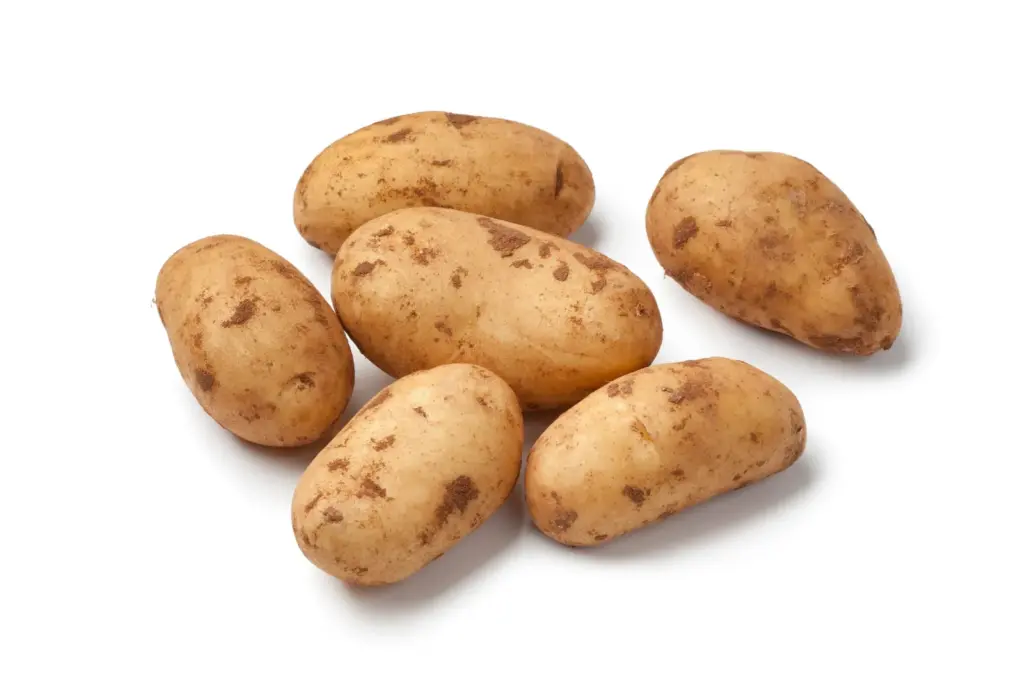
Semi-early or semi-late, of Dutch origin. It is an oval and elongated tuber, large in size, with thin, pale yellow skin and yellow flesh. It has shallow eyes and is quite difficult to store. Due to its low dry matter content, Pastor states that this variety is not suitable for frying. Therefore, it is recommended for boiling, in stews and casseroles, steaming, in purees, and roasts.
7
Colomba
Early variety, of Dutch origin, obtained from the cross between the Carrera and Ágata varieties. Oval to rounded in shape, medium-large in size, with thin yellow skin and yellow flesh. It has shallow eyes and good commercial presentation. Its dry matter content is low-medium, so it behaves as a fairly firm potato after cooking. It is suitable for boiling, roasting, and baking, stews and casseroles, and purees; however, it does not yield good results when fried, as it remains less crispy.
8
Elodie
Early, of French origin. It presents oval-shaped tubers, medium-sized, with thin yellow skin and light yellow, creamy flesh. It has shallow eyes and a firm texture, which holds up well after cooking. Its dry matter content is low-medium, making it a very versatile potato. It is recommended for boiling, stews and casseroles, oven roasts, and domestic frying, as it browns correctly and absorbs flavors well.
9
Baraka
Late variety, of Dutch origin. It is cultivated mainly in northern Spain, especially in Asturias. It presents large, oval, and elongated tubers, with yellow skin and light yellow flesh. It has shallow eyes and a texture ranging from firm to slightly floury, with medium-high dry matter content. It stands out for its good preservation and resistance to dehydration. In cooking, it is suitable for stews and casseroles, roasts and gratins, purees and tortillas, although it is also used for frying.