






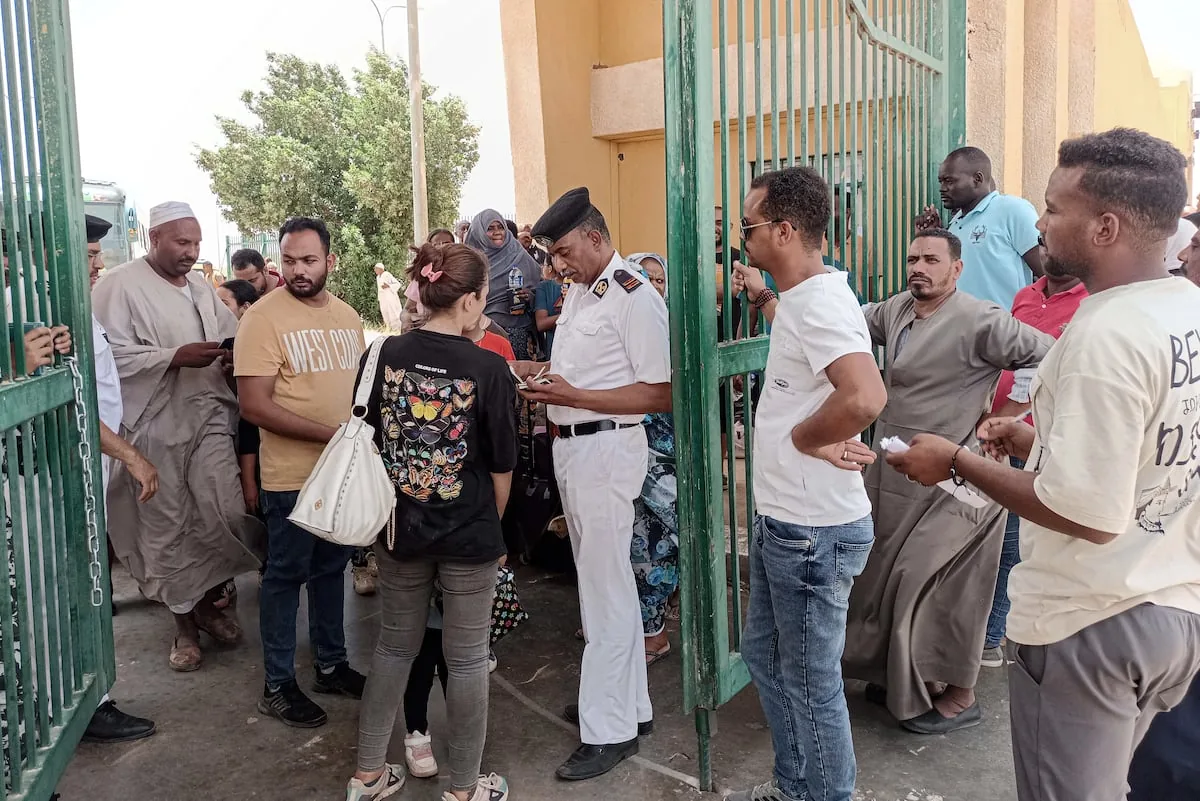
Sudanese refugee Nermeen (fictitious name) still remembers the ill-fated call she received on February 14: her husband had just been arrested while on his way to a doctor’s appointment in Faisal, one of Cairo’s neighborhoods where most displaced people from Sudan’s civil war are concentrated. “He is an elderly man, 60 years old, with only one kidney and an orthopedic brace. We are a family of 10 and we are struggling to survive,” describes Nermeen, who fled Kordofan and arrived in Egypt in May 2023. She asserts that her husband has a valid passport, a valid card from the UN Refugee Agency (Acnur), and a valid residence permit. But none of this saved him from being arrested and transferred to a police station on the outskirts of the Egyptian capital, as has happened with thousands of other migrants and refugees from Sudan and Syria this year.
The total number of arrests and deportations is unknown, partly due to the denial of access to police stations and border areas, but three sources familiar with the situation consulted by EL PAÍS agree that it amounts to at least several thousands. Among them are people with Acnur cards and valid residence permits, which human rights defenders judge to violate Egypt’s asylum law and the principle of non-refoulement in refugee law. It is a campaign that, according to human rights groups, is unprecedented.
Historically, Egypt has maintained a relatively open-door policy towards refugees, especially from other Arab states. But in recent years, it has been closing this space and has adopted increasingly strict restrictions for those already in the country. Currently, there are just over one million people registered with Acnur, 77% of them from Sudan and 10% from Syria, but the actual number is believed to be significantly higher.
We had never seen such a systematic attack against refugee communitiesKarim Ennarah, director of the research unit at the Egyptian Initiative for Personal Rights
The Egyptian government responded, in a letter addressed to the UN permanent mission, that no one is arrested for being an asylum seeker or refugee, but for violating the country’s residency laws or for crossing its borders illegally. But human rights groups believe there is a directive and attribute it primarily to the increasing efforts of Egyptian authorities to exert greater control over migration matters and an attempt to instill fear and reduce this population in the country.
“Before this policy change, especially in the [years] leading up to Sudan’s civil war, we had never seen such a systematic attack against refugee communities,” notes Karim Ennarah, director of the research unit at the Egyptian Initiative for Personal Rights (EIPR), which has documented arbitrary arrests and deportations. “This time, the main difference is the scale,” he continues. “The scale is unprecedented,” he insists.
Arrests have occurred in private homes, street checkpoints, public transport, workplaces, and in front of schools, hospitals, and universities, as documented by EIPR. Contacted by EL PAÍS, Acnur states that it “is aware of reports indicating that a growing number of refugees and asylum seekers are being detained in Egypt” and that it continues to collaborate with the government to emphasize “the importance of complying with [its] obligations” and advocate for the exemption of residence permits for registered refugees.
In the case of Nafisa (fictitious name), a young Sudanese woman from Khartoum who entered Egypt legally in May 2023, it happened while she was working. In early February, a police officer unexpectedly showed up at her cafe and asked for her documents. She states that she had her residence and Acnur card in order. But she was still detained. Like the other testimonies, she spoke on condition of anonymity for security reasons.
The young woman explains that she was never interrogated and could only call her sister after going through the Public Prosecutor’s Office the next day. She states that she remained in a cell with more than 50 people and that her asthma and leg problems worsened due to lack of space and sleep. She also claims to have witnessed repeated insults, mistreatment, and beatings against other inmates. “When I looked in the mirror [after getting out] I started crying because I didn’t recognize myself,” she recounts, from Sudan, by phone.
EIPR has warned that the high number of arrests has caused overcrowding in some police stations and that some detainees have been transferred to unofficial detention centers, where access to medical care and food is often very limited. “In the first three months of 2026, human rights groups have confirmed the deaths of seven detained migrants and refugees, according to EIPR. At least one was a minor and five were registered with Acnur.
Nafisa ended up being deported across the land border with Sudan almost a month after her detention. “You’ve just been through a war and displacement and you feel like it’s over,” she recounts, sobbing, “but then something like this happens.” “Just because I’m Black or Sudanese doesn’t mean I stop being a normal human being,” she continues, “I felt like a criminal, but I hadn’t done anything.”
Read more World Cup 2026: Profeco issues alert for scams on tickets and tourist packages
Mohamed Lotfy, director of the Egyptian Commission for Rights and Freedoms (ECRF), explains that “arrested individuals [generally] remain incommunicado, so lawyers can only take on their cases when families report it, which usually happens a few days later.” “By then,” he adds, “the person already has documentation for deportation or has been transferred to a court in preparation for their case or deportation.”
You’ve just been through a war and displacement and you feel like it’s over, but then something like this happensNafisa, refugee
In October 2025, when there had already been a surge in arrests of migrants and refugees, four UN special rapporteurs expressed their concern and questioned the Egyptian government. At that time, they reported an “alarming increase” in arrests of 56% for asylum seekers with residency and 121% for people registered by Acnur. Cairo responded two months later and stated that no one is arrested for being a refugee or asylum seeker, but for violating residency laws or entering the country illegally, and declared that if the person has an Acnur card, they are not deported. This March, UN rapporteurs again warned of violations against this population.
Lotfy believes that Egypt’s tougher stance has been brewing as a result of the arrival of more than a million Sudanese refugees since 2023, Israeli threats to expel Palestinians from Gaza to Egyptian territory, and financial aid talks between Cairo and the European Union (UE). “These security and financial aspects led the government to want absolute control over the migration situation,” he observes.
For Ennarah, from EIPR, “there is no official reason” to justify the detentions. “The state’s discourse continues to be that we are a country that welcomes refugees,” he points out. “I believe Egypt is trying, on the one hand, to make it clear that it is no longer as open as before so that these people stop arriving and, on the other hand, to pressure the EU and other countries to contribute more financially,” he speculates.
Hostile Climate
To apply for asylum in Egypt, a petition must first be submitted to Acnur, which, when studying the case, grants cards valid for between one and a half and three years so that a temporary residence can be obtained while awaiting a decision. However, each part of this process can be prolonged for months or years, leaving many trapped in what human rights groups describe as a situation of forced irregularity.
The current campaign of arrests and deportations comes just one year after Egypt ratified its first asylum law, with which it aims to assume responsibility for registering, studying, and resolving asylum applications in the country, a task that until today has been delegated to Acnur. Although the law enshrines some rights and opens the door for refugees to obtain nationality, its strong security-oriented nature has generated alarm.
“These raids and waves of arrests have become a common practice since the new asylum law was approved in Egypt in December 2024,” says Lotfy, who suspects that this could create “an unsustainable situation” for many migrants and refugees living in Egypt. “They may end up having to leave a place where they are not safe either,” he adds.
The increase in detentions and the risk of deportation are instilling concern and a sense of uncertainty in many families, according to three of the testimonies collected by EL PAÍS. “The general feeling is one of insecurity,” recounts a Sudanese activist in Egypt, “which leads some to consider alternatives, such as returning to Sudan or going to another country.”
Read more Latin America and the Caribbean must look again to the countryside to unlock their potential