



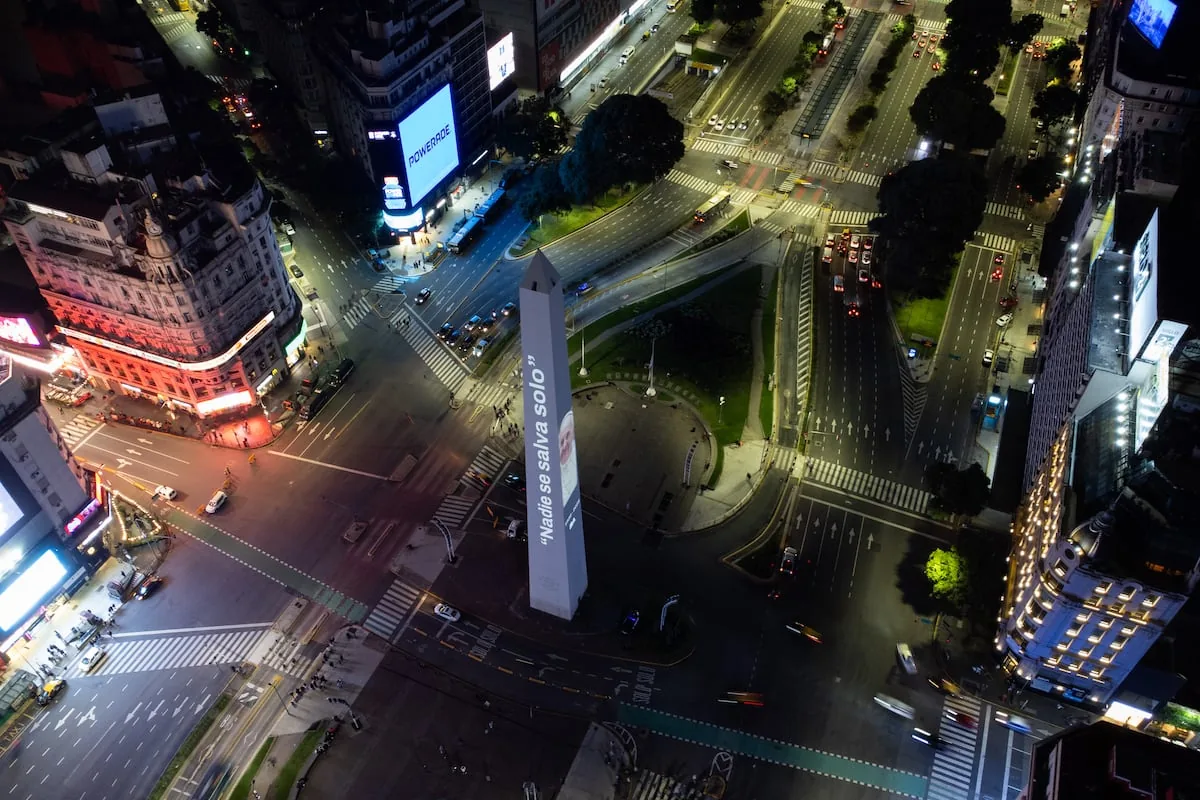
On a Buenos Aires night, a phrase illuminated the Obelisco, the symbol that reigns in the city center: “No one is saved alone.” Alongside the legend, a projected image of the one who used to utter it, Pope Francis. It was the last tribute of a day full of commemorations dedicated to Jorge Bergoglio (1936-2025), the Argentine pontiff, one year after his death.
Read more Calling Pablo Escobar’s lethal control of hippos ‘murder’ is unfair
“He played until the end of his days for the sublime cause of peace,” recalled Archbishop Marcelo Colombo, president of the Argentine Episcopal Conference. Bishops from all over the country, national and provincial authorities, political and social leaders filled the Basilica of Luján this Tuesday. There, in the Buenos Aires outskirts, the Catholic church organized the main institutional ceremony of the anniversary.
In charge of the homily, Colombo said that Bergoglio’s election as Pope in 2013 was an “immense joy” for the Argentine church and thanked the pontiff’s “luminous testimony,” “the light of his constant missionary call that does not fear going to the peripheries, the light of closeness to the poor, discarded, and suffering.” A defender like Francis of the idea of social justice, and a critic of the values promoted by the far-right, Colombo avoided explicitly confronting Javier Milei’s Government. Only one phrase seemed to have a recipient: “We must learn once and for all and stop punishing ourselves with indifference, disinterest, permanent aggression in language, and violent gestures,” he said.
Among the public present in Luján were various ministers and other high-ranking officials of the national Executive. With Milei in Israel, the presence of Vice President Victoria Villarruel —at odds with the president— was expected. But she was absent: “It seemed to me that the worst of the political caste was there,” she later declared. Versions fueled by her entourage indicated that she did not want to be seen alongside the Chief of Staff of ministers, Manuel Adorni, who is being investigated for possible acts of corruption.
Meanwhile, Milei participated in a tribute to Francis in the Church of the Holy Sepulchre in Jerusalem, on the last day of his visit to Israeli territory. On his social media, he also posted a photo of himself with Bergoglio, “the most important Argentine in history,” he noted. Several users reminded him of his insults to the Pope, whom before being elected president he called “a poorly shat turd” or “the representative of evil on Earth occupying the throne of God’s house.” Milei claimed to have apologized to the pontiff and stated that he forgave him.
Read more Taxco, Malinalco… intact the empire of crime
In the Flores neighborhood
In the Buenos Aires basilica of San José de Flores, where Bergoglio began his path as a priest, there were religious, cultural, and artistic activities and exhibitions throughout Tuesday. In the morning and under the rain, in the main square of the neighborhood, a “peace olive tree” was planted and a commemorative plaque was unveiled. In the afternoon, a mural alluding to Francis, made with Venetian mosaic, was installed at the subway station located on the same street. Shortly after, the musical “The Pope of the End of the World” was presented.
Many faithful approached Francis’s native neighborhood and toured the basilica, people alone, others with family or friends, many elderly people, also young people and children. “I come to celebrate the memory and what Francis left us, a message of hope, that together we can build a better Argentina,” said Catalina, 46, a housewife. “I am very religious and Francis is an example for all of us,” noted Ezequiel, a 55-year-old administrative employee, a resident of the Buenos Aires suburbs. “Following Francis’s words is very important in these times, to accept differences and help us never lose faith,” commented Analía, as she entered the church holding her daughter’s hand.
As night fell, the basilica was packed, and those who could not enter followed the activities through screens installed outside. The Archbishop of Buenos Aires, Jorge García Cuerta, officiated a mass and highlighted Francis’s ability to identify problems in order to confront them. Thus, he said, Francis “put on the table” problems such as ecology and global warming, “the problem of exclusion,” “warned about the culture of waste, about the need to seek out brothers and sisters who are left by the wayside,” also “the need to build peace.” “He put our young people and their difficulties on the table,” García emphasized, as well as “the need for transparency and reforms in the church.” “Perhaps that is why he was so criticized, because he did not cover up or gloss over the problems.” The archbishop asked his listeners: “Let us not remain sunk in sadness, nor let us remain in the memory of Francis […] Now we have a commitment to look up and look forward and see how together we build everything the Pope taught us.”
Almost at the same time, but a few kilometers from Flores, the political group Argentina Humana held a torchlight procession, from the Buenos Aires Cathedral, in the city center, to Plaza Constitución, “for a society without slaves or excluded people.” The tributes to Bergoglio, which will continue in the coming days, had begun last Saturday, with an unusual activity for the Catholic church in Argentina: thousands of people gathered in Plaza de Mayo to celebrate Francis to the rhythm of electronic music, with Portuguese priest Guilherme Peixoto as DJ and master of ceremonies.
Read more Before it’s too late: Mexico and the risk of copycat shootings