






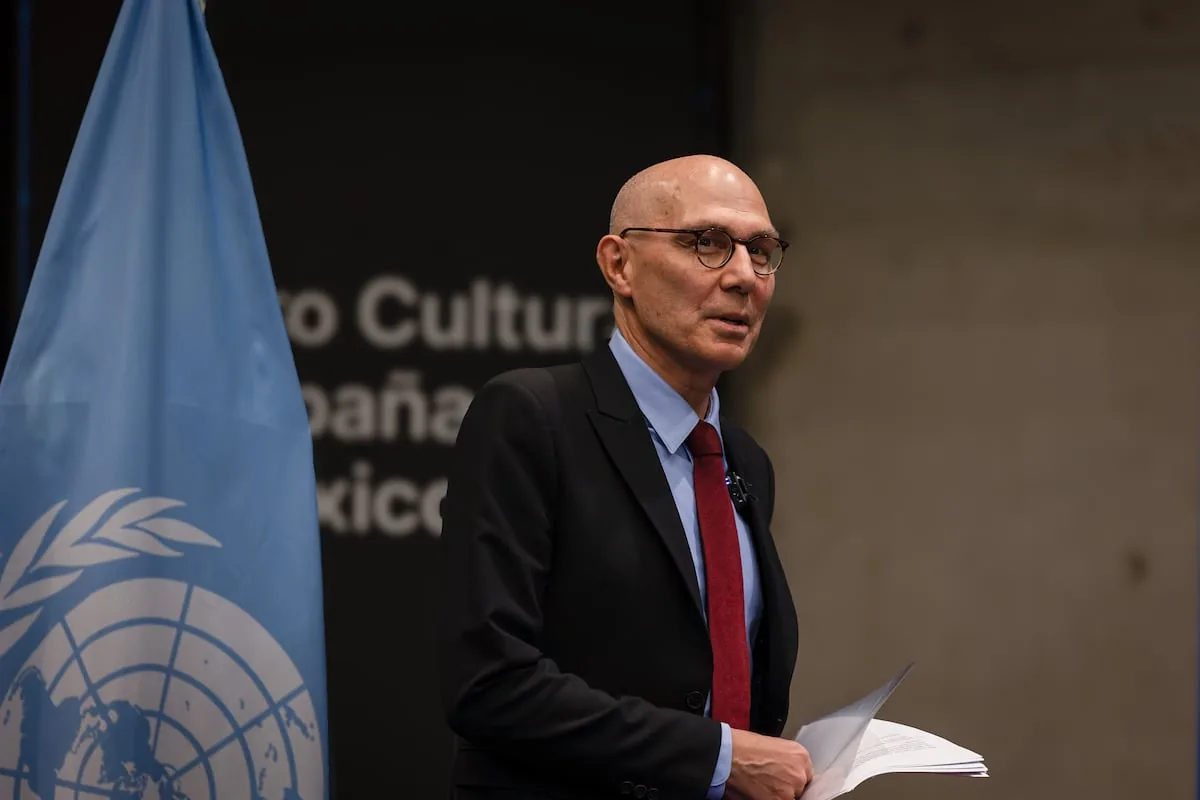
Sighs of relief in Claudia Sheinbaum’s Government. After her strong clash with the UN Committee on Enforced Disappearances, the Mexican Administration emerges unscathed from the four-day visit of the United Nations High Commissioner for Human Rights, Volker Türk. The official stated at a press conference this Wednesday his concern about the “serious” crisis of disappearances in the country, but acknowledged the “efforts” and “will” of the Mexican State to resolve it. “I have been encouraged by what I heard from the Government,” said the Austrian lawyer, who met this week with victims’ collectives and with the leadership of all branches of the country’s powers, from President Claudia Sheinbaum to Attorney General Ernestina Godoy and the 32 state prosecutors, to the president of the Supreme Court of Justice of the Nation (SCJN) and senators. Türk, who offered the country the help of the Human Rights Commission he heads, avoided criticizing the Government or mentioning the recent Article 34 that will bring Mexico before the UN General Assembly.
Read more Carlos Baute, María Corina Machado and Venezuelan racism
It had been a decade since the High Commissioner for Human Rights visited Mexico. The previous visit was in October 2015, by then-commissioner Zeid Ra’ad Al Hussein, to the Government of Enrique Peña Nieto. The statement after that visit was devastating: the official spoke of Tlatlaya and Ayotzinapa, of enforced disappearances, torture and extrajudicial executions, of 98% impunity, of murders of migrants, of rapes and femicides, of the failure of the police and the justice system to find the disappeared. “I will repeat the insensitive statistic again: Mexico has at least 26,000 cases of missing persons and new cases occur every day,” the official lamented then.
10 years have passed and the official registry of disappeared persons in Mexico already exceeds 130,000 entries —even with the Government’s data cut, more than 43,000 are counted—, impunity remains at 95% in the country and just this week three officials had to be suspended for extorting and failing to search for a disappeared girl. However, the High Commissioner’s appearance has been very different now.
“The issue of enforced disappearances came up in all my meetings, with the president, with the attorney general, with the secretary of government, with the senators… It was one of the main topics addressed. What needs to be done is to move forward, with a solution in between,” said Türk, who did not specify what it is but did offer “the support that the Government and society need to eradicate this phenomenon”: “The message I got from the victims, in general, was to ensure there was an effort in prevention and impunity, that impunity is resolved and it seems to me that this will is there, we just have to find a way to accompany the Government in this effort. The focus will be what the office can help achieve in the coming months and years.”
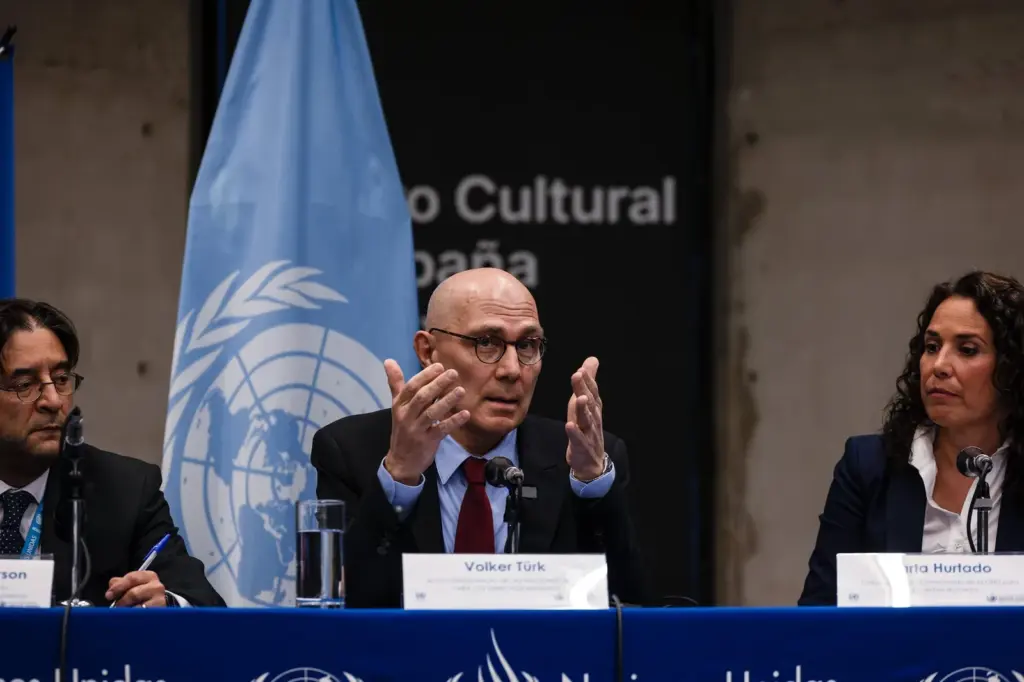
The High Commissioner did not mention any figures for disappeared persons to the press, nor did he point out specific cases such as the discovery of the Izaguirre ranch or rising tragedies such as forced recruitment. For much of his appearance, Volker Türk focused on the idea of strengthening what has already been built, such as search mechanisms, forensic identification processes, protection measures, and investigation capabilities: “I recognize the political will to continue strengthening existing institutions, and I am encouraged to have heard that families and collectives are recognized as key actors in search processes.” Last year alone, seven searchers were murdered and four others disappeared in the deadliest year for these activists. All of them demanded government inaction.
The official pointed out that there is a “social consensus” that “disappearances are a tragedy that must be fought.” “I made a request, a plea, which is also for society as a whole: that the issue of disappearances be addressed as a central issue that must be resolved, however, not polarized and not politicized,” he noted.
The commissioner’s visit came at a critical point between the United Nations and Mexico, after the strong offensive by Sheinbaum’s Government and her party, Morena, en bloc, against the report of the UN Committee on Enforced Disappearances, which identifies disappearances in the country as a “widespread and systematic practice,” to the point of activating the mechanism —Article 34— to bring the issue before the General Assembly. In that diplomatic escalation, the president even accused the committee of “having an orientation” aimed at “criticizing the Government of Mexico” and the Foreign Ministry of discrediting the report as “biased,” lacking “legal rigor,” “partial,” and “prejudiced.”
Despite questions from the press, Türk avoided commenting on that report or on Article 34. Nor did he want to define the severity of the human rights crisis in the country and focused on insisting on his office’s willingness to provide technical assistance and support to the Government in its fight against the crisis: “We talked about databases, forensic issues, even a healing process that addresses the issue in such a way that the truth must be reached and this puts many issues on the table,” he said to conclude: “We will work hard.”