




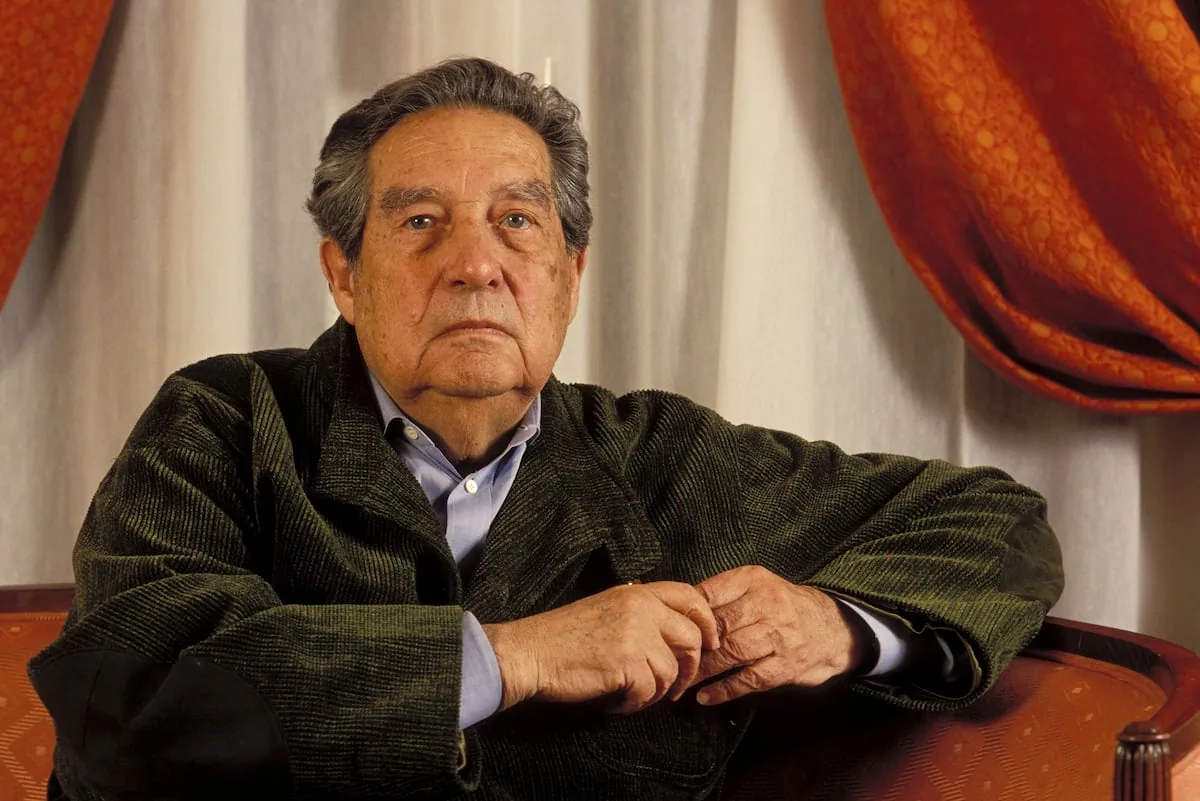
Given the good relationship that seems to be emerging between the governments of Mexico and Spain, a gesture of goodwill between both would be to jointly address the serious situation facing the legacy of the poet Octavio Paz. Why, some will ask, should Spain intervene? Because Octavio Paz was perhaps Spain’s best Mexican friend in the 20th century.
Before referring to the dramatic situation in which Paz’s legacy finds itself, it is important to remember his Spanish roots. His maternal grandparents came from Andalusia. As a child, he was educated by reading Benito Pérez Galdós’s National Episodes, whose heroes, like Salvador Monsalud, would imaginarily accompany him throughout his life. As a young man, José Bosch, son of a Catalan anarchist, became his intellectual guide. Years later, believing him to have fallen in the Civil War, Paz dedicated an Elegy to a comrade killed on the Aragon front to him. In 1935, he met Rafael Alberti in Mexico, who reaffirmed his political commitment but also his duty to write poetry that preserved the autonomy of art in the face of ideology. The following year, with the support of President Lázaro Cárdenas, Paz published ¡No pasarán!, his poem committed to the Spanish Republic. In July 1937, he attended the II Congress of Anti-Fascist Writers in Valencia, a city where, thanks to Manuel Altolaguirre, he published Under your clear shadow, his first book printed in Spain. In those tumultuous days, although prevented from joining the battle as he would have liked, Paz went to the Pozoblanco front. Spain needed him on the cultural front, and it was there that he served by strengthening ties with the poets of Hora de España, whom he would later welcome after their exile in Mexico.
Back in Mexico, Paz published the great Spanish writers in his magazine Taller. The poet León Felipe was very close to him. In 1941, together with Xavier Villaurrutia and the Spaniards Juan Gil-Albert and Emilio Prados, Paz edited Laurel: anthology of modern poetry in Spanish. And in the following years, his direct links with Spanish poetry and thought were continuous: in 1945 he met Jorge Guillén and reconnected in London with Luis Cernuda, to whom he would dedicate an essay in Cuadrivio (1965). In 1951 he defended Luis Buñuel’s Los olvidados in Cannes and met José Ortega y Gasset in Geneva. In 1958 he met Joan Miró in Paris. Between 1961 and 1964 he collaborated in Papeles de Son Armadans, directed by Camilo José Cela.
In 1971, after a long journey outside his country, Octavio Paz definitively settled in Mexico and founded the magazine Plural. In 1976, what would be his definitive magazine was born: Vuelta. While the great publishing houses of the peninsula expanded their presence in Latin America, Vuelta gathered the intellectual tradition of Revista de Occidente and the legacy of the best literary magazines prior to the Civil War. Great writers born of exile (Tomás Segovia, José de la Colina, Ramón Xirau), as well as Spanish writers of various generations, starting with Jaime Gil de Biedma, Juan Benet, Carlos Barral, and Jorge Semprún, participated in Vuelta. I don’t think I exaggerate if I say that the literary trajectory of Juan Goytisolo, Fernando Savater, Pere Gimferrer, Andrés Sánchez Robayna, and José Ángel Valente (among others) owes part of its splendor to their presence in Octavio Paz’s magazine. Naturally, Vuelta followed the Spanish Transition to democracy with immense interest, commitment, and enthusiasm. In 1982, Vuelta published a spread supporting Paz’s fulfilled dream: Spain as a constitutional monarchy with a socialist prime minister.
If Octavio Paz was generous with Spain, Spain was also, by far: in 1981 he received the Cervantes Prize, in 1987 the Menéndez Pelayo, and in 1993, Vuelta was recognized with the Prince of Asturias Award. The cycle of reciprocated love seemed complete when Paz passed away in 1998. Spanish culture sincerely mourned.
But Spain still has pending tasks with its adopted son: since his death, Paz’s legacy has been lost in a labyrinth, not of solitude, but of injustice, abandonment, and neglect. An inexplicable abuse, even more so considering a man who served so exemplarily —that is, with commitment, criticism, and self-criticism— the best socialist tradition of the 20th century. And for all this, there is only one responsible party: the Government of Mexico.
These are the antecedents. Paz died on April 19, 1998. In his will of November 17, 1997, he ordered that, if his wife Marie José Tramini did not dispose otherwise, these papers should be delivered to the Colegio Nacional (Colnal), a Mexican State institution created in 1943 to which about a hundred distinguished men and women in the arts, science, and letters have belonged. In that document, Paz expressed his wish to open the archive to the public 25 years after his death. His widow died intestate in 2018 and never made any provisions regarding his private papers, so their delivery should have proceeded long ago. None of that has happened: 28 years after his death, his wish to deposit his archive at Colnal remains unrespected.
In Mexico, as in other countries, the inheritance of those who die intestate passes to public welfare, in this case, the System for the Integral Development of the Family (DIF) of Mexico City. The DIF, however, improperly interpreted the facts, assuming that Marie José’s unexercised will absorbed Paz’s, so his papers should pass to their disposition, along with the rest of his assets. Colnal has never intended to keep anything other than the poet’s archives. It only wishes that the archive be assigned to it, in accordance with his will.
In August 2023, the DIF presented an agreement that the College considered unfair: it proposed the deposit as a mere loan, leaving the future of the archive to its discretion. Given the DIF’s refusal to negotiate another agreement, Colnal proceeded to sue it. To date, the College has won two definitive suspensions, which leads us to wonder: why does the DIF insist on keeping an archive that Paz himself bequeathed to the institution where it naturally belongs?
In August 2025, President Claudia Sheinbaum herself instructed the Ministry of Culture to resume its mediation functions between the DIF and Colnal to resolve the problem. That order has not been followed up.
Octavio Paz’s work survives and will survive these pettinesses. But it is necessary to save his archive. It contains invaluable documentation for the cultural and political history of the 20th century, especially that of Mexico and Spain. I don’t know if the public call I have made to the Mexican Government will have any effect. That is why I dare to suggest that a spokesperson for the Spanish Government raise their voice for that prodigal son of Spain who loved Spain so much, and who can no longer defend himself: Octavio Paz.