




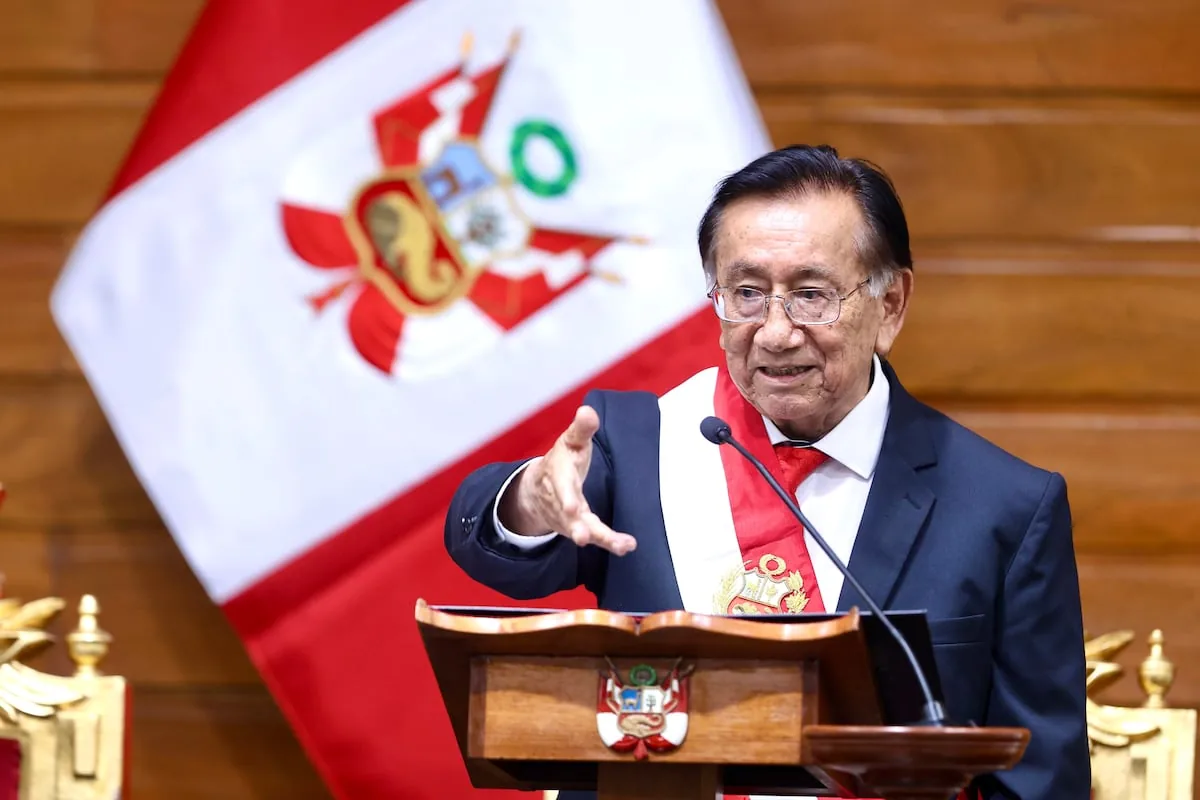
The controversy over the purchase of 24 F-16 Block 70 fighter jets from the United States Government has exposed the fragility of the leadership of Peru’s President, José María Balcázar, internal tensions within the Executive, and a clear alignment with Washington’s interests. Two of his ministers publicly disavowed him, accused him of lying, and ultimately overruled his decision to postpone an acquisition valued at 3.5 billion dollars.
Read more The new questions raised by the complaints against Angie Rodríguez
Balcázar, the third interim president of the last five years, had resisted approving the purchase from the American company Lockheed Martin. Since Friday the 17th —when he canceled the contract signing ceremony— he reiterated on at least four occasions that he would leave the decision to the next elected government, as it was a commitment of great magnitude that, in his opinion, did not correspond to a transitional administration.
His stance opened a deep rift in the Council of Ministers. Premier Luis Arroyo, Defense Minister Carlos Díaz, and Foreign Minister Hugo de Zela urged him to proceed with the operation, arguing that there was a prior commitment made during Dina Boluarte’s government in 2024. In parallel, a sector of the political class warned about possible penalties for the country if the process was halted, while others supported the president’s caution, pointing out that there are more urgent national priorities than the re-equipping of the Peruvian Air Force (FAP).
According to the newspaper La República, the process had been subject to questioning since José Jerí’s administration, when a public tender was allegedly discarded and options such as the French Dassault Aviation (Rafale F4) and the Swedish Saab (Gripen E/F) were set aside, directly favoring Lockheed Martin.
The conflict escalated on Monday. When the issue seemed settled and the president believed he had stopped the operation, it emerged that the contract had been signed in secret and without his participation. According to various sources, the then Minister of Defense, Carlos Díaz, ordered the FAP’s commanding general, Mario Contreras León Carty, to proceed with the purchase despite presidential opposition. That same day, Colonel Carlo Rey Benavente, head of the FAP’s Technical Supply Service, signed the contract with representatives of the American firm. It was an officer who gave the final approval, not Balcázar, who holds the position of supreme commander of the Armed Forces.
The next day, amidst contradictory versions, Balcázar, 83, denied the existence of the document and reaffirmed that the decision would fall to his successor. However, on Wednesday the situation took a definitive turn: Foreign Minister De Zela and Minister Díaz confirmed in a radio interview that the contract had already been signed, accusing the president of having lied.
Cornered by the revelations, Balcázar dismissed Díaz, accepted De Zela’s resignation, and delivered his first Address to the Nation in two months in office. In an attempt to contain the damage, he claimed not to have participated in the negotiations, but implicitly admitted his lack of authority: “I have not intervened in these dealings, so it cannot be said that I lied.”
Read more Murtra dismisses the CEO of Movistar Plus a year after appointing him
Almost in parallel, Premier Luis Arroyo issued a statement that ultimately undermined the presidential figure. He maintained that the National Security and Defense Council (Cosedena) had approved the purchase and that, being a “strategic decision,” the Executive had to comply with it.
In this scenario, the role of the United States Ambassador, Bernie Navarro, has been decisive. The diplomat previously warned that if his country’s “interests were undermined,” “all available tools” would be used in defense of the Trump administration. Navarro, who met with the Minister of Defense on the day of the signing, stated that the contract was signed “with full knowledge of the highest levels of the Peruvian government,” in a clear allusion to Balcázar’s stance.
The economic and political outcome
In recent hours, Navarro has intensified his media presence promoting the benefits of the F-16s, assuring that the first fleet will arrive between 2029 and 2030 after personnel training and infrastructure adaptation. “Peru complied with the contract. This means it is serious in its way of doing business,” the ambassador declared.
The episode added a critical chapter when the Minister of Economy, Rodolfo Acuña, authorized the first transfer of 462 million dollars to Lockheed Martin. The announcement was not made by the Executive, but by the President of Congress, Fernando Rospigliosi, who showed himself willing to process the motion of censure against Balcázar promoted by legislator Ilich López. “If it has the signatures, it must be processed. There’s no turning back,” he stated.
While Amadeo Flores takes over as the new Minister of Defense and the Foreign Ministry remains leaderless, Luis Arroyo remains in office despite his open defiance of the president. The Government thus navigates a crisis that leaves an open question: Who truly holds power in Peru today?