









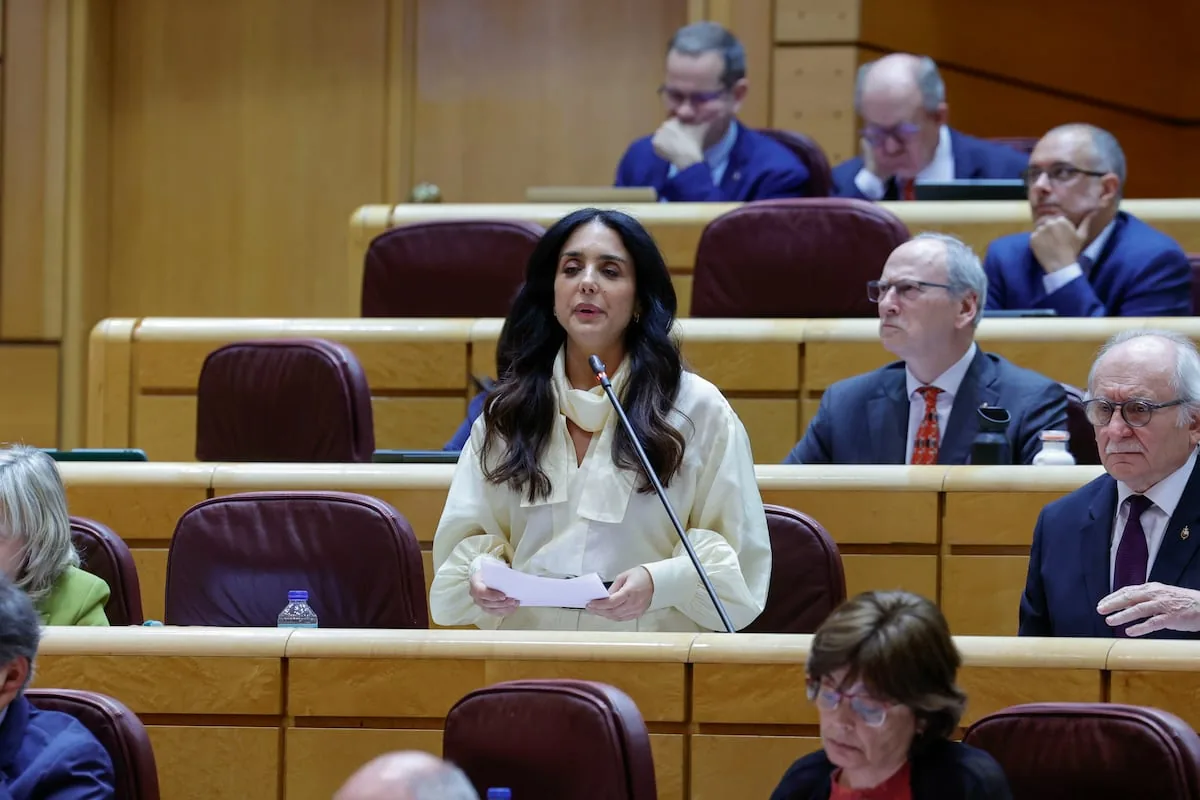
Vox has once again set the pace for the PP in the Senate. The strategy of Santiago Abascal’s party to corner the Populars with controversial and media-driven motions aimed primarily at exposing the Populars to their electorate returned to the upper chamber this Wednesday. Abascal’s party has now defended the need to outlaw EH Bildu. Vox urged senators to vote in favor of this proposal, but the PP senators, who hold an absolute majority in the chamber, abstained.
“How is it possible that the heirs of those who pulled the trigger dictate the laws of the nation they tried to destroy?” began Vox spokesperson Paloma Gómez, tasked with defending the measure. “This question has an answer,” she continued. “The outlawing of EH Bildu. We bring this not for strategy, but for justice.” Gómez said that Bildu is not just another acronym, but “the presence of the heirs of terror in the seats […] The dog is finished, the rage is finished.” It was then that the Vox spokesperson, aware of the media impact of the proposal, directly addressed the Popular bench. “You have the majority in this chamber,” she told them. “Don’t look at electoral calculation, look at firmness. Decide if you are with justice or not. This is not about persecuting ideas. Terror is fought.”
The discomfort of the PP was evident on this issue. It was not the first time it was brought up. In fact, two years ago, it was the Populars who assured that, if they came to power, they would propose the dissolution of those parties that promote the declaration of independence or an illegal referendum, clearly referring to the independence parties, such as ERC, Bildu, or Junts.
“We are faced with a delicate matter,” said Severiano Cuesta of the PP. “The outlawing of Bildu cannot be carried out under current legislation. The Supreme Court said so. Today, those criteria are not met. Spaniards need certainties, not a toast to the sun.” The PP senator tried to counter Vox’s arguments with the red line already imposed by his leader, Alberto Núñez Feijóo, on the party: the PP can make agreements with all parties, but not with EH Bildu.
Senator Cuesta also wanted to defend that, since the outlawing of EH Bildu cannot be carried out, what is needed is to toughen the penalty for terrorists. “Are you against it?” he asked aloud, clearly referring to Vox. “Gentlemen of Vox,” he continued in case there was any doubt, “I ask you, accept our proposal. Let’s approve a motion that has legal viability and not a fleeting headline that benefits Spaniards in no way.”
The debate, however, provoked outrage from the left and the independents. “The party most outside the Constitution is you [referring to Vox],” criticized socialist Adolfo Lander, senator for Álava. “It seems that anything goes in this Chamber,” began Idurre Bideguren of EH Bildu in her turn to speak. “Why do you repeatedly resort to outlawing Bildu? Because you cannot bear that the sovereignist forces are governing. The plurinational reality exists, even if you close your eyes not to see it.”
The “national priority,” which has marked political news since April 16 when María Guardiola’s Extremaduran PP included this principle in the government agreement with Vox, has also been criticized by left-wing and sovereignist groups. “You, the promoters of the national priority, have the nerve to ask for Bildu’s outlawing,” emphasized the senator for Navarra Uxue Barcos. “Your true national priority is to end democracy,” stressed the spokesperson of the Basque parliamentary group, Estefanía Beltrán.
The Constitutional Court already endorsed Bildu’s legality in 2011. In a historic ruling, the high court annulled the Supreme Court’s decision to cancel the party’s candidacies in the municipal elections for considering it the successor of Batasuna, outlawed in 2003 under the Political Parties Law. The Constitutional Court plenary concluded that there were no “elements proving the existence of links.”