








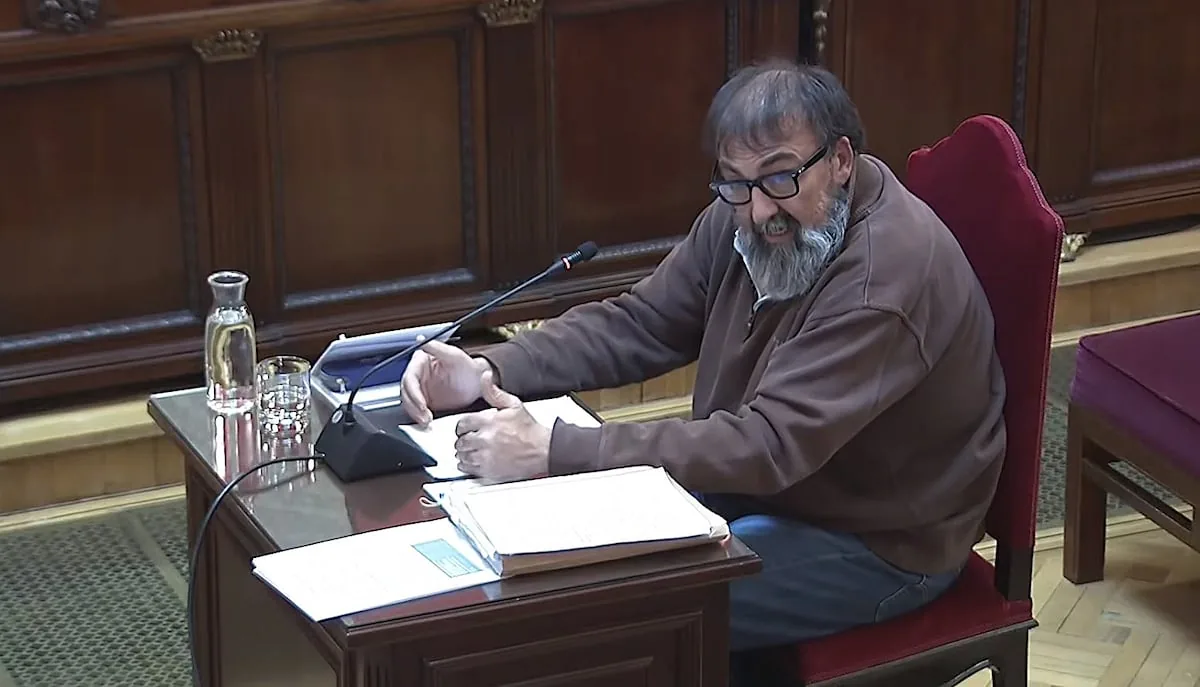
The interrogation of Koldo García has marked a plot twist in the trial over the mask scandal. The most obvious thing in this case is that the protagonist of the chapter is not fully aware of his role in the play. He knew what he was doing and why he was doing it, of course, but it is more than doubtful that he was aware of the significance and relevance of his actions. This episode could be titled “The Banality of Corruption,” paraphrasing once again the expression coined by the German philosopher Hannah Arendt, who referred to the banality of evil in much worse circumstances, in every sense.
Read more The former advisor who acts as a protective shield for the former minister
It was in the early 1960s, following the trial of Adolf Eichmann, a Nazi regime official accused of crimes against humanity, organizer of thousands of deportations to concentration camps, especially those in Poland. Obviously, this is not to compare the acts attributed to Koldo with that terrible chapter, but to note how the bureaucrat profile repeats itself in this other story. Koldo García examines his actions naturally, and nothing he presents seems serious to him, because everything was simply the development of his auxiliary functions and attending to the needs of his minister, José Luis Ábalos, and his reference businessman, Víctor de Aldama.
But it is potentially overwhelming to imagine Koldo García in the office he had at the Ministry of Development, pulling the strings of the mask traffic recorded during the worst moments of the covid pandemic. There has been talk of planes loaded with that protector and eight million pieces in circulation, waiting to fall into the hands of one administration or another hoping to face a daily onslaught of hundreds of deaths. One only has to remember the rows of coffins arranged at the time in the Palacio de Hielo in Madrid.
One can also recall circumstances as or more moving than those rows. For example, one can revisit the drama of nursing homes in Madrid. While hospitals had to select patients, deciding who was given a chance to survive, and while thousands of elderly awaited the possibility of being transferred and cared for in health centers, some found the situation the ideal setting for profiteering.
Read more Opposition to Lula approves in Congress reducing Bolsonaro’s sentence for coup plotting
Perhaps Koldo did not take a single euro for his role as distributor of the masks, demanded by all administrations. But his stomach and conscience must have been unsettled witnessing the spectacle of such a miserable business. And hearing him talk about it, it only seems that he accepted without anguish the role of merchandise placer. That is, however, compromising everyone who received the offer of a medical material whose real effectiveness was unknown, but that everyone sought as a refuge of hope against the threatening spread of the disease.
The same applies to other activities. Accommodating the minister’s partners, whether in rental apartments or in jobs where no schedule, specific training, or presence was required, or looking overseas — in Mexico, for example — for “young ladies” to help the boss relax, would not fall within the classification of acts of corruption, neither economic nor moral. And it remains as a mere anecdote that 500-euro bills could be “chistorras.” Deep down, it is a way to define his daily life. That amount may be a significant sum, a fortune, for many people, but for Koldo it is a figure that reminds him by its color of a bar drink, or an appetizer; that is, a trivial gesture.