







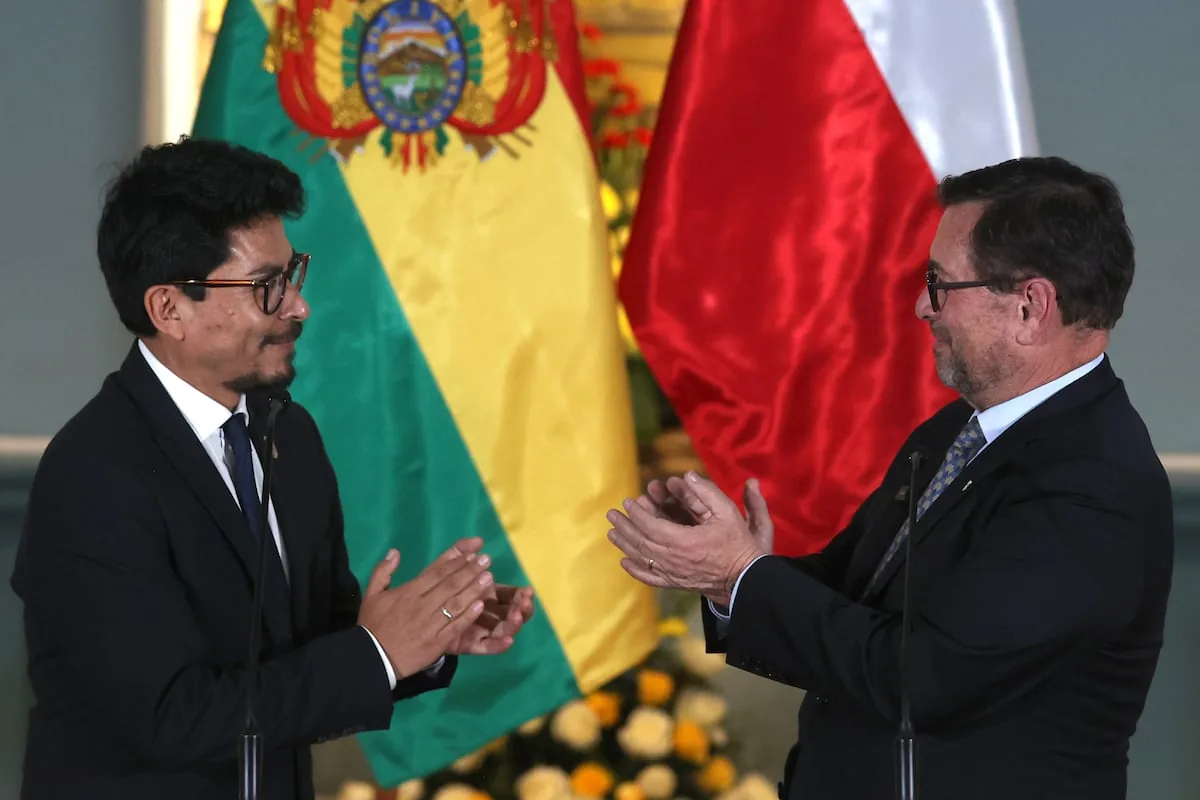
Since 1975 Chile and Bolivia have maintained broken diplomatic relations, bad news for two countries that share a border of more than 800 kilometers in length and have common challenges. In this regard, the recent rapprochement of the foreign ministers of both countries is undoubtedly hopeful, which materialized in a visit by Minister Francisco Pérez Mackena to La Paz and has led to the identification of a common agenda. However, it is worth remembering that the building of trust did not start there.
Read more The Civil Guard denies that there are four dead on the Oliva beach in Valencia
Although there were attempts to identify and build agendas at multiple points during the administrations of Lagos, Bachelet, and Piñera – how could we forget the strong and clear speech of former President Lagos at the Organization of American States Assembly in Monterrey pointing to his Bolivian counterpart “I offer diplomatic relations here and now” – there is no doubt that the processes carried out at the International Court of Justice, whose rulings occurred in 2018 and 2022, froze the possibilities of advancing this common agenda. However, the determined commitment to rapprochement and the multiple diplomatic gestures made by Presidents Boric and Arce during their terms made it possible to reinvigorate an agenda that seemed doomed to fail.
It is true that the 2009 Bolivian Political Constitution declares in its article 268 “its inalienable and imprescriptible right over the territory that gives it access to the Pacific Ocean and its maritime space” and for this it urges the peaceful resolution of the dispute. This, of course, poses an obligation for Bolivian authorities to raise a point that Chile understands as resolved since the 1904 Treaty. However, both countries have seemed to understand that only on the basis of a mutually interesting agenda that has a real possibility of materializing will it be possible to overcome past differences.
Diplomatic gestures were key, such as President Arce’s participation in the commemoration of the 50th anniversary of the coup d’état in Chile, added to President Gabriel Boric’s visit to Bolivia to participate in the inauguration of President Rodrigo Paz in Bolivia. It is necessary to highlight that the last Chilean president to visit the neighboring country – on a bilateral mission – was Ricardo Lagos on the occasion of Evo Morales’s inauguration in 2006. The participation of Foreign Minister Alberto Van Klaveren and Senate President Manuel José Ossandón in the celebration of Bolivia’s bicentennial in 2025 was also significant. The visit of the Bolivian Foreign Minister to Chile in January 2026, where several bilateral instruments were signed, stands out, including a modernization of ACE22 (economic complementation agreement) that incorporates a chapter on “trade and gender” and another related to MSMEs and cooperatives, consolidating a series of concrete gestures and initiatives to build the future.
But the dialogue mechanisms and construction of the bilateral agenda also contribute to building a network of links and agendas that give more solidity to the relationship. Thus, during the administrations of Presidents Arce and Boric, after several years of interruption, the integration and border committee was materialized, which has been developed uninterruptedly since 2023. This instance is especially important for the services and communities operating near the border. Likewise, the Joint Commission on Narcotics and Related Crimes (2023), the Chile-Bolivia Business Council (2023), the Administrative Commission of the Economic Complementation Agreement (2024), and the Binational Table of Shared Water Resources (2024 and signing of a Memorandum of Understanding in January 2026) were carried out. All these instances have allowed identifying agendas and advancing towards mutually interesting objectives.
Read more Final? What final? Sinner finishes Zverev in 57 minutes and rises at the Caja Mágica
Two more agreements are added to this positive agenda: the one that eliminates visas for Bolivian diplomats and the one that authorizes the use of Bolivian driver’s licenses in Chile. The reopening of BOA (Boliviana de Aviación) flights also stands out, especially the opening of flights connecting cities in northern Chile with various Bolivian cities, improving connectivity between the two countries.
Likewise, since security and migratory flows are a priority issue for both countries, in 2023 and 2024 agreements were signed, promoted by the Interior and Government Ministries of the two nations, supported by the respective Foreign Ministries, to combat vehicle theft and smuggling, prevent and investigate human trafficking, and strengthen joint coordination and cooperation to fight organized crime. This meant, for example, the possibility of carrying out more than four thousand “returns” (returning citizens of third countries who enter Chile irregularly) from March 2025 to January 2026. This shows that, beyond the stridency this discussion took in the National Congress and the recriminations made to the previous administration, when working quietly and seriously, good results are possible.
Following the best tradition of our foreign policy, considered a state policy, we face a long road paved by different governments in the past, of a slow but solid construction of trust and rapprochement between two countries that need to continue working to improve dialogue, cooperation, mutual understanding and, ultimately, make the relationship between two countries that need each other denser and richer at different levels. Reestablish diplomatic relations? Everything seems to indicate that the table is set.