



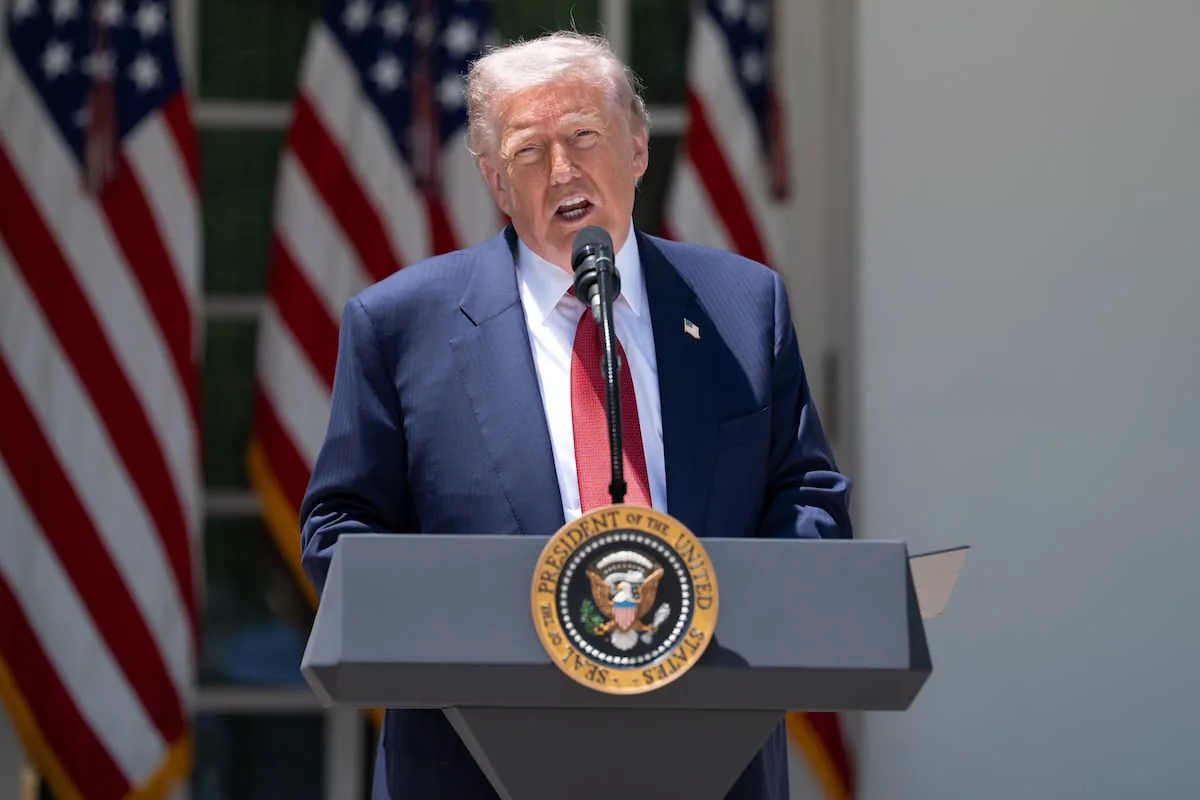
The President of the United States, Donald Trump, announced this Friday on Truth, his social network, a three-day ceasefire, “May 9, 10, and 11,” in the war between Russia and Ukraine.
Trump attributes it to the “celebration in Russia of Victory Day,” scheduled for this Saturday. “But it is also in Ukraine, since this country was also a part and a fundamental factor in World War II,” writes the Republican. “This ceasefire will include the suspension of all military activity, as well as an exchange of 1,000 prisoners from each country.”
The President of the United States states that the agreement arises from a “request made directly” by him. “I greatly appreciate that it was accepted by both President Vladimir Putin and President Volodymyr Zelensky,” he adds. “It is to be hoped that this marks the beginning of the end of a very long, deadly, and hard-fought war. Talks to end this great conflict — the largest since World War II — continue, and every day we are closer to achieving it.”
There was no immediate confirmation from Kiev or Moscow. It is also unclear when Trump spoke with their leaders or how the agreement he boasted about on Truth was reached. The last recorded phone conversation with Putin took place at the end of April to also discuss the war in Iran. As for Zelensky, the American last spoke with him in December.
Putin will preside over the Victory Day parade in Red Square this Saturday. Russian authorities feared a Ukrainian attack and have taken maximum precautions. The military march will not include any vehicles for the first time since 2007, due to the risk that they could be bombed during preparation, and the Federal Security Service (FSB) will completely cut off mobile internet in the region throughout the day.
The Russian Ministry of Foreign Affairs urged Western diplomatic missions to leave Kiev in the face of a possible massive bombing in retaliation, “including decision-making centers,” if Ukraine sabotaged their celebrations.
The pressure from the American leader to comply with a ceasefire gives the Kremlin a breather as its bombings on Ukraine have killed at least 70 civilians so far in May, according to the UN.
Trump’s announcement follows two unilateral ceasefire declarations by Moscow and Kiev, both resolved unsuccessfully. Putin had announced earlier this week a ceasefire for May 8 and 9. His goal? To prevent Ukraine from boycotting the celebration of a key day for its image.
Zelensky showed, however, that the Kremlin had no intention of reducing the intensity of the war. Shortly after, Kiev declared another ceasefire for May 5 and 6, whose compliance was also linked to Victory Day. As soon as it came into effect, Ukraine suffered an intense bombardment.
“There was no official appeal to Ukraine regarding the modality of a cessation of hostilities,” Zelensky denounced. “We believe that human life is much more valuable than any ‘celebration’ of an anniversary,” the Ukrainian leader added then.
The May 9 celebration commemorates the Soviet victory over Nazi Germany in 1945, in the final stages of World War II. For the Kremlin, it is the most sacred date on its calendar and a holiday that Putin takes advantage of every year to make a display of military strength before the rest of the world.
In 2023, in the midst of the Russian invasion, Ukraine changed the commemoration of the event from May 9 to May 8, the same day celebrated by the rest of the Allies. Kiev renamed the holiday as the Day of Remembrance and Victory over Nazism.
May 9 has been a holiday in Russia since 1965, but during the years of the Soviet Union, commemorative parades were only held in 1965, 1985, and 1990. From 1995, with Boris Yeltsin in power, the parades became annual. After Putin came to power on New Year’s Eve 1999, the militaristic passion has intensified over the years. In 2008, military vehicles were introduced into the commemorative formula.
Russian society celebrates that day the victory over the Nazis (and the memory of the 25 million Soviets killed in World War II) by gathering with family. Putin’s nationalism has turned this holiday, intended to prevent the disasters of that war from being forgotten, into a demonstration of Russia’s warlike power.