









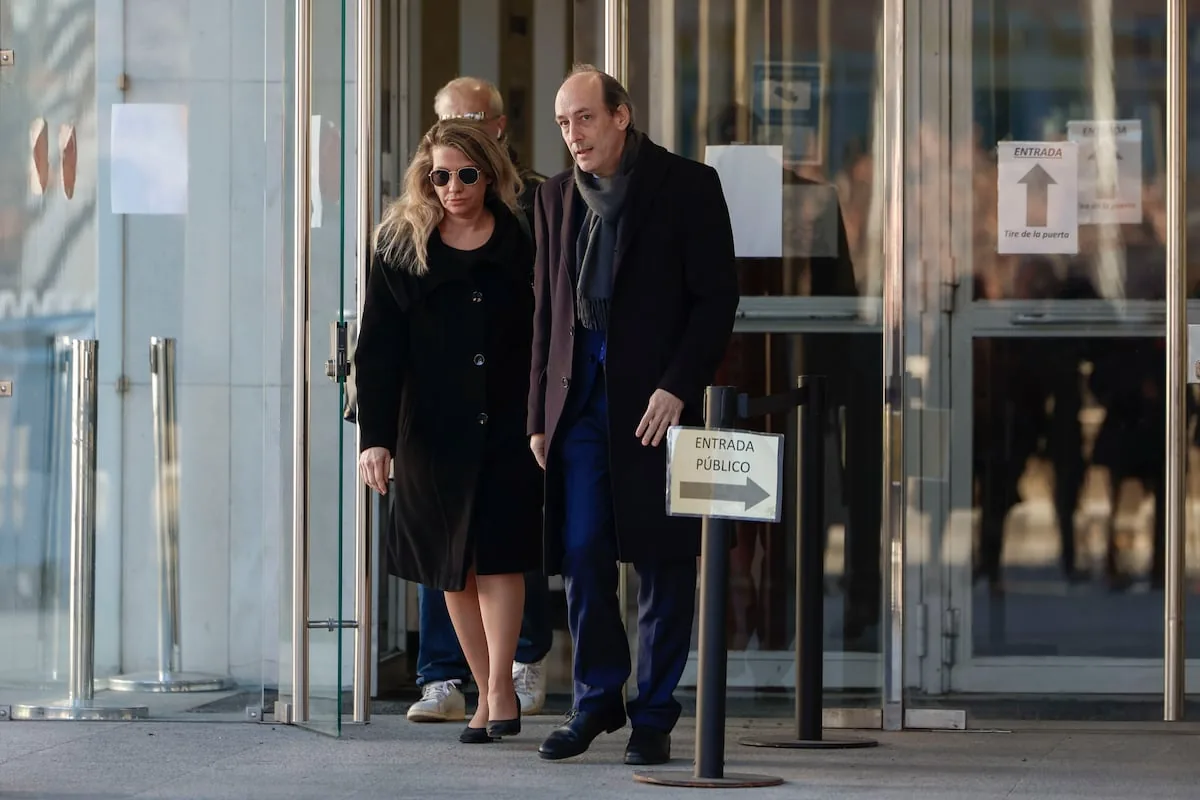
The defense of Cristina Álvarez, the advisor at La Moncloa to the wife of the Prime Minister, Begoña Gómez, has described as “absurd” the request for 22 years in prison made by the popular accusation led by Hazte Oír against her. In a document accessed by EL PAÍS, the Presidency employee has requested her acquittal and recalled that even Manos Limpias — which acts as one of the popular accusations in the case — has requested her exoneration.
The lawyer José María de Pablo, representing Álvarez, has submitted his provisional conclusions after Judge Juan Carlos Peinado agreed to send her to trial with a popular jury — along with Gómez and businessman Juan Carlos Barrabés — for alleged crimes of influence peddling, corruption in business, misappropriation of a trademark, and embezzlement. The lawyer complains that the head of the Madrid Court of Instruction Number 41 gave the defenses a five-day deadline to submit this document while responses to the appeals filed against his decision to end the investigation are still pending.
Throughout 32 pages, Álvarez’s defense reiterates the position it has maintained throughout the investigation: that there is no evidence against her. Furthermore, it accuses Hazte Oír of twisting Criminal Law and committing “genuine legal absurdities” to accuse the La Moncloa employee. Among the most “absurd” “absurdities” is the fact that it classifies the appointment of trusted temporary staff as influence peddling, accuses her of corruption between private parties “without describing any bribery,” attributes to her the crime of misappropriation of a trademark, and points to her for embezzlement by considering her a “civil servant supposedly exploited by her superior.”
The lawyer insists that the accusation is “so absurd” that “a split has occurred in the unified popular accusation.” Thus, he recalls that one of the organizations that form it, referring to Manos Limpias, has submitted documents and appeals requesting to separate from the rest of the accusations “because it considers — rightly — that Cristina Álvarez has committed no crime, that the accusation against her is unjust and exclusively political, and requests her dismissal.”
Similarly, De Pablo reproaches Hazte Oír for proposing the testimony of 120 witnesses at the trial, “the vast majority of them unrelated to the facts.” “The only intention of the political organizations that make up the popular accusation is to obtain political gain from a media trial,” he maintains.
He also adds that the Prosecutor’s Office has also requested the dismissal of the investigation and, therefore, rules out the possibility that a popular jury will judge Gómez, Álvarez, or Barrabés. Although Judge Peinado began investigating the Prime Minister’s wife in April 2024 following a complaint filed by Manos Limpias, it was not until August 2025 that the instructor decided to formally investigate the La Moncloa advisor, some time after taking her statement as a witness.
Reminds that there is no Statute regulating her functions
In this procedure, Peinado began investigating Begoña Gómez’s professional activity with businessmen and her employment relationship with the Complutense University of Madrid (UCM), as well as the development of software for that study center. In these facts, the judge sees conduct that would fit the crimes of influence peddling, corruption in business, and misappropriation of a trademark. The judge later expanded the case to try to determine whether there was a diversion of public money by hiring Álvarez as an advisor to Pedro Sánchez’s wife so that she would end up collaborating with her private activity instead of her institutional work. This thesis supports the alleged embezzlement.
Álvarez’s defense distances itself from all the crimes. It denies influence peddling by considering that there is no indication that Álvarez exerted any moral pressure on any official or authority. It also rejects having committed corruption in business: “The impression left by the indictment is that its authors are completely unaware of what the crime of corruption between private parties consists of.”
Regarding the accusation of misappropriation, which is limited to the fact that a web domain related to the Chair of Competitive Social Transformation co-directed by Begoña Gómez at the UCM was registered in her name, the defense insists that “the accusation’s own factual account” acknowledges that Álvarez did not intervene in that process. Nevertheless, it emphasizes that an “intangible asset,” such as software or a web domain, “can never be the object of misappropriation.”
As for embezzlement, it recalls that “there is no Statute or any legal norm that defines what the assistant to the wife of the Prime Minister can or cannot do.” And it points out that, in any case, this crime “can never” be attributed to the civil servant supposedly exploited by her superior. Thus, it describes as a “legal extravagance” the accusation against Álvarez “for having exceeded her duties by assisting her superior in more activities than those contained in her contract.” In this section, it emphasizes that the La Moncloa employee has always been dedicated to managing Gómez’s schedule, accompanying her to events, and coordinating her security protocols.