







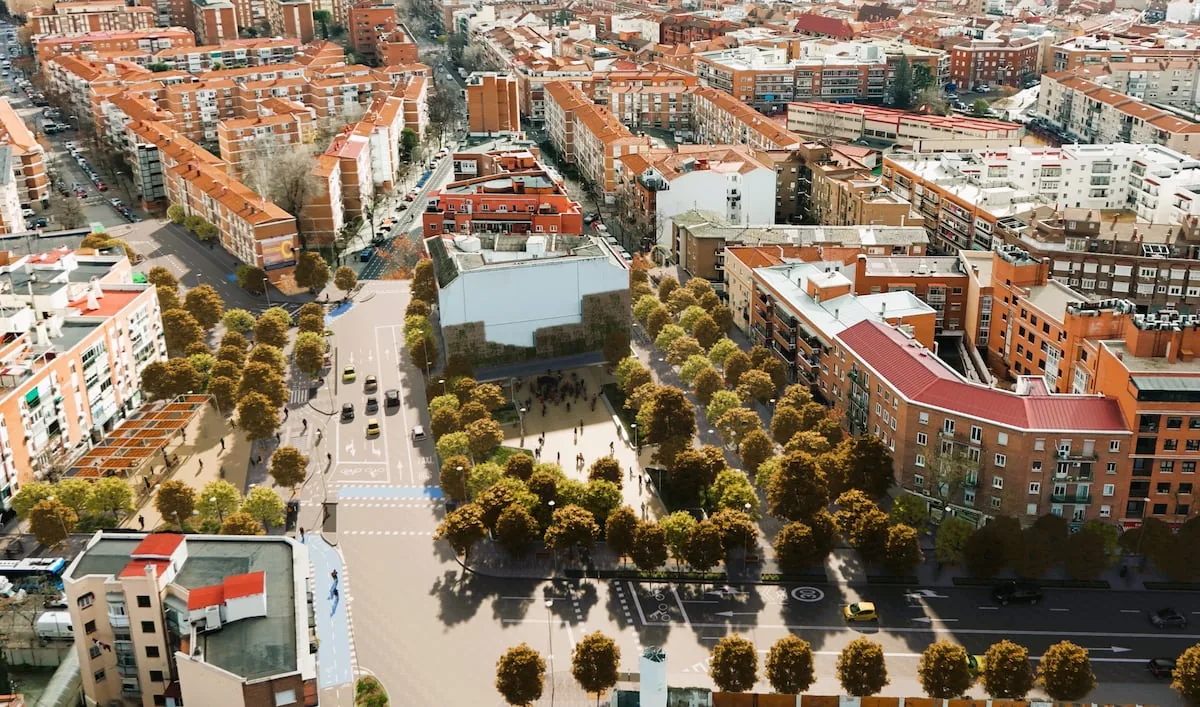
The coexistence between pedestrians and cars is about to change in one of the main transport hubs in the south of the capital: Plaza de Oporto. The Madrid City Council gave the green light this Thursday to a project to renovate the square and its surroundings, which includes, among other aspects, increasing the pedestrian area by 1,443 square meters, planting 110 new trees and more than 3,200 shrubs, and building an ornamental fountain. The work will have a budget of 5.3 million euros financed by the Sures Plan for the development of the southern and eastern districts of the capital and will start this spring to be completed in the second half of 2027.
The reform responds to a historic demand from the Carabanchel district, which called for more space for pedestrians in a square surrounded by traffic. “It is not just another square being remodeled; it represents a major transformation to give it a completely different concept,” said the district councilor president, Carlos Izquierdo, at the press conference following the Government Board meeting. He described the current space as follows: “Plaza de Oporto has two parts, a north and a south, and they do not coexist with each other […] The aim is for it to be the epicenter of all cultural and artistic activity and where major events will be held in the future.”
The actions will be financed through the district’s budgets, which this year will reach 76 million euros. “Until recently, there were two cities; the first thing done was to remove the M-30 to create a large park. Now great opportunities are being built in the south, such as this square. Many opportunities will be generated thanks to territorial rebalancing,” Izquierdo expressed.
The opposition in the Madrid City Council also welcomed the news, but both Más Madrid and the PSOE deny that there is a real commitment to territorial rebalancing by the City Council. “The reform remains aesthetic and does not address acting to solve coexistence and degradation problems in the area, nor have they taken the opportunity to tackle the lack of public facilities in the neighborhood,” criticizes Más Madrid councilor for Carabanchel, Esther Gómez, while criticizing the investment allocated to Carabanchel this year: “It is the second to last of the 21 districts in investment per inhabitant. Barely 42.12 euros compared to 232.81 in Chamartín or 209.38 in Salamanca.”
For the Socialist Municipal Group, the City Council distinguishes between “first and second-class districts.” “In these eight years, in Carabanchel they have barely remodeled one more square than this one, while in Centro we have seen the renovation of Sol, Tirso de Molina, Jacinto Benavente, Plaza del Rastrillo, or Plaza de los Mostenses. That is, there are districts where three or four renovations happen each year, while others seem completely forgotten,” condemns Antonio Giraldo, PSOE spokesperson for Urbanism in the capital.
Read more The singer Miguel Poveda discovers unpublished verses attributed to Federico García Lorca
The works are not limited exclusively to Plaza de Oporto. Intervention will also take place at the Valle de Oro roundabout, Valle de Oro and Juan Francisco streets, a section of Río de Oro and General Ricardos streets, and another of Oca Street, which connects with Plaza de Almodóvar. This area constitutes a strategic enclave that functions as a link between the historic axis of General Ricardos Street and Oporto Avenue. The government led by José Luis Martínez-Almeida plans to establish Oca Street as a connection axis between Plaza de Oporto and the future remodeling of Plaza de Almodóvar, in order to consolidate synergy between two of the district’s most important places.
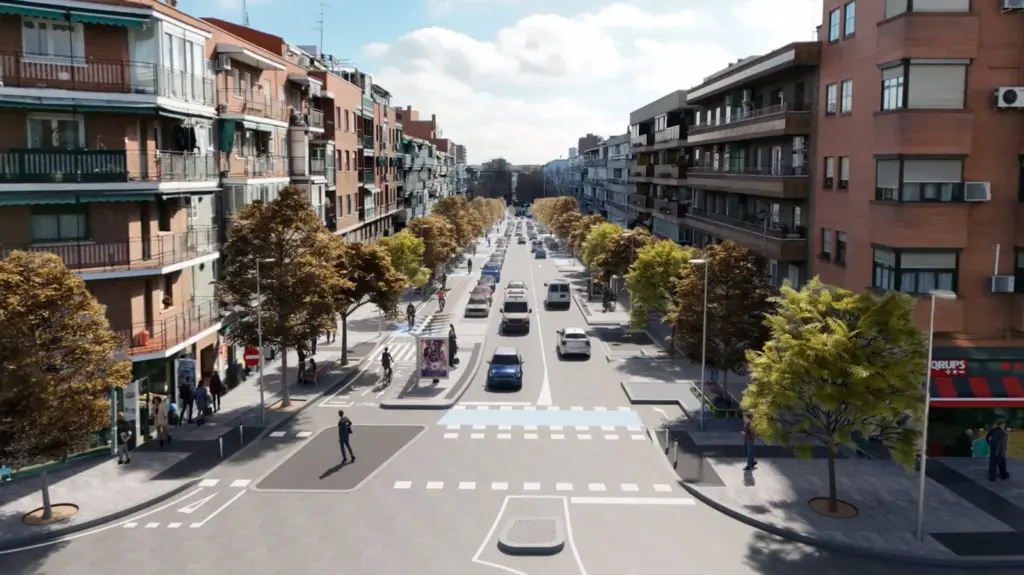
The list of changes includes the comprehensive renovation of the pavements of Plaza de Oporto, which will combine gray tones on the sides and ochre color in the center, as well as the creation of a new ornamental fountain. The existing party wall and the landscaping of the entire space surrounding the central area of the square will also be adapted.
Traffic will be reorganized on Oca Street. On one hand, the roadway will be reduced to one lane per direction, and parking will change from perpendicular to parallel. Additionally, sidewalks will be widened, incorporating flowerbeds and rest areas, and a new two-way bike lane will be added, connecting with the one at Valle del Oro roundabout. On General Ricardos Street, the roadway will be reduced to four lanes in the direction towards the center, maintaining four lanes in the other section, and sidewalks will be widened to gain pedestrian space with new flowerbeds and seating areas.
At Valle de Oro roundabout, the pedestrian area will be paved in warm tones and a two-level pergola will be installed to create a shaded space over the metro station slab. In terms of mobility, the roadway will be reduced to four lanes and the bike lane will be connected with that of Oca Street. Likewise, on Valle de Oro Street, which will maintain its three traffic lanes, only the right sidewalk will be remodeled and the adjacent green area will be redeveloped, equipping it with new street furniture and granite flowerbeds. Juan Francisco and Río de Oro streets will become shared space streets.