









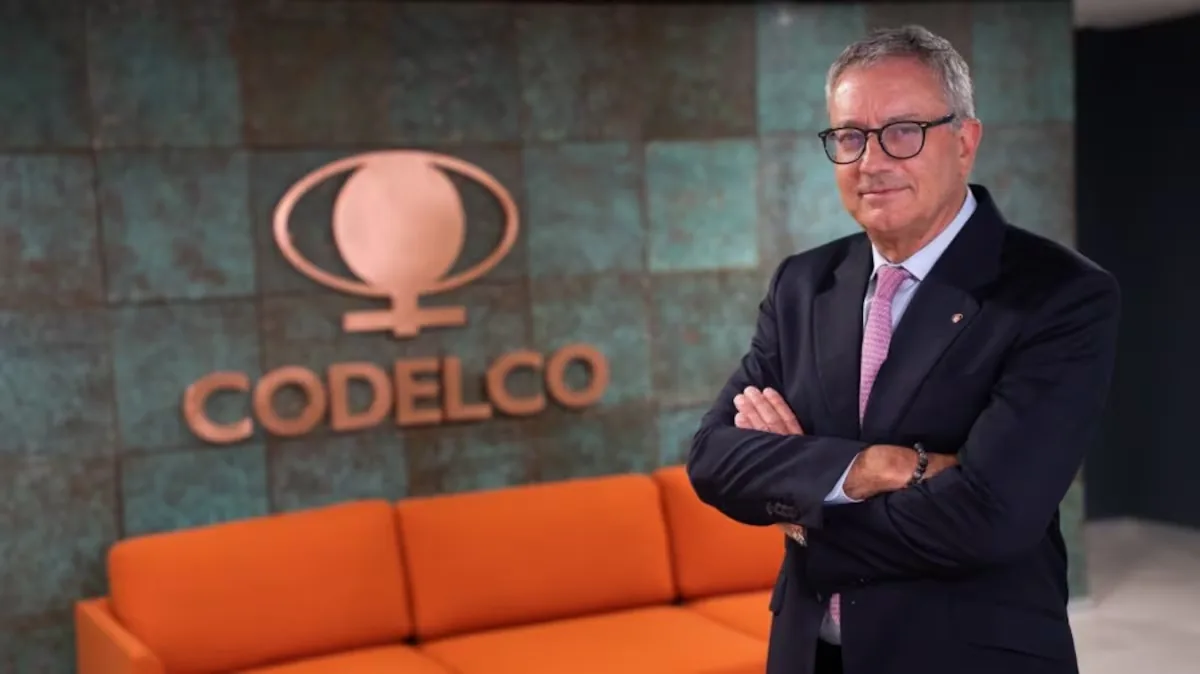
The president of Codelco, Bernardo Fontaine, recently announced that the company will begin to disclose the results and cash generation of its divisions. The initiative points in the right direction. However, the challenge is not only to disclose more information but to present that which allows for a better evaluation of the economic performance of each division and, especially, the investment decisions faced by the state-owned company.
Read more The Argentinian restaurant that challenges employment exclusion after 50
In 2025 it produced 1.334 million tons of its own copper, generated an EBITDA of 6.670 billion dollars, and made investments exceeding 5 billion dollars, the highest annual Capex in its history. Additionally, it reported contributions to the treasury of 1.778 billion dollars. These are relevant figures to evaluate Codelco, but they do not allow for assessing what each division contributes to these consolidated results.
There is financial information by division in the notes to its financial statements and, by associating it with the production figures available in the Reasoned Analysis, it is possible, for example, to calculate the operating result (EBIT) per ton. In 2025, El Teniente generated approximately 3,560 dollars per ton; Ministro Hales, 3,420 dollars; Radomiro Tomic, 2,890 dollars; Chuquicamata, 2,320 dollars; and Andina, 2,150 dollars. Gabriela Mistral and Salvador, on the other hand, showed negative operating results.
The differences are significant. The EBIT per ton of El Teniente was approximately 53% higher than that of Chuquicamata and 65% greater than that of Andina. Furthermore, the production scales are very different: El Teniente produced around 310 thousand tons; Radomiro Tomic, 295 thousand; Chuquicamata, 266 thousand; Andina, 182 thousand; Ministro Hales, 153 thousand; Gabriela Mistral, 82 thousand; and Salvador, 47 thousand. That is, behind the 1.334 million tons produced by Codelco coexist operations with very different sizes and economic results.
But these figures should not be interpreted directly as differences in the performance of the operations themselves. The reason lies in how part of the segment information is currently constructed.
Codelco distributes among its divisions various revenues and expenses managed by the Head Office using allocation criteria. Financial costs, for example, are distributed in proportion to investments in mining projects made by each division; certain commercial operation results are assigned according to their ordinary revenues; the contribution of Law No. 13,196, according to exports; and taxes, based on the results obtained after considering these allocations.
The problem is not necessarily the existence of these criteria. Every organization needs to distribute certain common costs for different accounting and management purposes. The difficulty arises when we want to use segment results to evaluate the economic performance of each division. Part of the result may come directly from the operation and another part from criteria used to distribute items managed by the Head Office.
Read more Latin America Time at the United Nations
Therefore, the progress announced by Codelco could go beyond publishing EBITDA and cash generation by division. It would be advisable to first present the performance of each division before corporate allocations and show the financial figures of the Head Office separately. Subsequently, a reconciliation would allow incorporating those items and reaching the 6.670 billion dollars of EBITDA and the rest of the company’s consolidated figures.
The current information provides some clues. Codelco indicates, for example, that it distributes financial costs according to investments in mining projects made by each division. Therefore, there is a divisional investment base used internally to make that allocation. However, from outside, we do not have a sufficiently direct and comparable presentation that allows systematically relating EBITDA, cash generation, and committed resources in each division.
This matters because Codelco simultaneously faces the challenge of recovering production, executing large projects, and managing high debt. Investment decisions should not be evaluated only by asking how many additional tons they will allow to produce. We must also know how much result and cash they will generate and what amount of capital will be necessary to obtain them.
Probably Codelco internally has much of this information. The problem lies outside the company. If we want to properly evaluate its decisions, we need to move from mainly knowing consolidated figures to understanding the financial figures of each division.
The announcement of greater transparency by division is an important step forward. Having this information will allow evaluating from outside not only how much each division produces but how much result and cash it generates and what resources it needs to do so. In a company with great investment needs and high debt, making these differences transparent would allow better evaluation of one of the most relevant decisions Codelco faces: where to allocate its capital.
Read more The Congress elects a National Electoral Council favorable to De la Espriella