






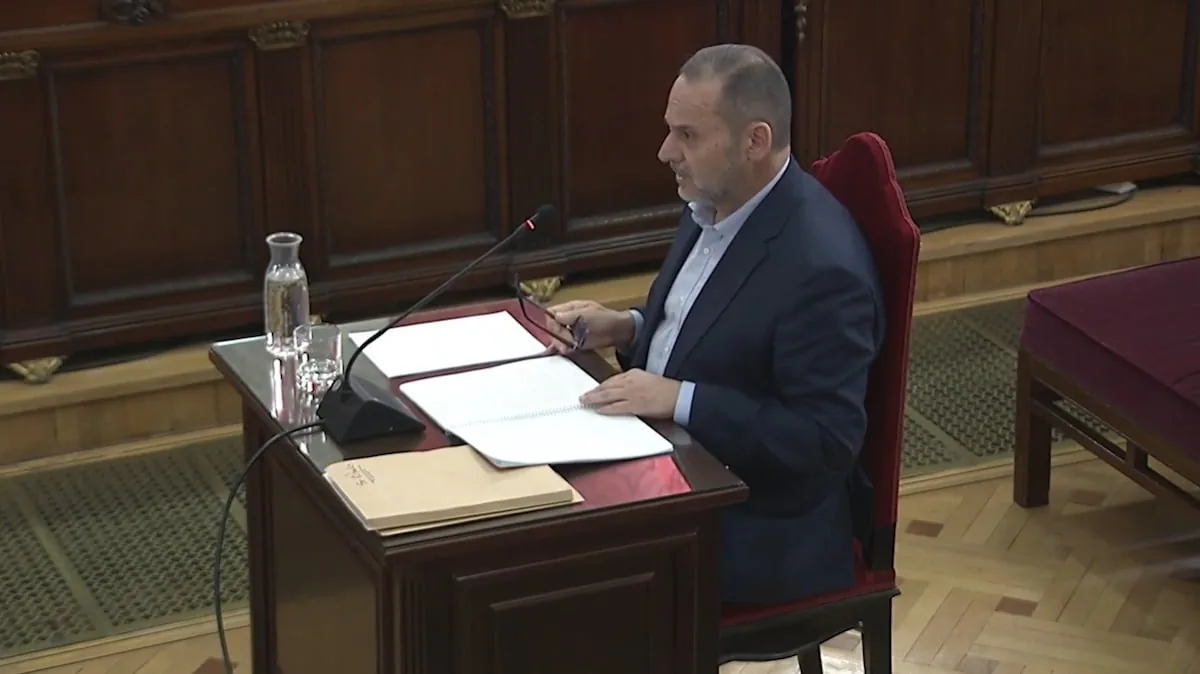
If the walls of the Supreme Court’s Plenary Hall could speak, they could recount tragic episodes in Spain. There, appeals against the verdict of the attempted coup d’état on February 23rd were seen, as well as the trial of the kidnapping of Segundo Marey—the first action attributed to the GAL—or the standoff between the State and the leaders of the procés independence movement. But, probably, never before had those walls, so draped and solemn, witnessed a mix of vaudeville and grotesque signs of public-private collusion like those narrated in the trial for the rigging of mask contracts during José Luis Ábalos’s tenure at the Ministry of Transport. The Anti-Corruption prosecutor emphasized this in his final report explaining why he demands such heavy sentences for Ábalos and Koldo García (24 and 19 and a half years in prison, respectively). “Political corruption is eating away at our democratic system, and only a strong reaction against it can stop it,” stated Alejandro Luzón, who tried to convince the court that the former minister, his advisor, and businessman Víctor de Aldama formed “a true criminal organization” whose goal was to obtain a benefit “under the cover of the position Ábalos held.” The defenses of the former minister and his advisor have requested acquittal and criticized the lack of evidence against them, while Aldama’s defense has asked for a greater sentence reduction and defended the importance of his cooperation.
The first trial of the Koldo case was concluded this Wednesday after 14 sessions in which more than 70 people testified, including public officials, civil servants, businessmen, experts, civil guards, and associates of the accused. The hearing was closed by Ábalos and Koldo García, who, unlike Aldama, chose to exercise their right to final words. They used this opportunity to launch a harsh plea against the investigation and judicial proceedings that put them on trial.
The former minister complained that he has never enjoyed the presumption of innocence because there was always a “presumption of guilt” against him, and when he had to testify, he felt that his answers “didn’t matter” to the investigators. Ábalos also reproached the Supreme Court and the Prosecutor’s Office that when they offered him to cooperate with justice, it was assumed he had to confess crimes. “What is then understood by collaboration? Is it confession? If the hypothesis of guilt and confession as the last phase of the process are combined, then this is an inquisitorial process,” Ábalos stated. “I am judged more as a person than for facts,” expressed the former socialist leader, who presented himself as a victim of “a general cause” in which, after much searching, only two temporary contracts for women linked to him were found. “Everything I am reproached for are two contracts and because they are two young ladies,” he said before addressing Aldama without looking at him: “What harm could I have done to deserve so much ill will?”
The former ministerial advisor used his final turn to accuse the PP lawyer of having offered him that the case would amount to “nothing” in exchange for “deceiving all Spaniards,” a claim later denied by the party. The popular party’s lawyer, who leads the popular accusation, also suggested, according to García, that if he did not agree to confess (“lie,” according to the former advisor), his ex-partner and brother, both charged in the National Court, would also end up in jail. And that is what, he claims, the businessman has accepted. “Aldama is living at all our expense because he put Ábalos and Koldo García in jail with lies, and this is a reality, it is the only truth. Because the only one who has companies outside Spain, living at the expense of all Spaniards, is him, not me,” lamented the former right-hand man of Ábalos. The former advisor insisted that during his time at the ministry he dedicated himself to trying to “help” anyone who asked, including Aldama, but he never took money. “Gentlemen, I guarantee that what I say I can prove. I have no money, I have not received any bribe, I have worked myself to death. Aldama knows this; the issue is that he chose the easy path.”
The oral hearing did not move an inch from the position each party arrived with, except for the PP lawyer, who considers that Aldama’s cooperation to clarify the facts deserves a greater reward than the seven years for which Anti-Corruption has set the sentence it requests for the businessman. The popular accusation has argued that the mitigating factor of confession should be applied in a highly qualified degree and that none of the crimes should be punished with more than two years in prison, which would open the door to avoiding incarceration.
The prosecutor maintained the request for seven years for the commission agent but did not oppose the option proposed by the popular accusation and left the decision in the hands of the court. Luzón, in an intervention lasting almost two hours, defended that the commission agent’s help was decisive in advancing the investigation, although he acknowledged that the businessman embellished his confession with unproven accusations that deserve no credibility for the Prosecutor’s Office. “Certainly, the president of the Government was not number 1 as Aldama confidently attributes that role to him,” Luzón stated regarding the accusation of Pedro Sánchez made by the accused in his testimony before the court last week.
Anti-Corruption and the popular accusation have tried to demonstrate during the trial that Ábalos, García, and the businessman activated a machinery of favors where the first two put their power and influence at Aldama’s disposal in exchange for monetary and in-kind compensation. Each had an “essential” role, explained the prosecutor, who recalled that although Ábalos tried to place himself in a more passive than active secondary role, the minister is “the person on whom decisions depend,” and his actions were indispensable to fulfill the objectives of the scheme. For the material execution of the crimes, the then minister counted on “the very loyal” Koldo García, while Aldama was, according to the public ministry, “the person who, for his own benefit and that of others,” took advantage of the influence of the minister and his advisor. “He was the driving element,” Luzón affirmed.
“Abundant, overwhelming” evidence
Against the doubts expressed by the defenses of Ábalos and Koldo about the lack of evidence to convict them, Anti-Corruption maintains that the evidence presented at trial has been “abundant, truly overwhelming.” The prosecutor considers that not only have facts such as the placement of women linked to Ábalos in public companies or that the former minister and his circle enjoyed houses paid for by businessmen been proven, but also that Aldama delivered 10,000 euros per month between 2019 and 2022 to his now co-defendants. Luzón highlighted the fact that the businessman himself has acknowledged this, “admitting the commission of a serious bribery crime,” to which the prosecutor adds the periodic meetings between the commission agent and Koldo García or his brother Joseba; notes in which Aldama recorded as an expense 10,000 to K. or to “grandu,” as they called the ministerial advisor; conversations between businessmen discussing payments to Koldo; and the asset increase of the advisor and his family.
For Anti-Corruption, the justification given by the defenses for each of these pieces of evidence is “insufficient” and “so childish that it is between pathetic and moving.” Luzón criticized the lawyers’ argument that there is no trace of the money supposedly obtained from kickbacks and addressed Ábalos directly, who in his testimony focused on the 94,000 euros of unexplained expenses found by the UCO in his accounts as all the investigators have on “the great mask corruption case.” “We know that Ábalos does not need his accounts to meet his needs, and Koldo is shocked that more than 400,000 euros were spent in two years,” pointed out the public ministry representative, who even left a summary of his thesis in a folkloric version: “Where does he get pa so much as he stands out?” he said, quoting the cuplé La chica del 17.
Ábalos and Koldo García followed the prosecutor’s intervention attentively, taking notes, shaking their heads, and continuously getting up from their bench to talk with their lawyers sitting in front of them. Both defenses denied in their interventions the existence of the criminal organization seen by the accusations and admitted by Aldama, whose lawyer, former magistrate José Antonio Choclán, rejected that it was the businessman who approached the minister and his advisor to corrupt them and defended that it was they who integrated him into the network they had begun to weave, with the participation of Santos Cerdán (charged in one of the cases investigated in the National Court), before Ábalos arrived at Transport. “It is not that Aldama tries to bend the will of a public official, but that the official seeks an Aldama,” Choclán explained, who maintains that “there were other Aldamas” in the Basque Country or Andalusia, referring to businessmen charged with alleged commissions in works awarded by Transport in those communities.
Ábalos’s defense rejected this version, recalling that the businessman himself stated in his testimony that he began to deliver favors to the minister and his advisor as a kind of “sowing” to later reap fruits. “Who was trying to penetrate the organization? The boss, who acts proactively to obtain contracts, is Aldama,” noted lawyer Marino Turiel, evoking the thesis of the UCO lieutenant colonel who declared that the commission agent was “the boss who paid and demanded.”
The lawyer also explained why, on the first day of the trial, he, gentle and courteous in manner, asked Jésica Rodríguez if she was engaged in prostitution, an intervention that hovered over the entire hearing and was reproached by the popular accusation and Aldama’s lawyer. The defenses of Ábalos and Koldo have strived to demonstrate that it was the businessman who introduced them to Jésica, a detail to which Anti-Corruption does not give importance, but which for the lawyers does because it supports their theory that the woman was “Aldama’s hook” for the then minister. And that is why, Turiel reasoned this Wednesday, the businessman paid, through his partner Luis Alberto Escolano, for the apartment where Rodríguez lived for almost three years, and even continued to cover the rent after the sentimental relationship with Ábalos ended. “Who is interested in this girl still being there?” asked Turiel. “It is not about disparaging this woman but about establishing a commercial relationship [with Aldama].”
The lawyer, with an orderly and meticulous presentation, defended the legality of the mask contracts and that “there is no trace” that Ábalos received commissions. “The minister does not intervene in the contracts; there is decentralization, and the purchase lies with Ports and Adif. There is a distinction between who signs the ministerial order and who contracts, and it is fundamental because the one who contracts has the decision of to whom, how, and at what price,” the lawyer explained. Ábalos acknowledged in his testimony that he was the one who raised from four million to eight million the number of masks that Ports bought from the company linked to Aldama but maintained that it was a “political decision” based on the technicians’ estimate of the amount necessary for a month. Turiel expanded on this argument defending that it was “a legitimate political decision.”