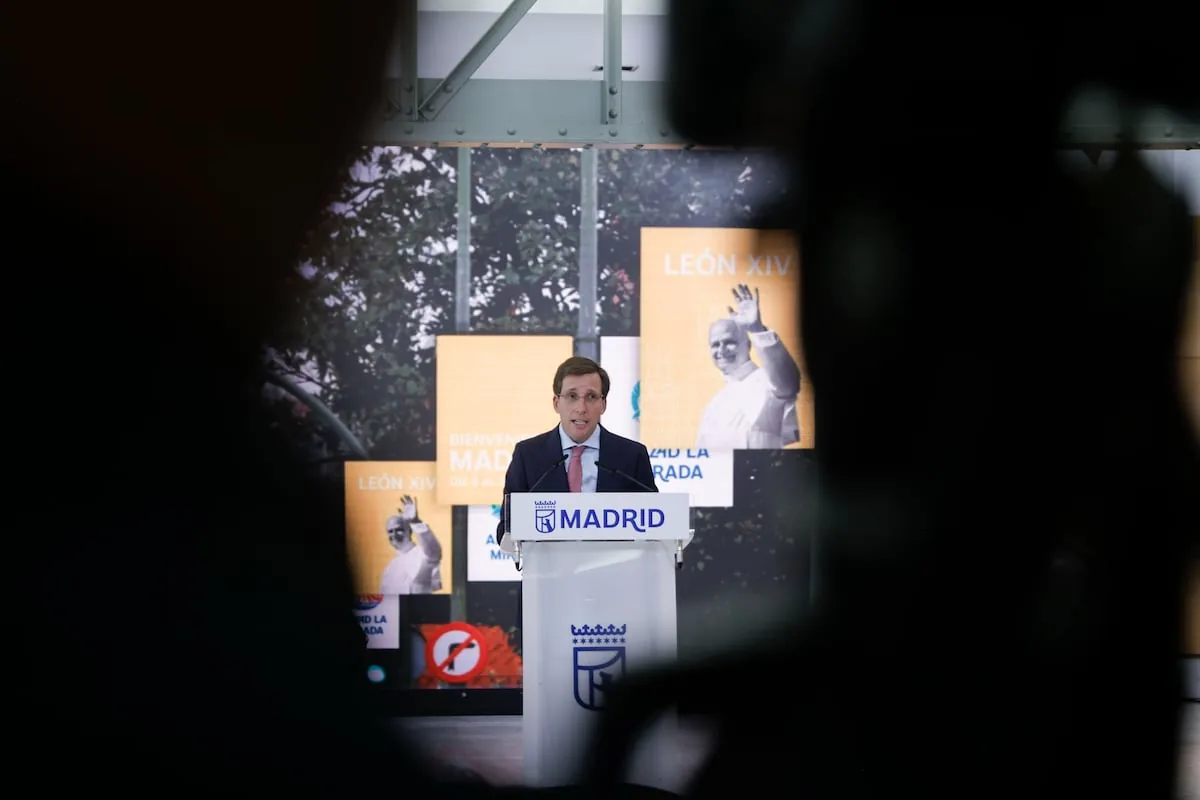
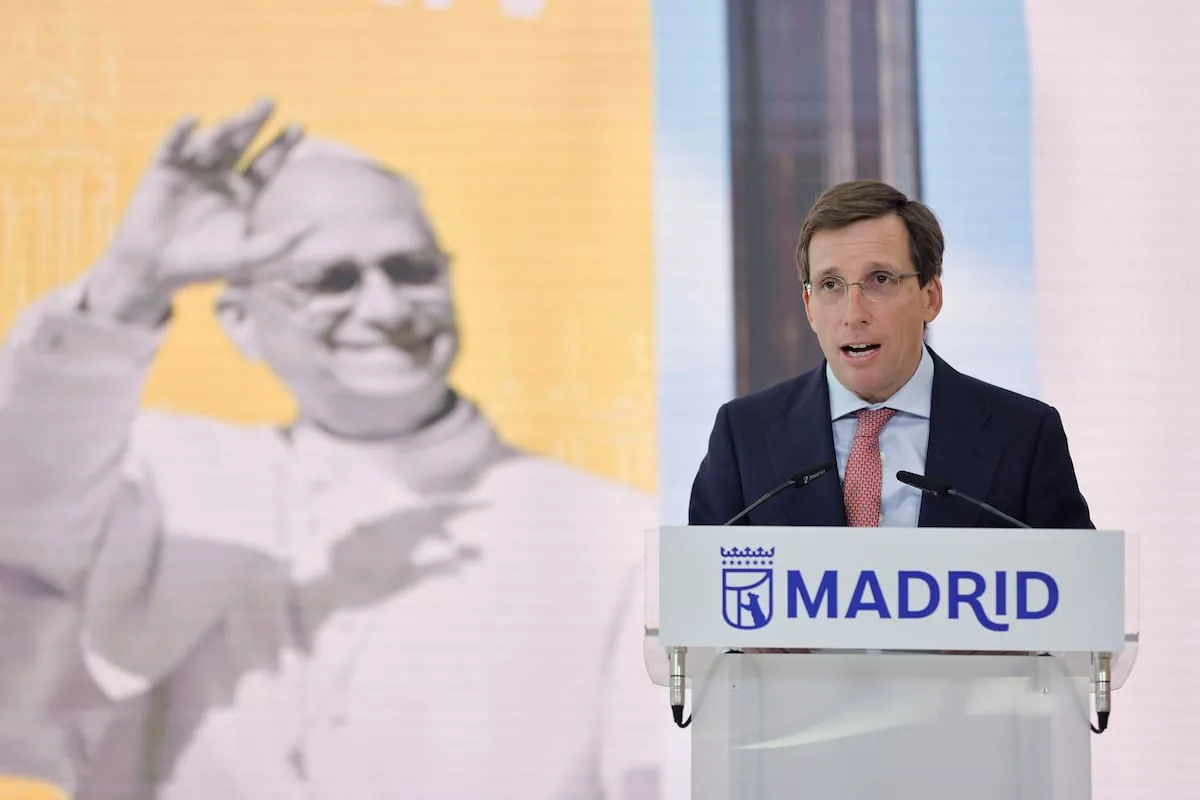
Two “very complicated” and “very difficult” weeks are expected for those living in Madrid or just passing through. The Pope’s visit will cause traffic cuts in the 10 days prior to his stay in the capital ―from June 6 to 9― and the two days after his departure, announced this Thursday the mayor, José Luis Martínez-Almeida (PP). The most affected places will be Plaza de Lima, in front of the Bernabéu, and Plaza de Cibeles, where a large mass is to be held with an expected attendance of one and a half million people. The two roundabouts in the city center, with heavy vehicle traffic, will be sealed off starting June 3 and 4, and cars will have to go around them to circulate. Even so, partial traffic cuts start this week and will last for 15 more days. “We are all going to be affected here,” Almeida predicted.
Read more Covite denounces two new “fraudulent” permits granted to ETA prisoners by the Basque Government
The logistical demands of the visit of Leo XIV, the mayor pointed out, “have no precedent” and are “of a greater dimension than those of NATO.” There are more days, with massive attendance ―more than 500,000 people are expected at the youth vigil― and large delegations. The plan, Almeida explained, is designed for even greater attendance than expected, but he warns Madrilenians that it will be two especially difficult weeks and asks for patience. Although the pontiff’s stay will alter the day-to-day life of the capital as a whole, the Castellana-Recoletos axis will be the most affected, with Plaza de Lima and Plaza de Cibeles as the center of the cuts, which will be progressive.
Cibeles and Lima, critical points
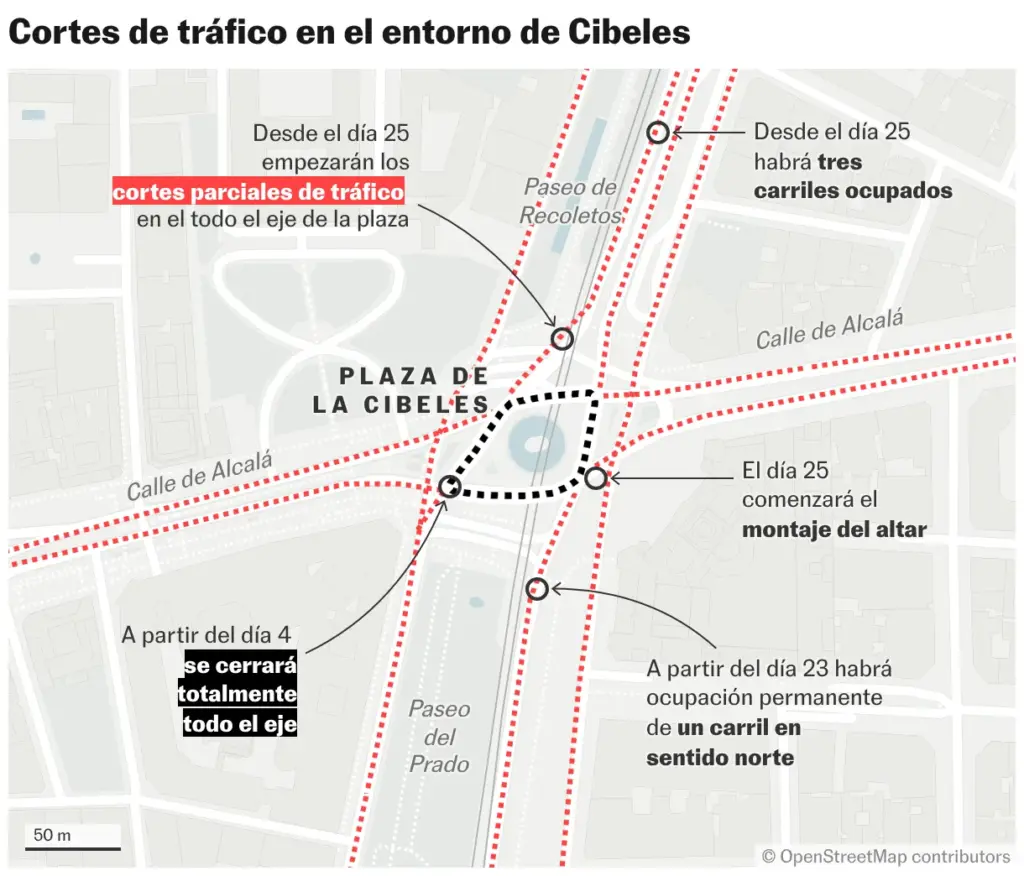
In Cibeles, the disruptions begin this Thursday, with the loading and unloading of materials to set up the stage. The roundabout will be gradually sealed off. On Saturday, May 23, the right lane of Paseo de Recoletos heading north will be permanently occupied, and two days later, the bays for night buses and three more lanes will be occupied. The choir for Sunday’s mass will be installed there. The total closure of the square will be on Thursday, June 4. From that moment on, vehicles will have to go around it.
The second key point is Plaza de Lima, right in front of the Santiago Bernabéu stadium. Starting this Thursday, the left lane of Paseo de la Castellana heading north will be closed from Plaza de San Juan de la Cruz to Raimundo Fernández Villaverde. On the 25th, all the central lanes of the Castellana at this square will be occupied, and vehicles will be able to circulate through the central lanes up to the roundabout. Once there, they will have to divert to the side lanes. The total closure will be on Wednesday, June 3, and from then on no car will be able to access. “This is the solution we can offer at this time so that there is no collapse during those days,” Almeida pointed out.
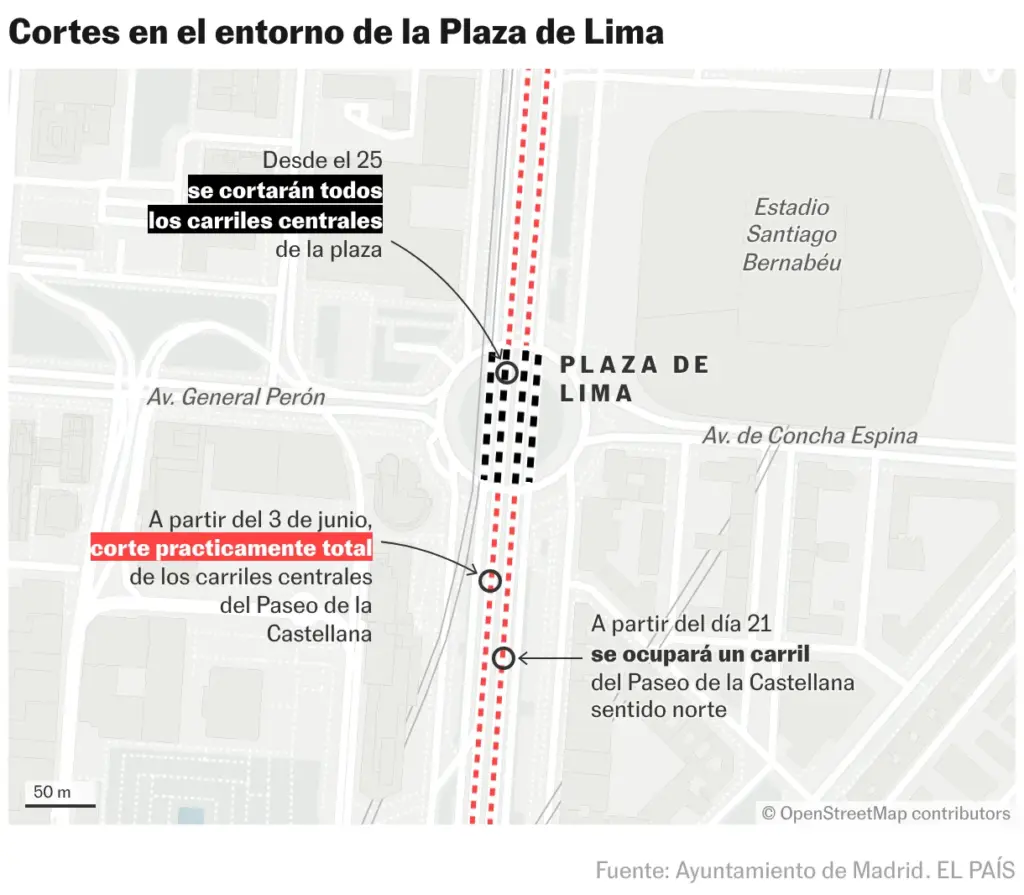
The mayor has indicated that, in principle, the Castellana-Recoletos axis will not be closed to traffic; cars will be able to continue circulating, although as the days of the visit approach, they will encounter more and more cuts at the accesses to Plaza de Lima and Plaza de Cibeles. The critical days will be the 6th and 7th, when the youth vigil and the mass are held. Attendees will occupy much of the streets converging at the two roundabouts and then traffic will be cut not only in the squares but in all the space being occupied: “It will be possible to circulate along Paseos de Recoletos and Castellana, although it is true that it will be complicated if the squares are completely closed.”
“The route we recommend using during those days is the M-30, it will be the best alternative to avoid the disruptions that will occur. We are working with platforms like Google and Waze [GPS navigator] so they can update traffic information in real time,” the mayor detailed. Residents living in the most affected areas, Almeida warned, will be able to access their homes by car, but “with difficulties at certain times and especially from June 4 in Cibeles.” He recommends, as much as possible, not to use them.
Read more Chess analysis | Karpov turns 75 years old
To encourage the use of public transport ―“the key element”― Almeida announced that EMT buses and Bicimad will be free between June 3 and 9, the day the Pope heads to Barcelona, his second stop on the visit to Spain. He has also “strongly” asked companies in the area to facilitate teleworking and flexible hours, as the Government Delegation in the Canary Islands has done. On those dates, municipal employees will not have to attend their workplaces in person. “All of us living in this city, whether inside or outside the M-30, will be affected. There will be alternative routes [such as Santa Gracia, Bravo Murillo, Joaquín Costa, Francisco Silvela, Velázquez or Serrano] to compensate for the problems along the entire Castellana axis,” the mayor added.
For now, the device that the Community of Madrid will implement and what disruptions will occur in the metro are unknown. It is also unknown what traffic cuts there will be in other locations the pontiff will visit, such as the Cáritas center in Lucero. The mayor has indicated that for security reasons they cannot provide exact itinerary data, but wherever he goes —the idea is that he mainly travels in the popemobile— there will be punctual traffic cuts.
Park and ride lots and 33 sports centers for sleeping
The City Council will establish park and ride lots for buses arriving in the city. They are located in Ifema, Valdebebas, Ciudad Universitaria, Casa de Campo, Caja Mágica, and Planetario, and shuttles will be available to take people from those areas to central points.
Also, 33 sports centers of municipal educational centers in 15 districts of the city will be offered so that the faithful can spend the night and avoid camping out in Cibeles or nearby areas, such as El Retiro. “We ask them not to stay overnight to save a spot for the mass, because it poses a significant organizational problem,” Almeida said. Once the day of the big mass arrives, the City Council will establish several access and stay points, like at a music festival, where both people registered for the events ―who will be assigned a specific sector― and those who have not registered and attend the Eucharist that day can go. The goal is to control the flow of people as much as possible.
During the days Leo XIV is in the city, there will be 4,000 police officers and 1,000 health personnel to cover all scheduled events.