










The crime fiction reader doesn’t need excuses to read: winter, summer, before and after the book fair in their city, whenever and however. But perhaps in these weeks we have a bit more time, so I have spent mine glimpsing among the new releases something that could satisfy the readers of this blog. The selection ranges from some lesser-known books by Agatha Christie, now that we are celebrating her centenary, to beach thrillers with their doses of excitement, passing through a couple of discoveries, a genius of spy novels, and some really good stories. Plenty to choose from, always read thoughtfully and analyzed. Along the way, titles you have seen on bookstore shelves have fallen: some, due to lack of time; others, because here we recommend what we like and is worthwhile. According to my criteria. Come in, read, and enjoy. See you in the bookstores.
Read more The many faces of the clever Ulysses
Different, excellent, highly recommended
Las almas feroces, Marie Vingtras (Nórdica, translation by María Teresa Gallego and Amaya García). The genre reader will know what I mean when I say that with some books you know from the start that you are on safe ground: there are characters, a story, a voice, a place. The book is divided into four parts, one for each season of the year. In spring, we encounter the strong and unpretentious voice of Sheriff Lauren Holber. We are in the USA, although the author is French, but this, against all odds, does not feel forced. A young woman named Leo has died, a girl who wanted to get out of the rural hole where she lived. With a structure divided into four parts, each corresponding to a season, the author tells the story from four points of view: the aforementioned sheriff, the professor, the student, the father. There is a tone for each and nothing clashes. She also uses them to manage the information so that the reader arrives near the end with fairly clear ideas about much of what happens in that town but without knowing Leo’s killer. It is found out, don’t worry, but that is not the important part. After a heartbreaking ending, many questions remain to be answered, as in good stories. And she renounces the pretension of telling everything, of hanging on that peculiar and narratively profitable sheriff and writing twice as much. This is appreciated in a world of 400-page books that say nothing.

La mano que mueve los hilos, Miyuki Miyabe (Salamandra, translation by Maite Madinabeitia). A new success from the Japanese mystery factory, which we like so much here. For those familiar with it, this would be a book with ingredients from El asesinato de los Aosawa (investigation within the investigation, true crime, metalanguage, etc.) and the monumental 64 by Hideo Yokoyama (careful procedural, panoramic and rigorous view of police work, a wide cast of well-defined law enforcement characters…). And yet, it does not resemble them. The story is as follows: the discovery in a park of an amputated arm and a woman’s purse belonging to a young woman who disappeared weeks before unleashes a feverish police activity. On the other hand, a journalist looking for the long-form story that will finally vindicate her sees in this case, perhaps related to others, an opportunity. In the middle, the victim’s family, so well portrayed by Miyabe, which is one of her main virtues here: we advance riding a very good police story, but she does not forget the soul of her characters (heartbreaking in his grief and dignity is that tofu-selling grandfather), described with care and emotion. She also knows how to look with pulse inside some of the many police officers who populate the story. There is one more element: the boy who found the arm is, in turn, a victim of a heinous crime. The two narrative paths find a link: someone smart and ruthless is playing with the victims. Is there a serial killer behind? The book is part of a huge project in size and ambition that unfolds over five installments. In Japan, the public endorsed a story with literary flight. In Spain, it has started very well. Four remain, and that is a lot of good reading time for those who dive in. Dare to try.
Make room for Mrs. Christie…
In 2026, the calendar is full of anniversaries about the great pioneer. It has been 100 years since the publication of The Murder of Roger Ackroyd (the novel that changed almost everything) and 50 years since her death, among other things. No excuses are needed, but here are two very good ones. The books I bring are a bit different from Christie’s canon (Death on the Nile, Murder on the Orient Express, and others), the best known and adapted, but they are stories that explain much about the best-selling author of all time.
Curtain, Agatha Christie (Espasa, translation by Alberto Coscarelli). Poirot’s last adventure but not the last Christie wrote. In fact, she finished it during World War II and kept it in a safe to be published posthumously. It finally came out in 1975, a year before her death, but the important thing here is the control she shows over her work: after writing it, she still published 12 novels with the irritating Belgian as protagonist and three collections of stories. And everything fits without any flaw. The book itself is brilliant. We return to Styles, where Poirot’s first novel took place, and Captain Hastings returns, the detective’s squire who here takes a more prominent role. Poirot is tired, old, in a wheelchair, but still brilliant and prickly, bien entendu, as he would say. The plot is simple in its premise and devilish in its development: Poirot knows that among those gathered in the house is a murderer and presents it to Hastings, who must discover who. Again, the portrait of that declining upper-class society is wonderful (there is always a great lady of the house, someone to suspect among the servants, a retired military man, a handsome rogue, some blackmailer… etc.). Here a very strong character is added: Judith, Hastings’ daughter, a female character ahead of her time. Espasa is doing an excellent job publishing the vast work of the English author. This is part of that collection with soft-textured covers and rounded edges. A sensory pleasure added to the literary one. But they have also released pocket books like the next one we discuss. Hastings says at one point: “I finished going down the stairs, still reflecting on how sad life would be without Poirot.” We, dear readers, do not have that problem.

The Mysterious Mr. Brown, Agatha Christie (Espasa, translation by C. Peraire del Molino). A novel published very early in the English author’s career (1922) that will unsettle many readers. Thanks to her discipline and imagination, Christie completed 80 mystery novels, dozens of stories, and about thirty plays, so it is not always easy to navigate her bibliography. Here we find an adventure and espionage novel starring a very peculiar couple, the young Tommy and Tuppence, whose relationship has always puzzled me. They have to recover secret documents from World War I lost after the sinking of the Lusitania and prevent a group of criminals controlled in the shadows by the Bolsheviks from getting them. The international political keys are measured to the millimeter and well documented, but here the important thing is fun. Tommy and Tuppence live all kinds of adventures and the novel always walks the edge of the improbable. However, it is easy to get caught and follow the author’s advice in the initial dedication: “To all those who lead a monotonous life, hoping they can enjoy the dangers and delights of adventure.” Amen.
…and two of her disciples
The Deadly Question, Janice Hallett (Ático de los libros, translation by Claudia Casanova). Those who regularly follow this blog already know that we are part of the club of die-hard Hallett fans. Beyond labels (the Agatha Christie of the 21st century, for example), we have a very funny author who challenges herself and us with each novel. Ático de los Libros is doing a great job in editing and translation. What do we find this time? A guy writes to a producer trying to sell a true crime story: the mystery around a pub closed tight overnight. The owners were his uncles and have disappeared. The place was part of a circuit of establishments where quiz contests much loved by the British were held. What happened to them? Where have they gone? That is what Hallett reconstructs with her usual style mixing text messages, emails, statements, reports, and other formats. Her skill in adapting tone is only matched by her fine sense of humor. There are two or three time frames, a couple of dozen characters… and yet the reader doesn’t even notice, the reading flows. However, far from sticking to a formula that works, on page 149 she gives a surprising and effective twist and, always with that hybrid format, it becomes a particular police story. Don’t think the matter withers: the novel advances in big steps, a laugh here, an essential discovery about some character there (trust no one). And there are absolutely hilarious dialogues. If you want a complex mystery but one that doesn’t take itself too seriously, this is your book. The ending, after the author makes several jumps and lands on her feet, is consistent with the quality and fun of the whole. If you liked it, and I am sure you will, then continue with The Twyford Code or The Appeal.
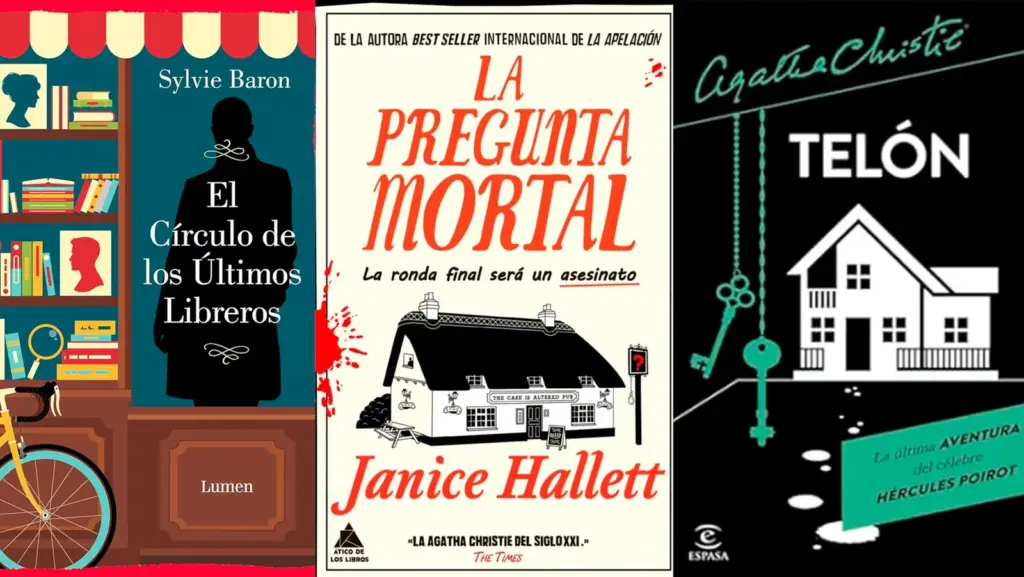
The Circle of the Last Booksellers, Sylvie Baron (Lumen, translation by José Antonio Soriano). This French cozy crime author brings us a delightful story for the summer. A sports journalist turned crime reporter (curious coincidence with the extraordinary The Truth of Walter Andretti by Antonio Manzini, a superb noir novel) has to investigate three deaths among the members of a peculiar booksellers’ club. The contrast generated by this little-read man in a world of literature fanatics is treated with intelligent humor; first point in favor. Each bookseller has died in a different way and the police do not believe it is a wave of murders of independent booksellers, but you know, in a cozy crime almost anything is possible as long as it is plausible. And here we have an expert. If you are bookstore visitors, you will find similarities with several profiles of readers and booksellers portrayed here with finesse. There is a romance, of course — what would this genre be without love? — and a good group of suspects that gradually gets entangled. The resolution, in Poirot style, with everyone gathered before the brave investigator to unravel the mystery, works well. And it ends well (if we forget the dead) because this subgenre is like that. Oh, and the key to the plot is copied from one of Ed McBain’s most famous novels but, what can you do, everything is invented. A pleasant read for summer.
A gem of espionage
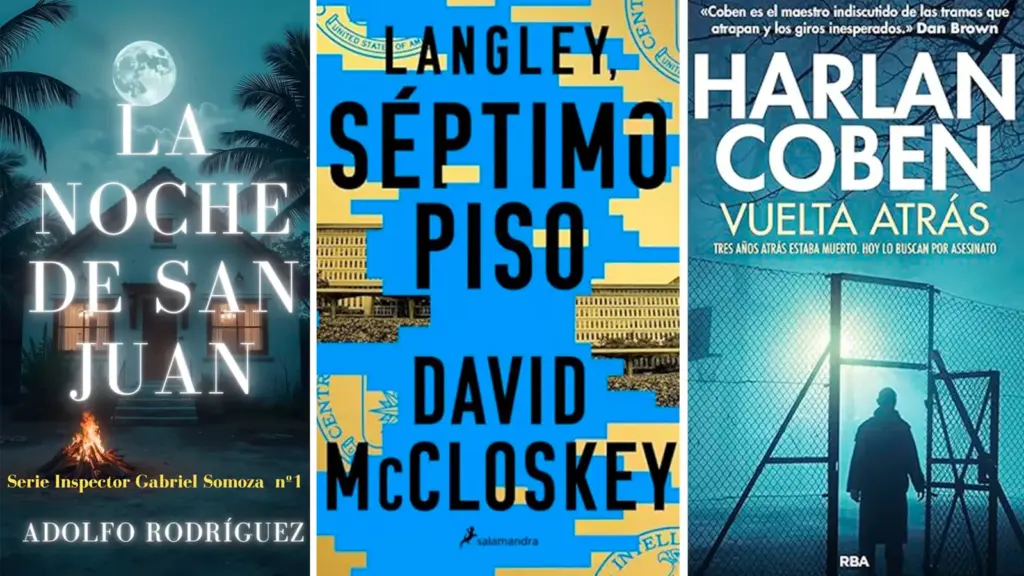
Langley, Seventh Floor, Dave McCloskey (Salamandra, translation by Jofre Homedes Beutnagel). Sitting down with a McCloskey book is doing so with one of the best authors in the genre today, as he already showed in Damascus Station and Moscow X, also published by Salamandra. In different settings and stories, the three novels are united by the presence of Artemis Procter, an unclassifiable and extraordinary CIA agent who in this case reaches an unprecedented height. The novels, in any case, are part of the same universe (the one built with pulse by this former CIA agent) but can be read independently. What do we find here? A John Le Carré The Spy Who Came in from the Cold but in the United States. Indeed, the daring Procter detects problems in the CIA and, specifically, in the ruthless division against the Russians just before her bosses arrange to fire her, which only confirms her suspicions. Here begins a fierce and rigorous but unconventional investigation in which Artemis must suspect all her former colleagues, friends with whom she has killed and almost died, because among them is the mole, the traitor, the poison that has set out to destroy the Agency from within. She is accompanied by Sam Joseph, a character with classic traits, a guy who falls into the Russians’ nets and returns from prison and torture shattered. He is not the only one. The handling of the narration, the memories that make us understand the pain Procter feels as she approaches the truth, the camaraderie, the madness of this woman who when not spying is a monitor in an alligator theme park but, above all, the passion and rigor with which McCloskey treats the world he belonged to make it an exceptional book. If you don’t have enough, I recommend the podcast The Rest is Classified, where McCloskey, along with journalist Gordon Corera, reviews with pulse and top-level information some of the best cases in espionage history.
Two pure ‘thrillers’
Backtrack, Harlan Coben (RBA, translation by Antonio Lozano). This is the book I listened to as an audiobook, through Audible, read by Jordi Brau. By now I suppose more people know Coben as the creator of Netflix clone hits, but the American author was before the platform explosion a well-known noir author. And he continues with the series that gave him fame: that of investigator, lawyer, and agent of professional athletes Myron Bolitar. This one is the tenth of a total of 12 that Coben has written since the mid-nineties and catches the character at an interesting point. Let’s see, Bolitar is one of those larger-than-life beings: former NBA player whose career was cut short by injury, successful hustler, ladies’ man, sharp investigator, man gifted for action… and so on. But this story is at an ideal moment. Here appear his ex, his former secretary, his old main rival and best friend, his current partner and millionaire friend… that is, anyone wanting to try their luck does not have to read the previous nine, just start with this one and in 20 pages will be fully in Bolitar’s world. Those who know Coben from Netflix will know he has a certain taste for luxury. Here there is that too: private planes, big houses, offices with views of Park Avenue. Ah, but what is this about? Let’s see. Bolitar has to clarify how that best friend and main rival from the past (the man we mentioned a bit above) has been able to kill three people if he has been dead for years. First he disappeared in Asia, then his death was notified, and finally, he was buried with honors. Now he is a murderer. Imagine the mess. On the other hand, it intersperses chapters with the description of meticulous murders, committed by someone we do not know and with whom I was not able to identify among the main characters until the end. Coben knows what he is doing, so the tangle is perfectly developed and keeps surprising. In the end, justice is done and the next adventure is prepared, although Bolitar will never be the same. A book that will not change your life, but very entertaining, written by a professional.
St. John’s Night, Adolfo Rodríguez (Grijalbo). First installment of a trilogy by this author who comes from the Amazon world and is a nursing professional (completed with Night of Secrets and Night of the Storm, also at Grijalbo). Within the category of thrillers that seek to exploit the most commercial side of the market, I have found several strictly unbearable ones, that is, even knowing what I was looking for in those books. It is obvious that not everything has to be Michael Connelly, but there are a series of red lines related to respect for the reader’s intelligence. Let’s go with the book at hand, which does not cross any of those lines: a police inspector on leave, destroyed by the loss of his wife and daughter in an accident, arrives at his parents’ beach house hours before the lockdown is declared in March 2020. From that stay with sea views, the last tenant disappeared months ago, a shady man who leaves puzzling clues in the chalet, clues that pull the protagonist’s curiosity. He returns to the police with his former partner, they take charge of the case and start investigating: in that neighborhood, everyone has something to hide and almost everyone knows something they shouldn’t about other neighbors. The investigation unfolds during the pandemic, which the author uses to extend certain investigative processes with a plausible excuse. The narration is approached from this present so typical of the genre nowadays, a choice that makes everything seem like the bible of a character, almost the prior work, very descriptive, as if they were preparing a treatment for a TV adaptation. At the end of the first part, the investigator believes he has solved the crime, but there is no spoiler possible because the reader does not discover it. Then in the second half, he dismantles the mechanism and explains, classic author trick included, how everything was possible. In the end, every piece fits, there are no nonsense, no gore, no embarrassing scenes (you will say, of course, that would be the last thing, but you don’t know what is out there) it reads well and entertains.
Coda
Throughout this course, we have talked in Elemental about books worth reading and that you can take in your suitcases. Thus, we told how lawyer Javier Melero cultivated with taste and quality that somewhat abandoned subgenre in Spain that is judicial novels in Decent Crimes (Tusquets) (you can read the review here). From the same publisher came a new installment of the Charlie Parker series by John Connolly, which maintains a level unaffected by the passage of time just as his detective faces the final part of his journey: don’t miss The Sons of Eve. If you have doubts, read the interview we published in Babelia.

Now I give you a few pills according to tastes with their corresponding review or linked interview in case you have doubts:
Read more Dying on the fifth floor of Gregorio Marañón: “Here they give me peace and love”
- If you are looking for pure police fiction, Manuel Marlasca and his Until You Stay (Destino). Interview.
- If you prefer a thriller with high doses of emotion and deception, Lie, by Juan Gómez Jurado (Ediciones B). Interview.
- Want to laugh while reading a good mystery novel? Choose It Must Be Money, by Aitor Marín (Siruela). Interview.
- If you like, on the other hand, depth and intensity, bet on Graeme Macrae Burnet and A Case of Matricide. Review.