









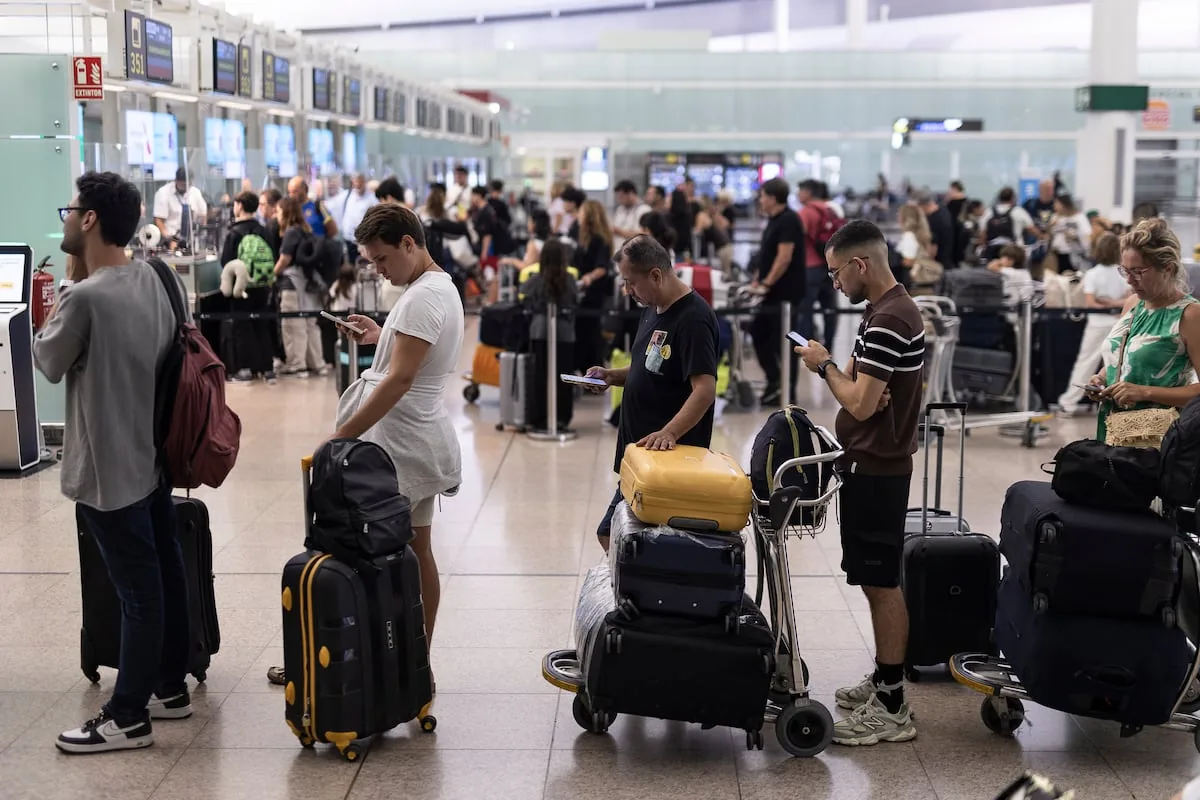
The new electronic border control system of the European Union is causing “very serious” delays at about fifteen European airports, according to warnings from the terminals themselves. Many passengers who have traveled in recent weeks, both at regional airports and major connection hubs, including those in France, Germany, Belgium, Italy, Spain, and Greece, have been waiting up to three hours at border controls.
Read more Euthanasia of hippos or how to deactivate a time bomb
“This situation, in the coming weeks and undoubtedly during the peak summer months, will be simply unmanageable,” warned Olivier Jankovec, director of the European division of the International Airport Council (ACI).
“Our latest data from airports in 15 different countries show that waiting times at border controls have increased significantly since the implementation of the EES; queues now usually last from two to three hours, or even longer during peak periods,” the organization states.
The Entry-Exit System, known as EES by its English acronym (Entry-Exit System), began to be applied in October last year. It was supposed to be fully operational this Friday at all airports in the Schengen area — 25 of the 27 EU countries, plus Iceland, Liechtenstein, Norway, and Switzerland.
The system replaces the manual passport stamp with a digital record of the traveler’s personal and biometric data. To enter and exit the EU, passengers from non-EU countries — including the United Kingdom — must go through machines and scan their passport, register their fingerprint, and have a photo taken. Afterwards, they proceed to police control.
ACI explains that although border authorities can partially suspend the system if it does not work properly or fails to capture the passenger’s biometric data correctly, queues inevitably lengthen. “This [malfunction] is creating conditions of extreme difficulty and distressing situations for passengers, as well as causing significant operational disruptions for both airports and airlines,” they state.
To the tension the sector is experiencing due to the possible shortage of fuel for planes ahead of summer, stemming from the Middle East conflict, is added the stress of implementing the EES. The airport organization calls for consideration of suspending the operation if it does not function properly.
Read more Snap fires 1,000 employees, 16% of the workforce, to cut costs due to AI pressure
“We need the ability to completely suspend EES registration whenever there are excessive waiting times at border controls that are simply unmanageable,” Jankovec requested.
According to the Financial Times, the system’s implementation had already been delayed several times due to problems with IT infrastructure, cybersecurity, and general delays in Member States. The BBC reported last Sunday that more than 100 people were unable to board their EasyJet flight from Milan to Manchester before takeoff due to the EES delay.
Many airports have not yet started collecting biometric data and are limited to recording personal information. Among the structural problems of the system highlighted by ACI are the poor performance of automatic machines and the “chronic shortage of staff” at border control, as well as crashes of each airport’s central IT system.
The European Commission has responded to ACI’s warnings, assuring that “the system is working very well,” according to the Financial Times. While ACI maintains that registering a passenger during peak hours can take up to five minutes, the Commission claims the average is 70 seconds.
“There are some Member States where technical problems have been detected, as expected in the early days of full operation of any large new system, but they are being addressed,” they say, before reminding: “It is the responsibility of Member States to ensure the proper implementation of the EES on the ground.”