


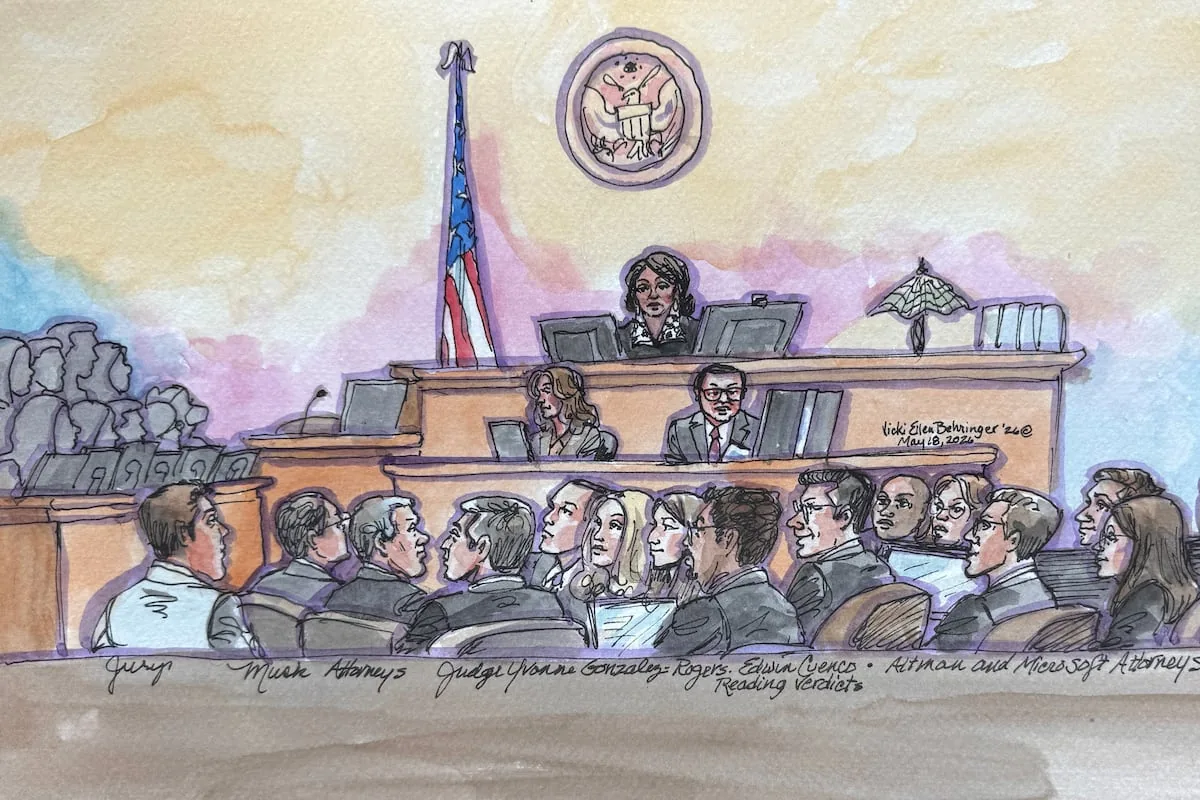
The great trial of Artificial Intelligence so far this century has ended quietly, with very little fanfare. Elon Musk lost and OpenAI won easily. Mainly because the jury considered Musk’s complaint to be out of time. The facts had expired. Neither the initial jury nor the judge later evaluated Musk’s complaint. It’s as if the World Cup final didn’t end up being played because one team couldn’t show up. Someone ends up winning, but without knowing if they really deserve it. These are the key points:
1. A simple “calendar technicality.” That’s how Musk defined it, but if he took the case to court so late, it’s also his fault. Musk sued Sam Altman and Greg Brockman, co-founders of OpenAI, for having abandoned the nonprofit entity, which they created among others with donations from Musk himself, to turn it into a normal company. Musk says they have forgotten their initial mission: an AI for the benefit of humanity, that “doesn’t kill us all,” in Musk’s words during the trial. And on top of that, they have become millionaires at his expense.
Regarding the OpenAI case, the judge & jury never actually ruled on the merits of the case, just on a calendar technicality.
There is no question to anyone following the case in detail that Altman & Brockman did in fact enrich themselves by stealing a charity. The only question…
— Elon Musk (@elonmusk) May 18, 2026
OpenAI replied that he himself had already thought in those early years about turning them into a company. Also that Musk has sued just now because ChatGPT is a success and if he had won, he would have subdued one of the biggest rivals of his own AI company, xAI.
In the end, that technicality is something more: the jury and the judge told Musk that if he cared so much about humanity, he could have sued earlier.
2. Has Sam Altman won? The short answer is yes. OpenAI will continue to be the market leader with ChatGPT, will go public this year, and won’t have to think about Musk for now. But the image of the trial has not been good. Musk has insisted again and again on how Altman and Brockman have enriched themselves. The gossip that has emerged shows banal humans in eternal power struggles, like kids with a huge toy in their hands. Altman aspired to have an image of saint and peacemaker of AI. He will be left with that of an AI magnate. Meanwhile, Anthropic and Google continue to eat into his market and headlines.
Read more The EU intensifies its diplomacy in Greenland amid a new Trump offensive to control the island
3. This is not over. At the doors of the Oakland court where the three weeks of trial took place, Musk’s lawyer, Marc Toberoff, had “only one word” about the verdict: “Appeal.” “This war is not over. We are firmly convinced that what happened with OpenAI was wrong at a very basic level: you cannot raise millions of dollars as a charity subsidized with public money and then, when it suits you, simply become a for-profit company in which the directors and advisors of that same charity enrich themselves by billions,” Toberoff declared.
4. The big question remains pending. There is something the trial has not resolved: can what OpenAI has done be done? Can a nonprofit entity become a for-profit company without anything happening? In response to the lack of a clear verdict, there were Musk fans suggesting that from now on they could create nonprofit entities with all their profits and then jump to making a lot of money.
5. Another underlying problem. AI is one of the great debates of our time: it is already influencing jobs, universities, hospitals, and courts. Even the youngest, who in theory should benefit like no one else, do not see it clearly.
No one knows what the final impact will be, whether it will be good or bad. But if the central debate of AI, instead of how it will cure cancer or solve the energy problem, focuses on who will end up winning more millions or more market share, there will be much to lose.