







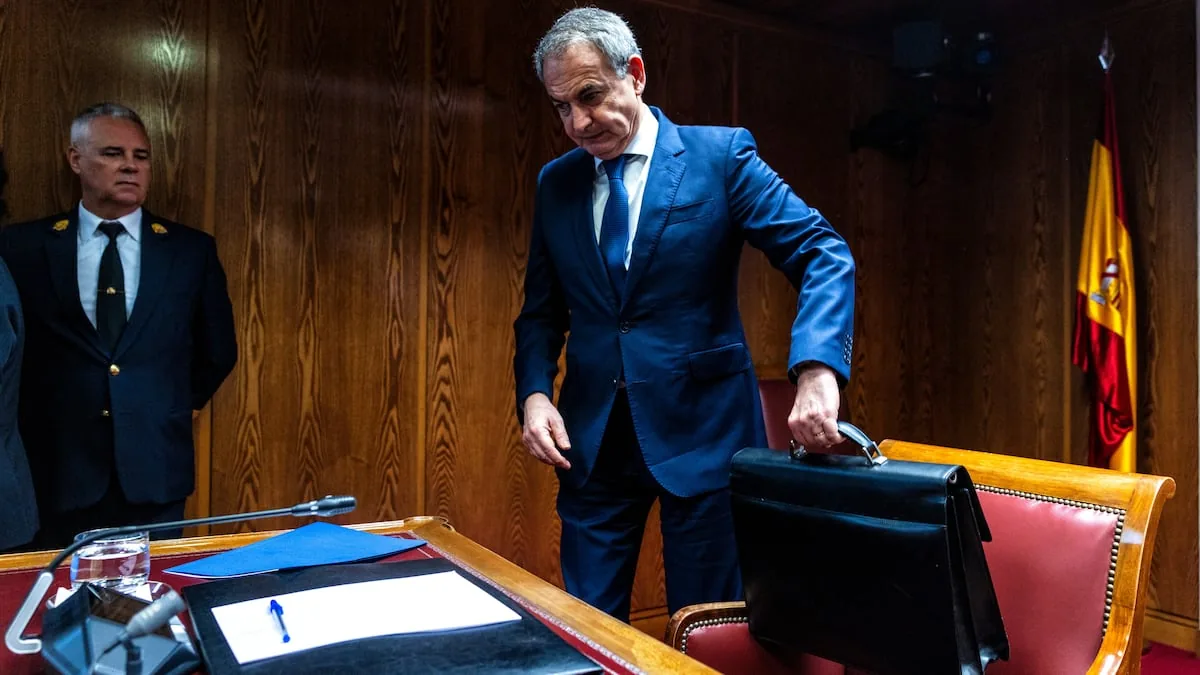
José Luis Rodríguez Zapatero now faces a complex path ahead in the National Court. The former Prime Minister and former leader of the PSOE, whose indictment has caused a huge shock in Pedro Sánchez’s government and much of the Spanish left, is facing a labyrinthine and massive judicial investigation (with international connections), which has ultimately escalated to his figure. His defense was able to access on Monday the thousands of pages that make up the case file — which developed in several phases and in several courts with the support of the Anti-Corruption Prosecutor’s Office — and which will be supplemented in the coming weeks with new reports from the Economic and Fiscal Crime Unit (UDEF) of the National Police, which will work on analyzing all the material seized in the search of his office, such as paper documents, agendas, and electronic devices (hard drives, pendrives, phones…). The investigating judge has also requested to obtain the content of an email linked to Zapatero from 2020 to the present.
Read more Chess analysis | Firouzja entangles Carlsen
Access to the case file of the so-called Plus Ultra case marks a turning point in the case. After indicting Zapatero last week, the investigating judge José Luis Calama ordered the lifting of the secrecy of the investigation. This Monday, after several days of waiting, the parties were finally able to navigate the details of the investigation that supported the magistrate’s decision, which focused on the former prime minister by pointing to him as the alleged leader of “a stable and hierarchical structure of influence peddling” to obtain “economic benefits” through “intermediation before public bodies in favor of third parties, mainly Plus Ultra.”
Zapatero will have to appear at 9:00 a.m. on June 2 before Judge Calama, who concluded that the UDEF and the public prosecutor have gathered sufficient evidence against him to summon him for questioning. Sources close to him emphasize that the socialist is already preparing for that interrogation, although he will always have the option to exercise his right not to answer or to respond only to the questions he deems appropriate. The documentation revealed this Monday, accessed by EL PAÍS, shows that the Police asked the magistrate to go much further last week: they requested to also search the former prime minister’s home, considering it an “operational command center” of the alleged influence peddling network (which would, in turn, lead to an alleged money laundering scheme). According to the agents, his residence was an “ideal space” for “channeling and safeguarding the strategic planning of instructions” that involved “greater sensitivity.”
Judge Calama denied the search of the former PSOE leader’s home, declaring it unnecessary, but did authorize entry into his office and the headquarters of his daughters’ company, What The Fav. In all this, the magistrate had the support of prosecutor Elena Lorente (known for previously promoting the investigations of the Rato case). “We are facing the investigation of a multi-offense criminal activity, which, besides being considered serious in legal-criminal terms, generates broad and widespread rejection due to its great economic and social significance. This proportionality is supported by the evidence that has been specified, not mere assumptions or conjectures,” argued the public prosecutor.
Thus, last week, after years of investigations, the first steps were taken against Zapatero. The initiative resulted in access to the former head of government’s office, where agents found a safe containing multiple watches and jewelry (necklaces, bracelets, earrings, rings, brooches…), according to the report signed by the investigators. The socialist’s own secretary, María Gertrudis Alcázar, indicated at that time that these items came from the former prime minister and his wife’s home, and that the jewelry was an “inheritance from Mrs. Sonsoles” and “gifts from trips.” In this regard, sources close to the former PSOE leader explained this Monday that the couple has not had a safe at home since they moved (they currently rent) and use the office safe. According to these same sources, the jewelry comes from trips, the family of Zapatero’s wife, and the former prime minister’s mother.
However, the agents took more material from there. According to the case file documentation, more than a dozen agendas, about twenty folders with documents, two handwritten sheets, at least two pendrives, three hard drives, and a mobile phone were seized. The agents also downloaded files and emails from two computers, one used by each of the secretaries. The UDEF will now have to analyze all that material.
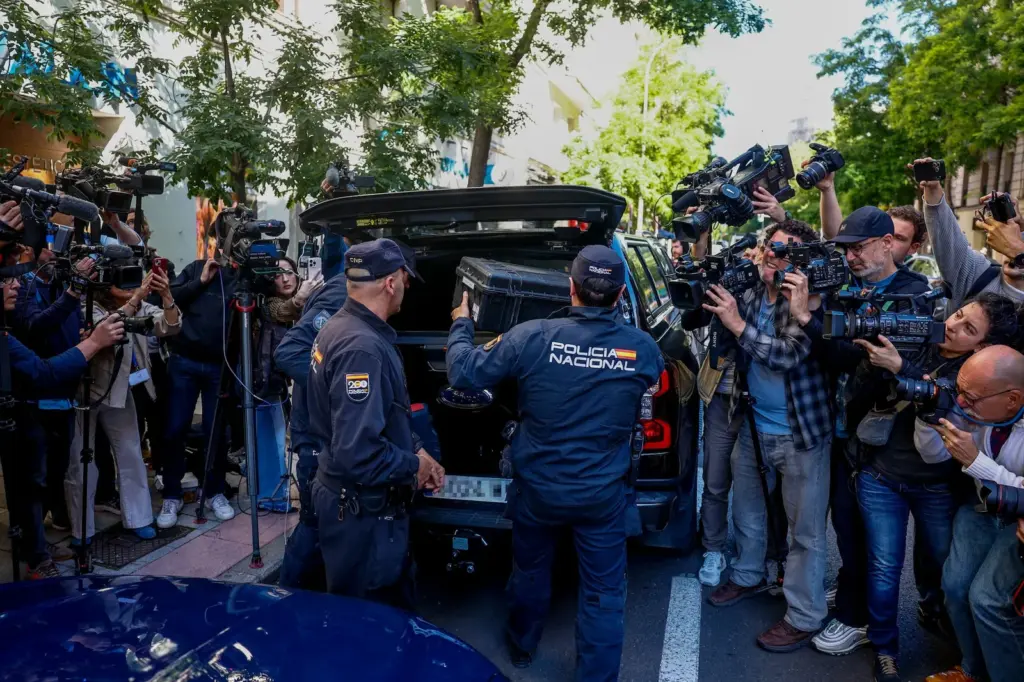
Although Judge Calama wants to obtain even more information. The case file includes another ruling by the magistrate ordering to obtain all the content from 2020 of the email linked to Zapatero’s office — managed by his secretary Gertrudis Alcázar, according to the Police. The magistrate also requests the full content of the email used by his daughters at What The Fav.
Zapatero is “surprised” by the content of the UDEF reports and says he feels “unrelated” to all the accusations made against him. The former prime minister defends himself, through journalist Luis Arroyo as authorized spokesperson, assuring that he “is not responsible for the businesses Julio has.” According to the former prime minister’s circle, the value of the jewelry found in the safe ranges from 30,000 to 50,000 euros.
Money transfers
When the former prime minister sits before the magistrate on June 2, he will face many questions. The case file includes conversations from third parties pointing to him as the entryway into the Administration or as an intermediary — “Do you think we can ask Zapatero for help?”; “I’m looking for how to reach ZP”; “The bridge with ZP has just been made”; “Tomorrow Zapatero intervenes directly”… — but also suspicious money movements, according to the agents.
The UDEF has analyzed the amounts Zapatero moved in his accounts from 2020 to 2025, which is the time period covered by the case. The Police detail 174 transfers from investigated companies and other commercial entities not under suspicion, totaling 2.6 million euros. The money currently under scrutiny is the 490,780 euros that the consulting firm Análisis Relevante paid Zapatero over five years. That is precisely the amount the judge has frozen in his account. However, the UDEF includes in its reports other transfers for talks, conferences, or consulting services (both in Spain and through Chinese capital companies), which, in principle, are not part of the investigation. Análisis Relevante also paid 239,755 euros to his daughters’ company — income that is under scrutiny.
The focus is also on the entire business network of Julio Martínez Martínez, a friend of Zapatero, whom investigators believe may have been used to move money irregularly and that ended up in the former prime minister’s family orbit. For example, about 760,971 euros that went from Plus Ultra to the company Caletón Consultores and ended up in Julio Martínez’s companies. Also analyzed are 380,208 euros that Inteligencia Prospectiva (owned by two Venezuelan brothers) paid Martínez Martínez, despite being a loss-making company with continuous capital increases from abroad. That company also paid 551,760 euros to What The Fav.
The Venezuelan connection
Julio Martínez Martínez has emerged as one of the most complex characters in this network, with many facets. Martínez not only shared business with the former prime minister through the consulting firm he managed and with which he paid him (Análisis Relevante), but also trips and dealings in Venezuela, which the Alicante businessman noted in an agenda. According to the case file, the Police seized several notebooks handwritten by him where he recorded “agreements, decisions, commitments, responsibility, deadlines, and high-level events” in the country. The UDEF considers that these notes “reveal a possible intervention [by Martínez] in strategic public decisions” in the American state, such as the “repatriation of Edmundo González” or the “release of prisoners.”
The agents found “another documentary group” with notes on a sheet called “Topics of interest,” which “reflects what could correspond to a business plan related to oil and its derivatives.” In red appears the expression “(10%)” and “notes on the buying and selling of gold,” alongside the phrase “Bandes must be concealed.” “Bandes,” according to the agents, refers to the Economic and Social Development Bank of Venezuela.
In the search of Martínez’s house, agents found 286,070 euros distributed in a golf bag (10,000 euros), in a radiator (50,000 euros), in a drawer unit (30,000 euros), in a glass box (25,000 euros), and in the bathroom, among other places. The agents used dogs that indicated all the points in the house where there was cash. Additionally, 10,000 euros were seized in a series of envelopes with Chinese characters. Four computers and 12 mobile phones were also confiscated, as well as nine luxury watches and documents.
Martínez Martínez has a bank account in Miami with a balance of 653,874 euros that was opened in 2014. According to a document submitted by his defense in the case file, this account “has absolutely nothing to do with the facts under investigation by this investigating court, which is why he did not consider himself obliged to inform or warn this judicial body.” The account is in the name of a company that was first called Landside Holdings, LTD and later renamed Boreal Capital Management.
The magistrate does not say that Martínez was the former prime minister’s front man. However, in some way and according to the evidence provided by the UDEF, he describes his role as the person overlaid in all the businesses and who channeled the payments of the alleged influence network that ended up with him. Sources close to the politician explained this Monday that Zapatero does not have to be responsible for the businesses Martínez had.
Gold and oil
One of the new elements the case file brings is the alleged influence capacity of the alleged scheme beyond the bailout of Plus Ultra. The investigation points to the existence of business between Julio Martínez and a Venezuelan businessman, Domingo Amaro Chacón, for the buying and selling of Venezuelan oil, with the involvement of a Chinese Communist Party company and a Swiss agent. With this same Venezuelan businessman, they would be negotiating possible businesses for gold export and currency sales.
Judge Calama’s order briefly mentioned other businesses, such as gold and oil, but the rest of the case file revealed this Monday includes conversations about an alleged gold export, the conversion of euros into cash in Caracas, or the implementation of a route for the physical product “amounting to several million.” Zapatero’s role is not defined at this point, nor even his alleged involvement, although conversations of Plus Ultra airline executives such as Julio Martínez Sola and Rodolfo Reyes are transcribed where it is stated “Zapatero is in charge here,” referring to Venezuela.
Amaro Chacón is administrator, along with his brother, of Inteligencia Prospectiva. This company, according to investigation sources, is one of the keys to the case to determine if it escalates to a much larger influence network. The UDEF suspects that, through this company, Venezuelan money entered that was sought to be laundered in the legal circuit. The scheme presented by the agents is that Amaro Chacón sent messages to Zapatero through his friend Julio Martínez Martínez.
The investigations delve into other characters in the network and the coordination that existed with the French and Swiss prosecutors who are also investigating money laundering in those territories. Judge Calama, in fact, has issued a search and arrest warrant against Rodolfo Reyes, the owner of Plus Ultra during the bailout. He did the same with a Peruvian businessman, Felipe Baca, who was found on vacation in Aruba and was extradited. The National Court took his statement and then released him.
Read more La Casa de Misericordia de Pamplona maintains the ban on Diego Ventura in the Sanfermines