

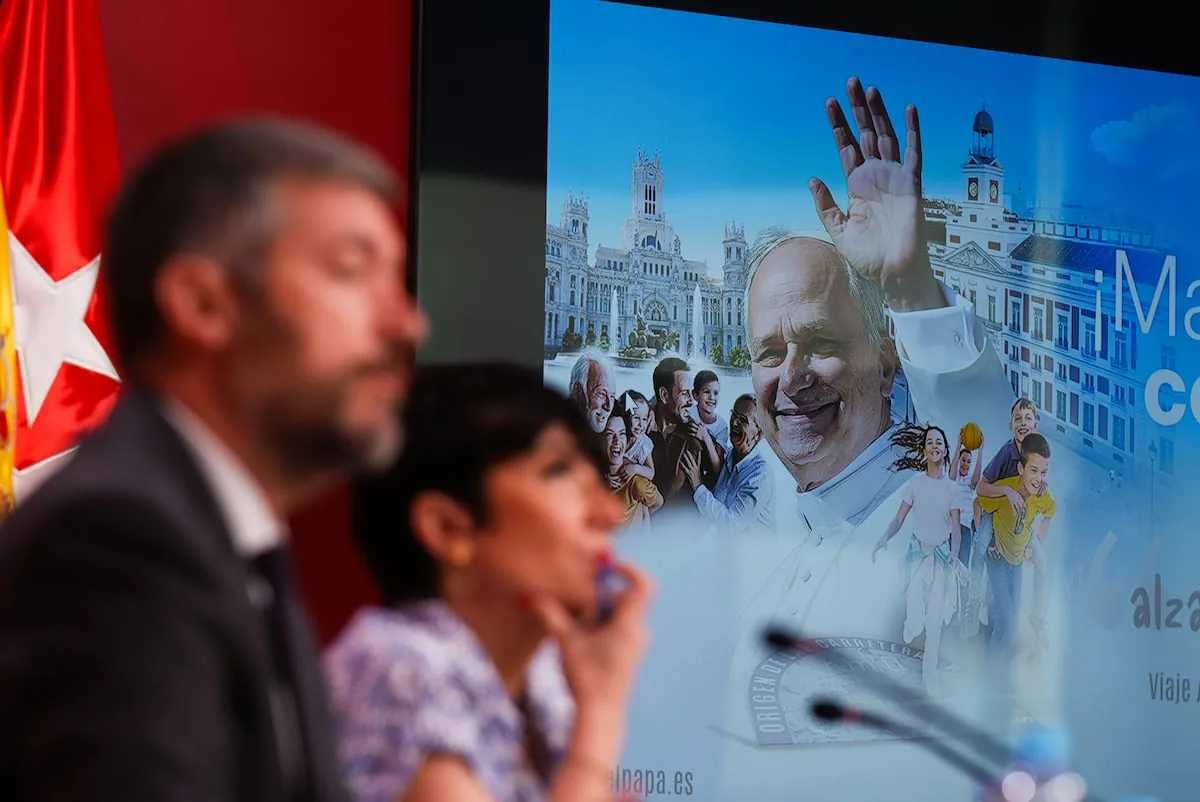
Pilgrims attending the capital for the Pope’s visit will camp in the yards and gyms of about 80 public schools, but some families and teachers have protested against this “preferential treatment.” The decision announced on Monday by the Community of Madrid faces opposition from the largest union in Madrid’s education sector, Comisiones Obreras. The discontent is due to several reasons. Some are bothered that this “privilege” is given to followers of “a religious star” and not, for example, to those of Bad Bunny, the artist who has caused a sensation with his ten concerts in the capital, which will coincide with the papal ceremonies. Others are concerned whether the facilities will be in suitable condition to hold classes the next day. And others are upset that the schools will bear the costs of electricity, water, or cleaning. A minority union, the Sindicato de Trabajadoras y Trabajadores de la Enseñanza de Madrid (STEM), has issued a statement with an image of Pope Leo XIV holding the keys to a public school, stating that “public school is not a hotel.”
The use of the school facilities will extend from Friday, June 5 to Sunday, June 7. The measure corresponds to the municipalities and the government of Isabel Díaz Ayuso because the maintenance of the facilities depends on the former in the case of schools and on the latter in the case of institutes. Neither the Madrid City Council nor the Community have revealed the list of affected centers. Nor have they responded to questions from EL PAÍS. The Madrid employers’ association grouping 340 religious charter schools, Escuelas Católicas de Madrid, estimates that about 80 of its schools will also host visitors.
The Minister of the Presidency, Miguel Ángel García, gave some details on Monday at a press conference about the public schools and institutes. The measure will not coincide with class hours because the use of these spaces will take place from the afternoon of Friday, June 5 until 10:00 p.m. on Sunday, June 7 and will be limited to areas such as yards and gyms.
The Madrid authorities have called this visit “historic,” the first by a pontiff in 15 years. The city mayor, José Luis Martínez-Almeida, has said that the logistical demands “are unprecedented” and “of a greater scale than those of the NATO summit.” The City Council said in a press release that it expects an attendance of “1.5 million people” at Plaza de Cibeles, where a mass is scheduled for Saturday morning.
Complaints had been brewing for weeks. Teachers and family associations learned through the principals, to whom the Ministry of Education communicated that they had been “chosen.” Some have raised their discontent to the unions or to the federation of family associations Giner de los Ríos. These protests were already heard in 2011 during the last visit of a pontiff to the capital, Benedict XVI, but then there were no classes because the pilgrimage took place in August. At that time, the media reported the arrival of more than a million people.
Comisiones Obreras Madrid considers that schools should be kept out of religious interests since Spain is a non-confessional state. “Public schools should be open to neighborhoods and the educational community but not for private or religious purposes,” says their Education secretary, Aida San Millán.
STEM argues that the regulation governing the management of spaces has been violated, a decree that establishes that anyone wishing to use school facilities must request it 20 days in advance from the School Council, the democratic body of each center where teachers, families, and students sit. Besides this approval, the green light from the Ministry of Education is also required.
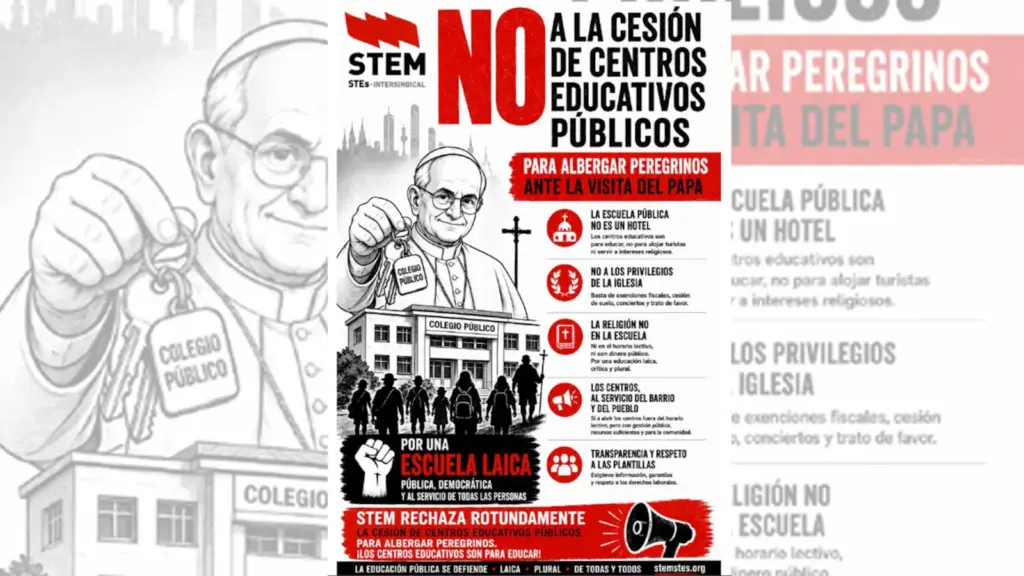
Enrique García, spokesperson for STEM, reproaches the Community for violating its own rules. “This is not a decree imposed by the evil central government,” says García. “It is questionable that a religion uses public resources for free but aside from that, there is a procedure specific to the Community that is being ignored.” The Ministry of Education assures through a spokesperson that the transfer “has been carried out in compliance with all current regulations,” without responding to a question about what is stated in article 5 of that decree, which regulates the intervention of the School Council.
That decree, approved during the presidency of Cristina Cifuentes to regulate these transfers, sparked complaints because it “made it difficult” for neighbors to use schools, says Isabel Galvín, professor of School Organization at Complutense and then head of Education at CCOO-Madrid. “There is no availability for that and the Ministry has countless prohibitions,” says Galvín, who adds that however, with Catholics, the authorities have been “quick to open the centers.”
Some families have also protested, according to the Giner de los Ríos federation. They believe that pilgrims should be assigned only to religious charter schools and are concerned about how the visit will affect classes on Monday the 8th. “It is not a massive anger but it is not something that is very pleasing either,” says the president of this federation, Mari Carmen Morillas.
A case that draws attention is that of the Méjico school, in the Ciudad Lineal district (east), whose family association has been forced to cancel an extracurricular activity called The Magic Night, prepared months in advance. “It really annoys us that other centers aligned with their beliefs and with better facilities are not used,” says the association president, Nacho Peña. “It has been a total imposition and it feels very, very bad.”
Do you have something to share? Write to the author at fpeinado@elpais.es