









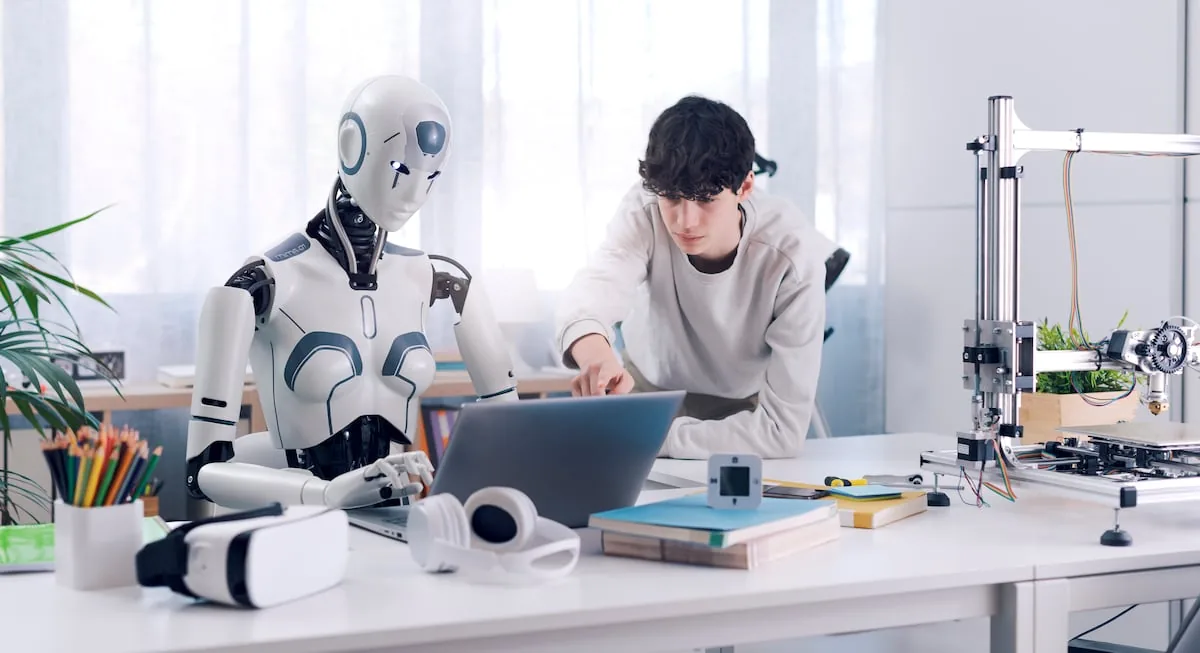
For years, the conversation about education and technology has been dominated by a question that, although relevant, is incomplete: how do we incorporate digital tools into the classroom? Recent evidence forces us to reformulate, and the question is not only what technology we use, but for what purpose and how we use it.
Read more How the Sence tax exemption that Kast’s Government seeks to eliminate works
Given the current increase in school conflicts and difficulties in coexistence within schools, it is worth asking what other concrete alternatives exist to – in the medium term – contribute to improving the situation. A study shows that robotics can be an efficient tool to strengthen social skills and reactivate the interest in learning.
An analysis carried out within the framework of the RIEN program —Robotics for the School Integration of Children and Adolescents, promoted by the Pontifical Catholic University of Chile and the Kiri and Mustakis foundations— shows that educational robotics not only teaches how to program or build artifacts. It can, if well designed, strengthen social and motivational skills that are decisive for students’ trajectories.
In four schools in the Santiago Metropolitan Region, students who participated in robotics workshops showed significant improvements in their ability to integrate socially. This is not a minor result. We are talking about concrete skills, such as working in a team, collaborating with others, actively participating, and adjusting behavior to different group contexts. In simple terms, getting along better with peers in the space where they spend a good part of their lives: school.
Why does this happen in a robotics workshop? The answer is not in the technology itself, but in the experience surrounding it. When students face progressive challenges, with clear goals and constant feedback, problem-solving ceases to be an individual exercise. It becomes a shared task. Technological devices operate as a meeting point, with a common object that forces coordination, listening, yielding, and persistence.
In this process, another key dimension is also strengthened: achievement motivation. Students not only work together; they also develop a greater goal orientation, persistence in the face of difficulty, and willingness to strive to achieve objectives. In an educational system where frustration or disengagement often predominates, these advances are especially relevant.
Read more Bachelet’s intense preparation for the «social debut» of her candidacy before UN members
In Chile, the educational discussion often oscillates between proposals for quick solutions and broad diagnoses. This type of evidence offers an intermediate point, demonstrating that it is possible to influence relevant skills, but also that the effects are specific and depend on how learning experiences are structured.
The challenge, then, is not simply to bring more technology to schools. It is to build intentional educational experiences, where the development of social and motivational skills is not a side effect, but a central objective. Robotics, in this case, is a means. What is important is the type of interaction it generates.
School administrators who have participated in these experiences have proudly celebrated the positive behavioral change in their students, compared to those who do not access these workshops. They highlight that attendance and commitment are higher, and that their grades have even increased in other classes and in standardized tests like the Simce.
If today we are concerned about school coexistence and seek permanent and concrete solutions, as well as preparing students for sustained educational trajectories —and, later, for a working world that demands collaboration, adaptability, and persistence—, we need to look more closely at this type of initiative. Not because they are seemingly innovative, but because, when well designed, they achieve something much more difficult: changing the way students experience education.
That, probably, is the technology that matters most.