







A journalist, a citizen with rights and, above all, a socialist. For this reason, when faced with cases affecting the PSOE, Leire Díez put “special enthusiasm” into preparing a book about the State’s sewers. This is how the former socialist member presented and defended herself publicly almost a year ago, after several audios were leaked in which she offered to mediate in trials for businessmen charged in various cases in exchange for information about, for example, Lieutenant Colonel of the UCO, Antonio Balas.
However, Judge Santiago Pedraz paints a very different story: that of a plumber who, under the orders of the then party Secretary of Organization, the multiple-charged Santos Cerdán, sought to sabotage judicial cases and police investigations. In an order made public this Wednesday, the investigating judge of the National Court points to Díez as the person appointed by Cerdán for the “coordination and execution” of a series of actions aimed at “systematically and continuously destabilizing any judicial procedure or police action that could directly or indirectly impact the interests of the PSOE or the Government.” These are the contradictions between the image Díez has tried to project in her few public appearances and judicial statements and the role Pedraz attributes to her in his investigation:
“Any relationship with the Prosecutor’s Office would correspond to the lawyers of those involved. I have never had any”
Pressures or offers to members of the public prosecutor’s office constitute one of the pillars of the plot outlined by Pedraz in his order. The judge indicates that Díez participated directly or indirectly in approaches to two prosecutors: José Grinda and Ignacio Stampa. Both confirmed this in statements during the investigation conducted by a Madrid investigating court against Díez, which will presumably now be taken over by the National Court. Grinda’s circle denied to Cadena SER that he ever received a bribe or even an attempted payment from Leire Díez or her circle.
Grinda testified at the time that he met with a journalist, Pere Rusiñol, in February 2025, who gave him a paper, which he could neither keep nor photograph, to read. It offered him a transfer abroad. Díez did not participate in this meeting, but Pedraz considers that she mediated for it to happen and was aware of its content. “It is known,” says the judge, that Javier Pérez Dolset — another of the accused — sent Díez the journalist’s contact “during the night before the meeting.”
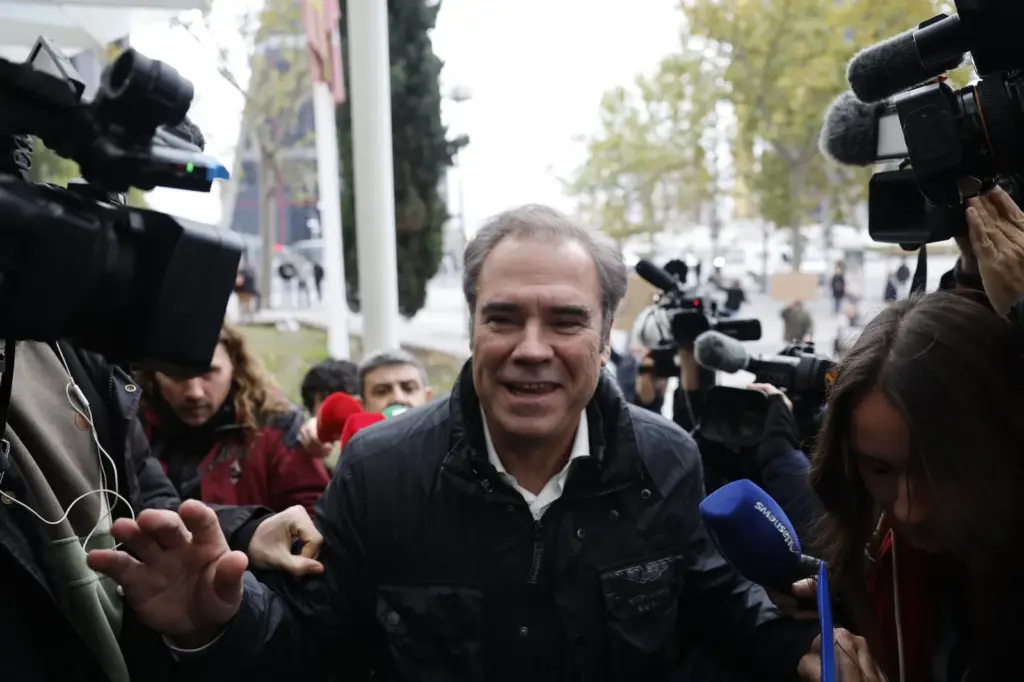
The next day, the journalist sent the following message to the former socialist member: “There was no water, at least for now.” Pedraz maintains, based on a handwritten note found with Díez, that the plot prepared an economic offer of 300,000 euros to Grinda, who was then involved in a judicial case. In exchange, they requested — always according to the order — information about the head of the Anti-Corruption Prosecutor’s Office, Alejandro Luzón, as well as that he request the dismissal of several judicial cases. Grinda was in charge of the Zed case (which affected Pérez Dolset) and the trial against the company Duro Felguera for bribery of high officials in Venezuela, in which Nervis Villalobos, a former Venezuelan official and client of Ismael Oliver, a lawyer mentioned in Pedraz’s order, was involved. He also handled some offshoots of the Pujol family corruption scandals.
Prosecutor Stampa was another “line of action” of the plot. Díez and Pérez Dolset met with him in May 2025, in a meeting that the prosecutor recorded. They also had a phone call a few days later, in which only the former socialist member participated. To Stampa, as the order recalls and he himself confirmed before the investigating judge, they hinted at the possibility of returning to the Anti-Corruption Prosecutor’s Office, where he had handled part of the Villajero case and from which he left after an intense discredit campaign. In exchange, said the prosecutor, they wanted information about Grinda, Luzón, and Manuel García-Castellón, former judge of the National Court.
And the former member’s interactions were not limited to the prosecutors of the cases: to Francisco Martínez, former Secretary of State currently on trial for the Kitchen Operation, she offered, according to his own account, agreements with the Prosecutor’s Office in exchange for compromising information about past operations that could have harmed the PSOE.
—And who do you pass that on to? — Martínez asked her, according to an audio revealed by EL PAÍS.
—To those who told me to take charge of this — she replied.
—Are they on Ferraz Street or in the Moncloa Palace?
—On Ferraz Street, connected with the Moncloa Palace. Because, as you well know, the party on Ferraz Street governs.
Read more The Milei Government trusts in imposing the economy over politics to win the elections
“My work is my work and in no case have I done it on behalf of or representing anyone”: from 2 to 22 meetings with Cerdán
Díez defended in her appearance that she was nothing more than a journalist (“and socialist”) and that she did not act on anyone’s orders, but on her own in preparing a book. She did not always present herself this way, the order records: in her meeting with prosecutor Stampa, he asked if she was “Santos Cerdán’s right hand,” to which she answered yes, and defined herself as the person “who put the PSOE.” However, she clarified that she was a right hand “that was not going to appear anywhere.”
Díez defended last November before the judge investigating her that she met twice with Cerdán, always as a journalist. The alleged right hand participated in up to 22 meetings with the then party Secretary of Organization, according to Pedraz. The first took place on April 26, 2024, two days after, following the indictment of his wife, the Prime Minister, Pedro Sánchez, opened “a period of reflection” about his continuation in Moncloa. The day before the meeting, Díez wrote to the former president of the State Industrial Holdings Company (SEPI), Vicente Fernández: “I’m urgently going to Madrid (…) Santos sent me. We have information that can help the president.”
The services provided were not free. Over 50 pages, the judge refers to several alleged payments to the former member: 16,000 euros through the consultancy of the former vice president of the Andalusian Government Gaspar Zarrías and 27,225 euros from the PSOE to a company managed by lawyer Ismael Oliver, but which allegedly ended up in Díez’s hands through another company. The total amount of money moved to fund the operation is yet to be determined, Pedraz told this newspaper. In her appearance in the Senate last September, she defended that she has only been paid by the party for her role as communications manager in the PSOE of Cantabria in 2008.
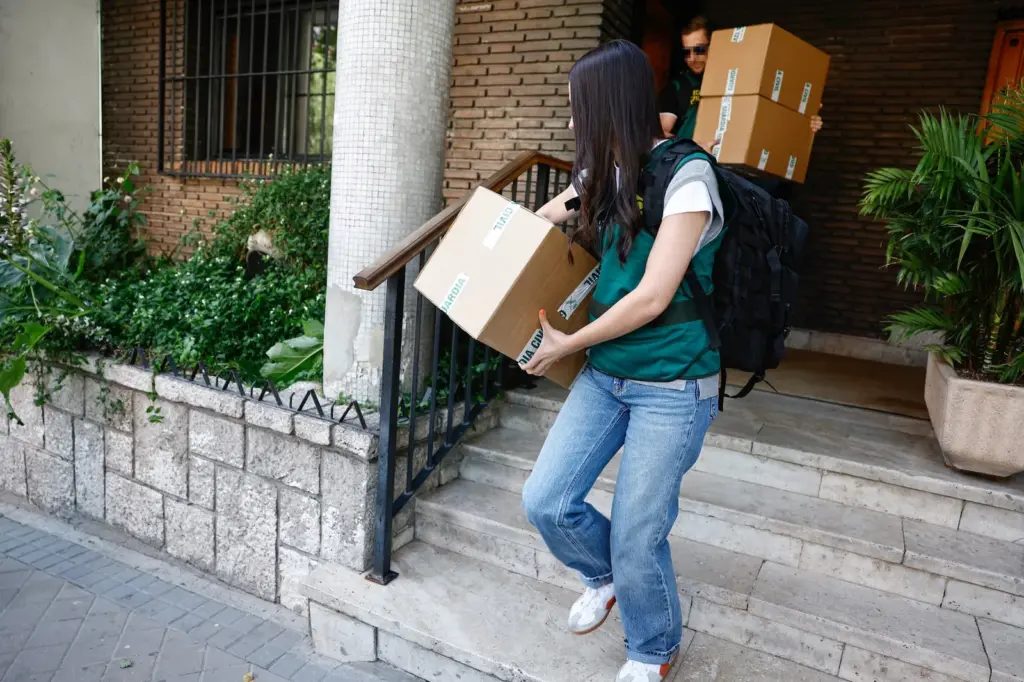
“Calculated and premeditated leaks are something our Rule of Law must address, and quickly”
The work of the “graduate in Social Sciences and Communication” sought, according to her version, to shed light on “the ravages of false patriotism”: from the Kitchen operation, the patriotic police allegedly organized by the Ministry of the Interior’s leadership under the Popular Party’s Jorge Fernández Díaz, to the hydrocarbons case, passing through the Catalonia operation. And, incidentally, to clarify a virtuous circle of interested leaks, journalistic investigations, and judicial cases. “I can show you how there are journalists who not only did this but did something worse. Their investigations are part of judicial reports,” she stated in the Senate.
On April 29, 2024, Pedro Sánchez returned from his period of reflection to confirm he would remain in office. While addressing the public, Díez wrote the following message to Vicente Fernández: “The Prime Minister is referring to everything we are doing.” “Directly referring to the use of information provided by the group,” Pedraz emphasizes in his order. In the same vein, the former president of Correos (and her former boss at Correos) Juan Manuel Serrano wrote to the former member: “Look how the boss quotes the audios.”
Pedraz maintains throughout his writing that Díez, helped or in collusion with other members of the plot, sought compromising information from officials and police to later leak it. In this operation, the late Patricia López, director of the media Crónica Libre, was key, through which consistent information was disseminated, in some cases consisting of recordings of the shadowy commissioner Villarejo (currently on trial in the National Court for the Kitchen case). According to Pedraz, the PSOE paid the company behind the media, Grupo Crónica Libre, S. L., 20,000 euros via an advertising campaign. In her personal notes, Díez linked the “creation of a newspaper” with the so-called “PSOE Operation,” the judge states in the order.
“What is summarized as investigative journalism,” Díez concluded in that media appearance last year, where she emphasized: “I did not compromise any behavior of any public servant, neither prosecutors nor anyone (…) if something else has been interpreted, it may be a misinterpretation or perhaps I was wrong in the formulation.” “Even Judge [Juan Carlos] Peinado [who investigates the Prime Minister’s wife, Begoña Gómez] makes mistakes,” she added.
If it goes to trial, it will be up to the court to determine whether the “special enthusiasm,” due to her status as a socialist member, led the graduate in Information Sciences to err in the formulation of her alleged inquiries. As well as to determine whether she was, indeed, a journalist preparing a book (with some tendency to boutades) or the PSOE plumber and “right hand” of her then Secretary of Organization. “I prefer to be a ‘plumber’ than a ‘sewer dweller,’” she concluded herself in the Senate.
Read more Chess analysis | This time, Carlsen toppled Gukesh in Norway