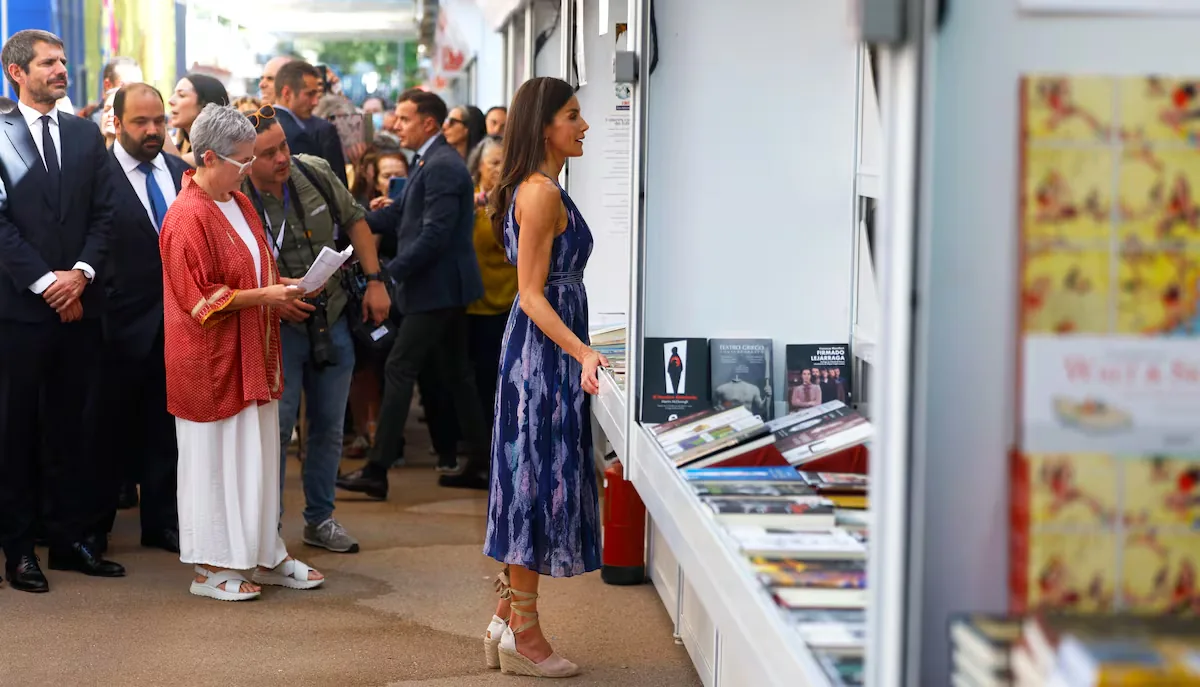





It is often said that fun is not the opposite of seriousness… but of boredom. Humor, then, can be a very serious and respectable thing. Even so, it has had a strange relationship with Spanish literature: although tradition finds in it one of its pillars (just think of Cervantes, Quevedo, Valle-Inclán, Ramón Gómez de la Serna…), there is a feeling that it is not very well regarded in the world of letters today, which tends more to solemnity than irreverence. Literature is nothing but a game, but see, in contrast, the stiff formality of a Cervantes Prize ceremony. The Madrid Book Fair, which is also a celebration, prefers to play and chooses humor as this year’s thematic focus, to explore it in its different facets and analyze it in the light of books.
“We announced the theme at the end of the last edition: we wanted to talk about the relationships of humor with literary tradition and also about humor as armor, as a tool, in the current state of the world. As always, we were afraid it would become obsolete,” says Eva Orúe, director of the fair. A year later it is clear that reality has been stubborn, providing abundant wars, economic difficulties, corruption cases, and general discouragement. “I believe that in these 12 months the theme has not become obsolete, but is even more urgent: today more than ever humor is necessary to deal with the world,” adds the director. The cheerful program will talk about jokes (in clear decline), graphic humor, British humor (with Jonathan Coe), stereotypes and clichés, or the relationships between humor and horror; and there will be tributes to Maitena, Kurt Vonnegut, Rafael Azcona, or Les Luthiers. In short, the thousand and one faces of humor.
Because humor is laughter, but not only that: it often presents itself as a tickle in the intellect. Thus, it encompasses many styles: irony, parody, absurd humor, or black humor. Satire or caricature. There are writers considered humorists because their purpose is pure humor, like P. G. Wodehouse, Tom Sharpe, Terry Pratchett, or Douglas Adams. Other authors do not have that sole purpose, but there is usually humor in their perspective, from Juan José Millás to David Foster Wallace, passing through Franz Kafka, Oscar Wilde, Laurence Sterne, Enrique Vila-Matas, or Julio Cortázar.
There are intermediate cases, like Eduardo Mendoza, who moves between purely humorous works and others of a different nature. Curiously, it is the latter that are considered part of the canon of contemporary novels; although the writer opted for humor and a sly smile in his acceptance speech for his recent Princess of Asturias Award.
In fact, Mendoza could be considered a great restorer of that humor which was certainly diminished in Spanish literature during the second half of the 20th century, when the novel became more rigid and serious, less cheerful and playful. “Humor is the Spanish tradition,” says Rafael Reig, a literary writer with a character tending to the hilarious. And it is at the origin of the Western tradition: he recalls that academic Francisco Rico considered Lazarillo de Tormes the first modern narrative fiction work of the West. Then, of course, the Quixote. And from there on.
“Humor serves to unite things separated by divine or physical laws, humor is border-crossing, and ranges from bar jokes to philosophical meditation,” explains the writer. That is why sometimes there are works with a humorous outlook, like in Franz Kafka, or Samuel Beckett, or Thomas Bernhard, who do not shy away from delving into the deepest human being. Then it comes down to tastes. “I am interested in there being sex in a novel, but not so much that it is an erotic novel,” says Reig. “Well, the same with humor,” he adds. Humor understood as an important ingredient in cultural products, but not necessarily dominating them. Humor as a perspective. Or as a “stance towards life,” as Wenceslao Fernández Flores wrote.
Read more Cybersecurity Forum
Female names are not abundant in the historical series displayed. There were fewer women writers, but it is also likely that they were less inclined to use humor for fear of not being taken seriously. Today women writers are the protagonists of the scene and, although many choose seriousness, there are no shortages of names with humor in their gaze. For example, Mercedes Cebrián, Laura Fernández, or Esther García Llovet. Among younger generations, Berta García Faet, Laura Chivite, Ana Flecha Marco, or Virginia Higa. Among others.
“Traditionally, the clown woman was an unwanted woman, it was automatically thought that when humor appeared eros disappeared,” says Cebrián, “there was the fear of not being taken seriously, of stepping out of what was correct.” The writer, by the way, participates in several of the festival talks, those relating humor with translation, childhood, Latin American literature, besides the opening session. “I believe literature has had the mission — if literature has a mission — not to reproduce chewed and prefabricated language, but to generate rupture,” concludes Cebrián. And humor can slip through that breach.
Is humor abundant? “We believe it is more widespread than it seems in Spanish literature, although it is true that there is a stigma: what is considered serious seems that it cannot be marked by humor,” says Carolina Ontivero, director of the Ja! Festival, which in Bilbao explores the connections between art, literature, and humor. They collaborate with a couple of talks at the Book Fair. One dedicated to black humor, with authors like Marta Sanz, Jon Bilbao, Miguel Ángel Hernández, and Juan Bas. And another about the “other” Generation of ’27, not that of Lorca and Cernuda, but that of the humorists: Jardiel Poncela, Edgar Neville, Mihura, López Rubio, Tono, and Conchita Montes. “The poets of ’27 were not as separated from the humorists as it might seem,” says Ontivero, “they coincided in the same circles and come from a common cultural impulse. For example, Ramón Gómez de la Serna was like the intellectual father of these humorists, but he also greatly influenced Lorca or Alberti.”
In recent times, when humor has been discussed it has generally been about the limits of humor. “There have been cases of cancellation and that has caused self-censorship,” says Ontivero, “but it is also true that humor is a language, a social code, and it changes with society. There are things that a few years ago were funny and now, simply, are not. It is a natural process.”
Humor can function as a filter of critical thinking or as a subversive element. Curiously, humor is also present in some of those rulers who, according to essayist Giuliano da Empoli (see The Hour of the Predators), have taken the place of dissidents or revolutionaries when causing disruption and generating chaos. Donald Trump or Javier Milei have incorporated quite a bit of humor into their speeches and performances, dances, jokes, and chainsaws, and they are funny to their electorate and even to those who do not vote for them or abhor them. “It seems that the era of the male politician with a loden and a leather briefcase has passed. Sometimes I miss them because, although boring and looking like civil servants, they seemed trustworthy. Now there are some politicians who have learned that what matters is the spectacle,” concludes Cebrián. They produce a strange laughter.
Read more Zapatero, the unmeasured mediator