








The Casita that Bad Bunny places on the stages of his tour was born as a vindication of Puerto Rican identity: it represents the classic popular Puerto Rican constructions of the island. At the singer’s concerts, however, this resource has ended up transforming into a sort of VIP area that hosts celebrities from all over the world — and some chosen from the audience —. For this reason, it has become ammunition to denounce the housing crisis throughout Spain.
Read more Caetano Veloso: “Right now what predominates in me is worry; Brazil seems like it cannot be saved”
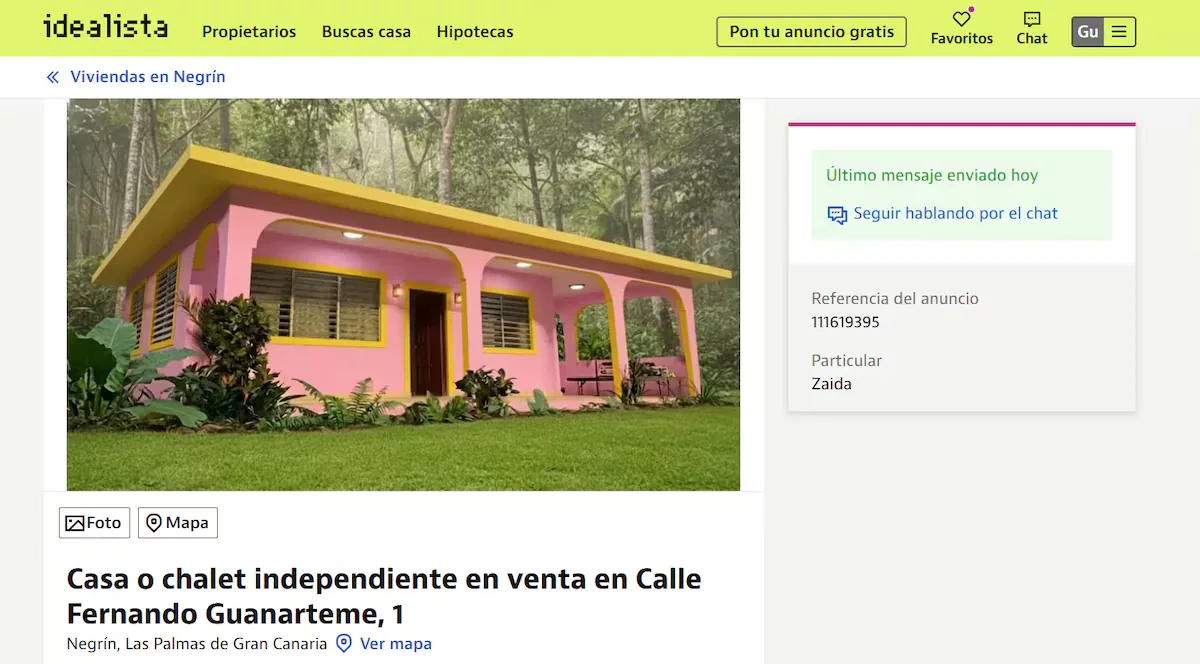
On the afternoon of this Sunday, a user named Zaida uploaded a fake listing to the real estate platform Idealista offering Bad Bunny’s Casita at a price of one million euros: 16,129 euros per square meter. Its supposed location is Fernando Guanarteme, a street near Las Canteras beach, in Las Palmas de Gran Canaria, which has suffered like few in the city from the effects of speculation and vacation homes. The listing uses the image of the famous house in Humacao (Puerto Rico) that was used for the short film DeBÍ TiRAR MáS FOToS.
“This wonderful “Casita” of 62 square meters and drywall,” the listing text explains, “works very well as a marketing concept for Bad Bunny’s concert. Exclusive. Limited. Aspirational.” It gives you “the feeling that you are part of something that not everyone can access.” However, once the concert is over, the author of the listing maintains, “you realize that the same thing is happening outside”: “Only here we are not talking about an experience. We are talking about a house. And at this rate, a little house will also be a luxury reserved for VIP people.” The supposed house, by the way, offers one bedroom, one bathroom, built-in wardrobes, and south orientation. And a garden.
The use of La Casita on the tour to host personalities has sparked criticism. Not in vain, the album DeBÍ TiRAR MáS FOToS, Bad Bunny’s latest work, has intended to be a plea against gentrification, the displacement of communities, and the privatization of natural resources (a theme developed especially in the song (LO QUE LE PASÓ A HAWAii).
View this post on Instagram
Amnesty International also took advantage this Sunday of Bad Bunny’s Casita to criticize the housing crisis. “It is easier to get into Benito’s Casita than to get decent housing” or “Benito’s Casita is small. The housing crisis is huge,” reads the organization’s creative, which uses the platform’s colors and typography. “Renting an affordable house in Spain is a joke,” the organization states. “Those who manage to leave their parents’ house do so under conditions that not even Benito himself could endure,” the organization continues. “And meanwhile, a whole generation waits for someone to finally do something. We cannot continue normalizing the unsustainable.”
Read more The Pope’s visit challenges labor mobility in the communities, the two sides of teleworking in Spain
The real estate market closed 2025 with a new national record high, with the average price at 2,354 euros per square meter, 2.2% more than the previous quarter and 9.5% more year-on-year. The Canary Islands rank as the fifth most expensive community in the country with 2,721 euros per square meter, behind Madrid (4,241 euros), Balearic Islands (4,101 euros), Basque Country (3,489 euros), and Catalonia (2,779 euros), and also records one of the largest quarterly increases, 4.7%, only surpassed by Basque Country (6.6%) and Navarre (5.5%). Year-on-year, the Canary Islands rise 14%, the second community with the highest growth after Madrid (16%), and in used housing specifically, the archipelago records a 15.3% year-on-year increase, also second place after the capital.
According to data published on the 18th by the National Institute of Statistics (INE), 61,295 homes were sold in March, 2.2% less than in the same period last year, when 62,676 transactions were reached. This downward trend is also felt in the aggregate balance of the first quarter, which closes with 178,473 sales, 2.6% less than between January and March 2025.
Despite this slowdown, prices remain sky-high and hinder emancipation: 76% of Spanish young people aged 20 to 29 live with their parents, more than in almost any other country. In the OECD, only two surpass us: Korea (82%) and Italy (79%). We are far from the European average (54%) and very far from Denmark (12%), Finland (14%), Sweden or Norway (22%), where almost no one stays at home.