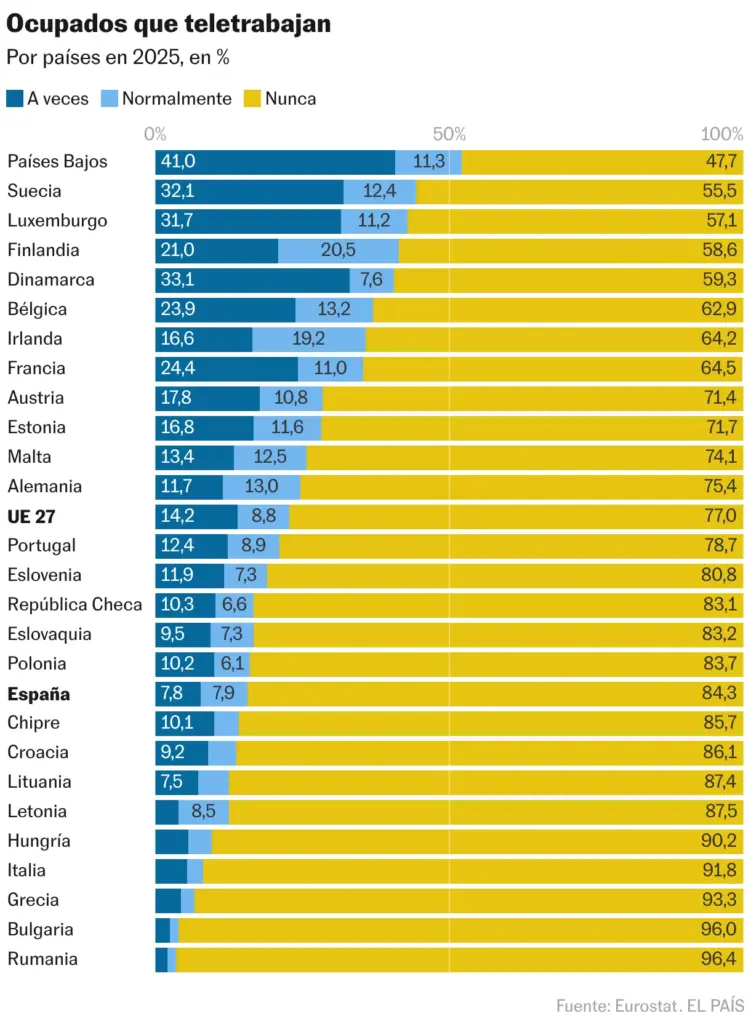










In Spain, teleworking is less common compared to other European countries. According to the latest Eurostat data, 15.7% of employed people in the country work fully or partially from home, far from the EU average (23%) and the countries with the highest adoption: the Netherlands (52%), Sweden (45%), and Luxembourg (43%). On the other side of the scale are Greece (6.7%), Bulgaria (4%), and Romania (3.6%). On one side are the higher value-added economies, and on the other, some less developed ones. This logic, like a miniature continent, is reproduced in Spain, with regions such as Madrid and Catalonia having the largest share of teleworkers and others like the Canary Islands at the bottom. These are the three autonomous communities that León XIV will visit during his trip to Spain from June 6 to 12, an event with such profound implications for mobility that business associations and public administrations have called for teleworking.
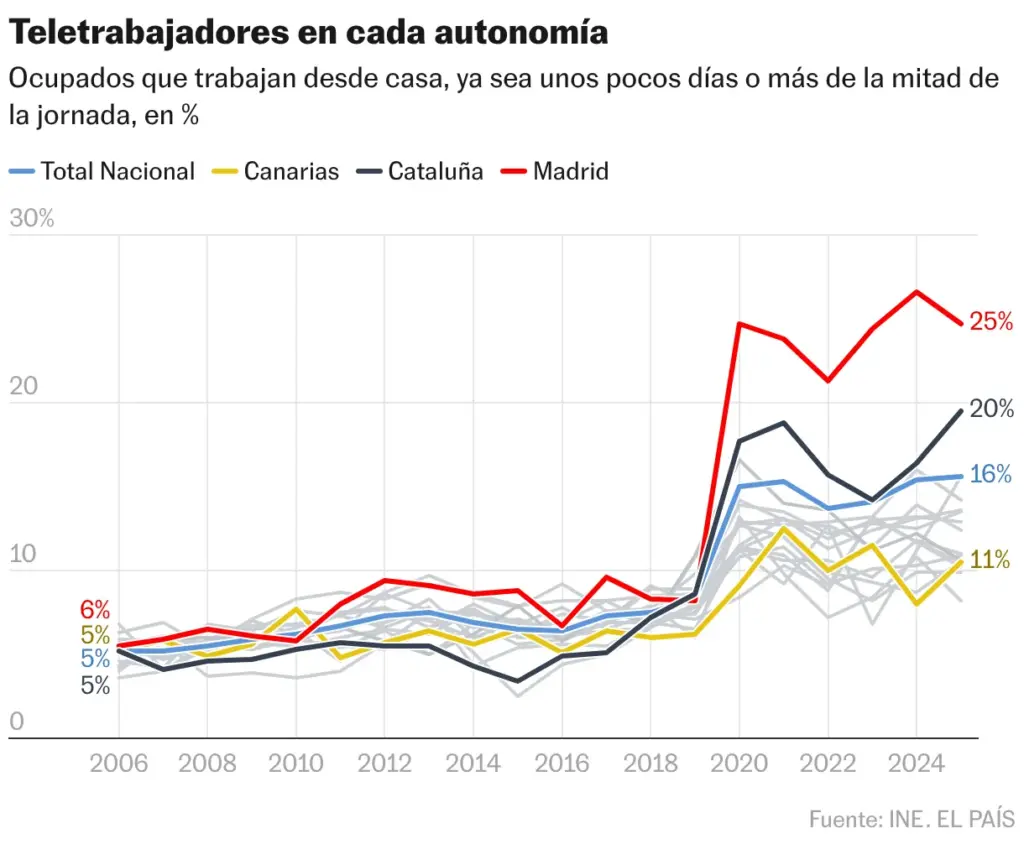
The clearest appeal is from Madrid, the region with the most teleworkers in Spain: 24.7% in 2025, according to the latest data from the National Statistics Institute. “The Madrid City Council has decided that from June 3 to 9 there will be teleworking for municipal employees. I request that companies and workplaces facilitate teleworking conditions,” said the capital’s mayor, José Luis Martínez Almeida, on May 21. The main Madrid employers’ association, CEIM, took up the call a week later with a statement also urging companies that can to facilitate teleworking: “Whenever the nature of the activity allows, teleworking can be an effective tool to reduce commuting.”
The conditions of Almeida’s recommendation have been criticized by Madrid’s unions, as they do not see sufficient reinforcement of public transport to compensate for street closures and expected crowds. “Most cannot telework and it is the workers who make this city function. For them, getting home should not be more difficult, so we demand more measures, flexible hours, permits, and no penalties for delays caused by this situation,” says Susana Huertas, general secretary of UGT in Madrid.

The recommendation is not replicated in the Pope’s second stop, Barcelona. Neither the City Council, the Government Delegation, the Generalitat, nor the main employers’ association (Foment del Treball) have recommended teleworking. “A plan has been developed that strengthens the metro service and considers alternatives to the bus lines that will be affected, and there will be a communication effort so that citizens can plan their trips with minimal impact,” defends the Barcelona City Council, reports Clara Blanchar. Catalonia is the second community with the most teleworking in Spain, 19.5% in 2025.
The position of the Canary Islands, among the autonomous communities with the fewest teleworkers, a mere 10.5%, is very far behind. This has not prevented public administrations from recommending remote work on those days for employees who can do so: both the Government Delegation and the Santa Cruz de Tenerife City Council advise employees to telework to mitigate the expected mobility problems on those days. “We are in favor of teleworking but always from a negotiated, voluntary, reversible approach with guaranteed rights,” says Montse Cosano, employment secretary of CC OO in the Canary Islands.
The differences in teleworking adoption in each region are due, according to specialists, to the productive fabric of each territory. The president of the Madrid employers’ association, Miguel Garrido, explains that in the Community of Madrid teleworking has a higher adoption than the national average due to “the strong presence of office sector companies, large technology corporations, headquarters of multinationals, and a dense core of Administration, not only regional and local but also the central General State Administration, which allow remote work to be developed more easily.”
This is the opposite scenario to that of the Canary Islands, according to the CC OO representative in the Canary Islands. “Emerging sectors more linked to technologies are starting to gain weight, but we cannot lose sight of the structural reality of the Canary Islands. Our engine is tourism, the service sector. We wish we could have beers from home, but it’s not possible,” says this unionist, an analysis echoed by the employers’ leader José Cristóbal García, vice president of the Canary Islands Confederation of Employers: “Hotels cannot operate with teleworking. The economic structure of the Canary Islands allows it in fewer sectors than other territories.”
Cosano believes another reason explaining the weak teleworking in the Canary Islands is the lack of union strength: “A significant part of workers in the Canary Islands face greater difficulties influencing the organization of their workday, their tasks, and working conditions, especially in a context of widespread presence of small companies with more complications for union representation.” She considers that when teleworking depends exclusively on the company’s will and there is no balanced negotiation, its adoption ends up being much more limited.
Room for improvement
INE statistics show that beyond the different adoption by territories, there is room for teleworking growth. In all autonomous communities, there is a significant portion of employees who do not telework and whose tasks, according to the respondents, could be done remotely. The community with the most people in this situation is Navarra, with 21% of employed people. The Canary Islands (16.9%) is slightly above the average (16.1%), which it ties with Catalonia. In Madrid, it is limited to 13.6%.
The upward trend of teleworking has slowed recently, after experiencing significant increases during the coronavirus pandemic and lockdown. The national average recorded by the INE (15.6% in 2025, one tenth higher than Eurostat) is the highest mark since records began, three tenths above the peak reached in 2021. Since then, some companies have limited it, but, as unions have been explaining, it has also definitively become a topic to discuss in collective bargaining. Thus, remote work is being regulated in companies that until now did not include it, agreement by agreement. Although slowly (it only advanced two tenths from 2024 to 2025), teleworking is increasing.
The evolution of recent years varies depending on the community. The largest increase from 2024 to 2025 is in the Balearic Islands, which goes from 11.2% teleworkers to 15.6%, a similar increase to Catalonia, where the proportion grows from 16.4% to 19.5%. At the same time, this variable decreases in La Rioja (from 10.8% to 8.2%) and in the Community of Madrid, which peaked in 2024 at 26.6% and fell to 24.7% in 2025. By far, that percentage still keeps it as the autonomous community with the most teleworking. “Teleworking is a formula regulated by law and developed in many collective agreements, which allows its normal application when it benefits both parties. And if the situation changes, it can be reversed or reformulated,” defends the Madrid employers’ leader, Garrido.
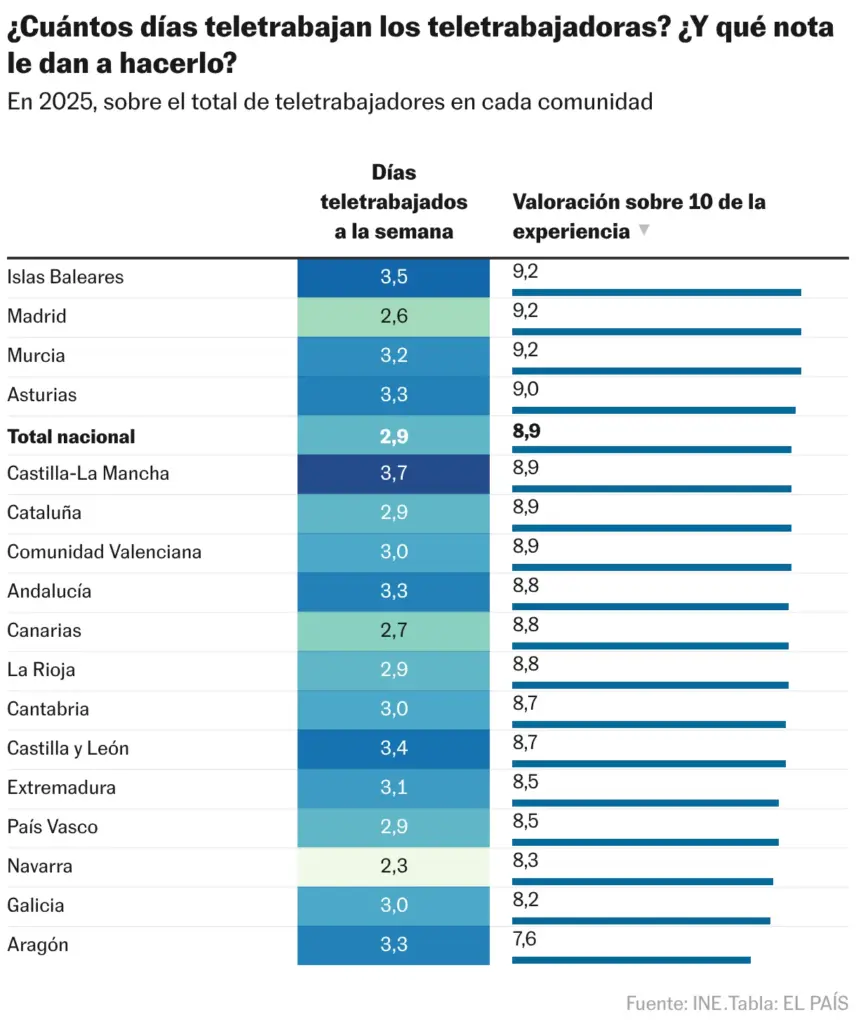
What is consistent across all territories is the positive assessment of teleworking by those who have the opportunity to do it. Spaniards give it, on average, a score of 8.9 out of 10 for the experience, with peaks of up to 9.2 in the Balearic Islands and Madrid. The lowest score is given by people from Aragon, still a notable 7.6.