









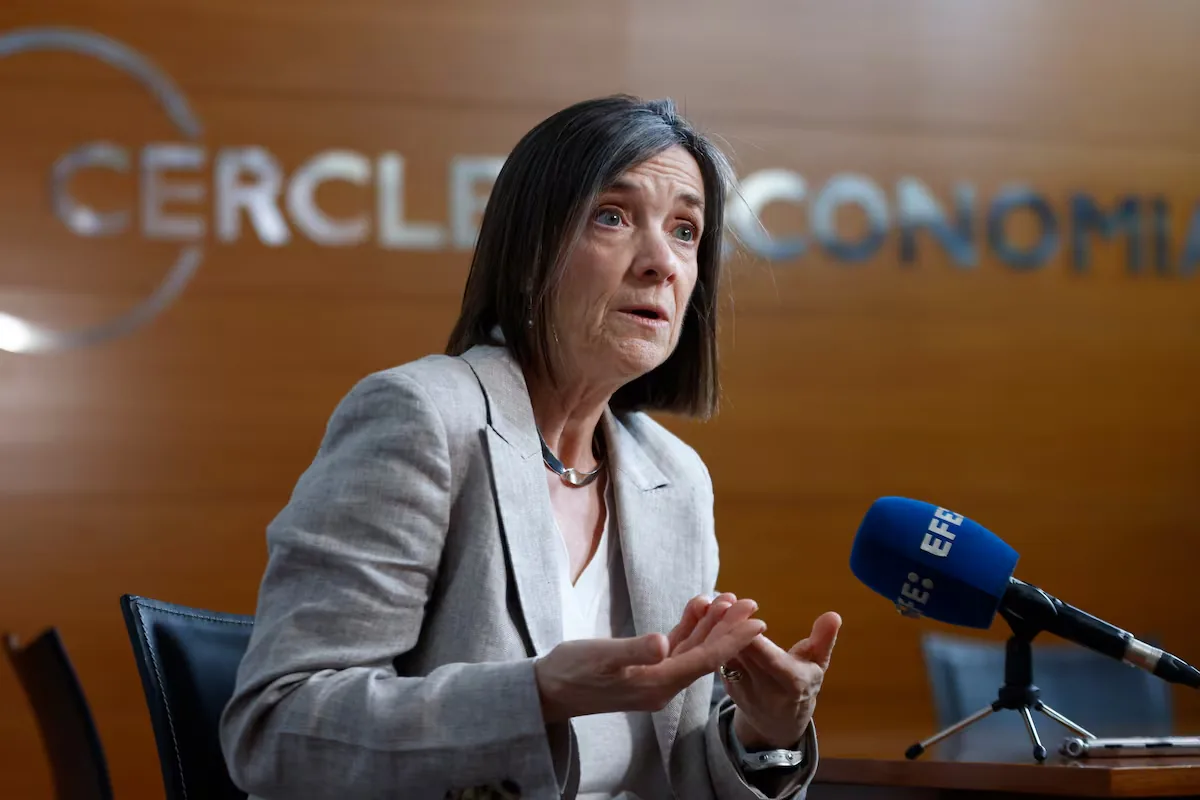
One step forward and one step back. The Circle of Economy has welcomed the president of the Generalitat, Salvador Illa, praising that he has reached an agreement with his parliamentary partners to approve a Budget after three years of extension. The president of the entity, Teresa García-Milà, highlighted that this is “very good news.” “We do not see it only as a budget agreement, but as a sign of normality and predictability,” García-Milà stated at the opening of the 40th Meeting of the Circle of Economy, held at the Barcelona Congress Palace. The reproach came, for the second consecutive year, regarding the Govern’s housing policy, which was judged to be “going in the wrong direction.”
Read more Niubó warns that a “no” to the reached agreement would lead to “a scenario of educational chaos”
Illa has come to the Circle this year with his homework done. Entrepreneurs have long been demanding Budgets that give the Govern stability to carry out the key projects ahead. In a context in Spain and Catalonia of several years without approved accounts, García-Milà considered that the PSC agreement with ERC and Comunes sends a “signal” of predictability. Not only to the business community. “It has great value,” said the president of the Circle, who put it into perspective: “We come from years of instability that have weakened credibility in Catalan institutions.”
The president of the Circle especially highlighted the investment consortium accompanying the budget pact, agreed between the Govern and ERC and which will be structured through a commercial company after Junts decided to block that initiative in Congress. “It will allow resources that are not executed to remain in Catalonia to be carried out later,” emphasized the president of the institution, who also highlighted the “shareholder change” in the Barcelona Free Zone Consortium. Despite these good news, García-Milà stated that the progressive majority, of 68 deputies, is very “tight” and recalled that the partners have “very diverse agendas.”
The economic lobby will dedicate the next three days to addressing the European Union’s “strategic autonomy,” necessary in the face of challenges coming from outside the borders of the Old Continent: from Russia and China, but also from the United States, with an increasingly defiant Donald Trump. García-Milà maintained that this strategic autonomy directly challenges the Generalitat, for example, in key sectors such as biotechnology, defense, or energy.
Catalonia, García-Milà said, has an “enviable” healthcare ecosystem, with top research centers and hospitals, but needs more funding. However, she highlighted that the community remains more lagging in the fields of the defense industry amid European rearmament and energy. “Catalonia, with a strong industrial base, cannot be left out of this process. Its weight is small and it is an anomaly that must be corrected,” she stated.
Read more A man in Canada pleads guilty to helping 14 people commit suicide
Not all has been praise for Illa. Even sharing the “diagnosis,” Catalan entrepreneurs still believe that the president’s housing policy is not the right one. “We must be frank. We recognize the willingness to act,” said the president of the Circle, “but there is a housing shortage and some well-intentioned measures are going in the wrong direction.” The Circle considers that price caps “slow down supply” and constitute a “regressive measure,” so they have invited Illa to “not shift the responsibility” for the lack of housing “to the owners,” but to develop the public-private initiative, mobilize land, and guarantee legal security.
Illa sees the caps as “positive”
Illa responded that he prefers to “make mistakes” rather than not try and asked entrepreneurs to “put themselves in the place of the president of the Generalitat.” Illa explained that on Friday he was at an event of the Catalan Institute of Finance (ICF) where several young people told him they could not afford rent despite having a “decent salary.” “How do I explain that to them, that in the short term no adequate measures are taken,” he said referring to the adoption of rent caps. “I cannot tell them to wait five years,” added the president, who judged that “in the short term” the results are “positive.”
The institution also referred to the Catalan productive model. García-Milà considered that Catalonia has grown in recent years, but with an extensive model that has meant more employment but “less productivity and stagnant wages.” And despite considering that “immigrants contribute a lot to the economy,” she pointed out that “immigration must be aligned with the productive model” being pursued. Illa replied that there are two models: that of economist and statistician Josep Antoni Vandellòs, who in 1935 warned of the dangers of immigration, and that of Jordi Pujol, who considered that immigration could also be a “hope.” “I am with the second,” he stated.
Read more Chess Videos | The Emigrant Gulko Delivers His Queen in the Long Term