








Lawyers experienced in jury trials know that, in high-profile cases, the oral hearing does not begin when the judge opens the session and the nine citizens take their seats and scrutinize the accused face to face for the first time; it begins much earlier. The people who these days read, listen to, and watch the news about the investigation into the death of the founder of Mango, Isak Andic, are potential members of the jury that, in a more or less near future—if the defense does not manage to dismiss the case earlier—will end up deciding whether he died accidentally or was a victim of a homicide committed by his eldest son, Jonathan Andic. That is why it is important, both for the prosecution and the defense, that certain ideas take strong hold in the imagination of those potential jurors who will face deliberation.
Read more The ultras flags of Abelardo de la Espriella
After being arrested, brought before the court, and finally released after paying a bail of one million euros, Jonathan Andic and his team launched an attack this week. First, with a public letter in which the eldest son announced his resignation from the vice presidency of Mango while proclaiming his innocence and lamenting the “partial, decontextualized, and distorted” view of the facts that had generated a “perception of guilt.” Aside from that gesture, the accused has entrusted the mission of fighting the battle of public opinion to private investigator Paco Marco, who has led the defense’s expert reports.
Marco went on Friday to the most listened-to radio station in Catalonia, RAC 1, to make a staunch defense of Jonathan’s innocence and put the spotlight on the head of investigation of the Mossos, whom he accused of falsifying evidence. The detective even called for an internal investigation in a high-voltage interview that, sources familiar with the strategy say, aimed to cut short the negative narrative about Jonathan after his arrest, like a basketball coach calling a timeout during a disastrous score. The idea was to come out, bite, and reverse the narrative because, as a veteran criminal lawyer says, “the people who will judge tomorrow are out on the street today.”
Jonathan’s handcuffs
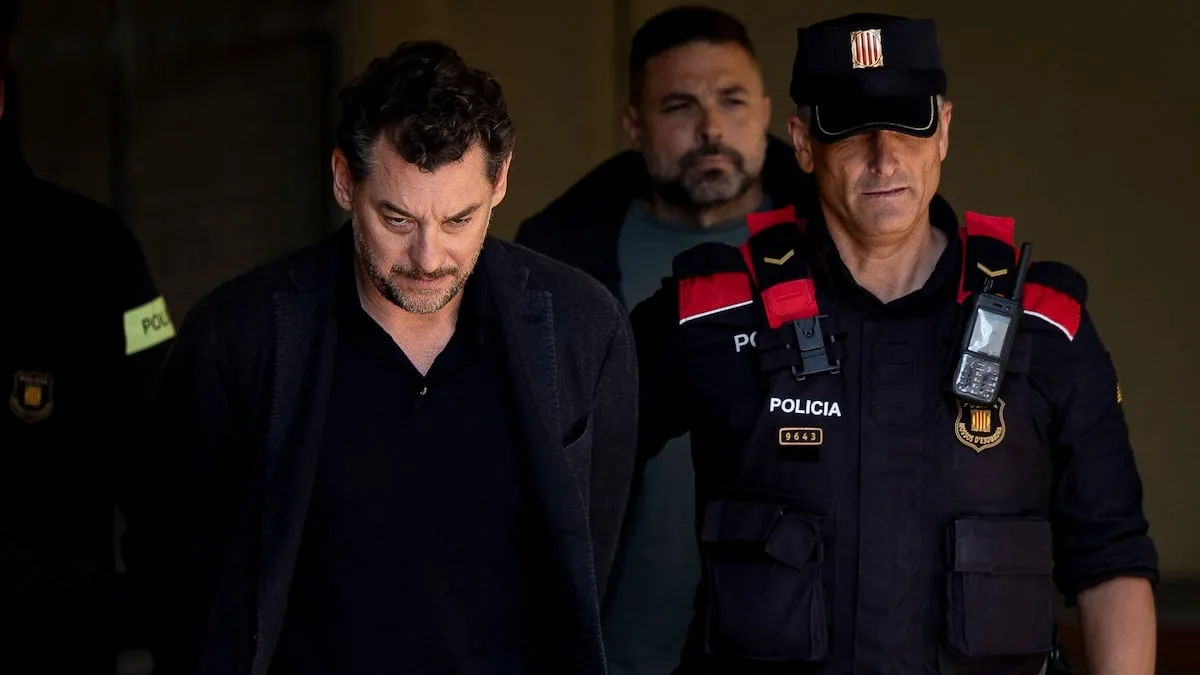
The Andic case investigates the death of the founder of Mango, at 71 years old, during a mountain excursion in Montserrat with his son on December 14, 2024. Isak died after leaving the Les Feixades path, sliding down an embankment, and falling off a cliff nearly 100 meters high. After a year and five months of secret investigation, on May 19 an unusual image was released that went around the world and, due to its impact, may be etched deeply in the memory of many of those future lay judges: the arrival at the Martorell courts (Barcelona), with hands handcuffed behind his back, of a somber and downcast Jonathan Andic, guarded by five Mossos d’Esquadra officers. “To the public, seeing someone in handcuffs can be equivalent to considering them guilty,” says another lawyer with years of jury experience.
For the police, the arrest was inevitable: faced with a serious fact such as an alleged homicide, there is no choice but to arrest the suspect and bring him before the court. It so happened, unfortunately for the accused, that the Martorell courts are among the worst judicial buildings in Catalonia: they are scattered across ground floors of an old complex of buildings, as if they were shops. So there was no way to discreetly escort the detainee, for example, through an underground parking lot that does not exist. Between arrival at the court, transfer to the cell (located in another court a few meters away), return before the judge to personally hear the judge’s decision, and release (after paying a bail of one million euros to avoid provisional imprisonment for flight risk), cameras captured his image up to four times.
The defense replies that the arrest was “completely unnecessary” because Jonathan Andic had appeared twice (as a witness) before the Mossos, had made himself available to the court, and had no intention of fleeing. But the most serious, in their view, is that the arrest has been an essential ingredient in the construction of the “anticipated social condemnation” suffered by the eldest son, according to the appeal by lawyer Cristóbal Martell against the bail order. And the problem with that supposed public condemnation (the “news penalty,” as it is commonly known) is that it can affect a process that, because it is a homicide crime, will have to be decided by a popular jury.
The judge’s order lists seven indications against Jonathan and attributes to him an “active and premeditated” role in his father’s death for an “economic motive.” In a case where there is no direct evidence (an image of the moment of the facts, a witness who saw what happened), there are two indications that seem to have more weight for the investigators: the accused’s visits to Montserrat in the days before the incident and the loss of his mobile phone on an alleged trip to Quito (Ecuador) months later. That is the narrative of facts, based on the Mossos’ reports, that was established on the day of the arrest and in the following days, until Andic’s team decided to go on the counterattack to refute it.
Convinced of his innocence, Jonathan Andic’s defense has been preparing exculpatory arguments since the investigation began. Until now, it had remained silent, waiting to know the judicial file, about 1,400 pages. His lawyers have also fought the battle in the strictly judicial sphere, through a detailed appeal that follows the order’s outline and, as if it were its reverse, tries to dismantle the indications one by one. The document requests the removal of the measures imposed on Jonathan (prohibition to leave Spain, passport withdrawal, weekly appearances at court) and presents parts of the case that may favor Jonathan, such as the transcription of his calls to 112 after the fall: “I need help. My father has fallen, we are in Collbató, he has fallen.” It also introduces elements of doubt about the investigation (noting errors and “confusions” by the judge) and denounces the “careful drip in the leaking of police investigation lines.”
Read more Sánchez questions the justice system’s treatment of the PSOE before his leadership