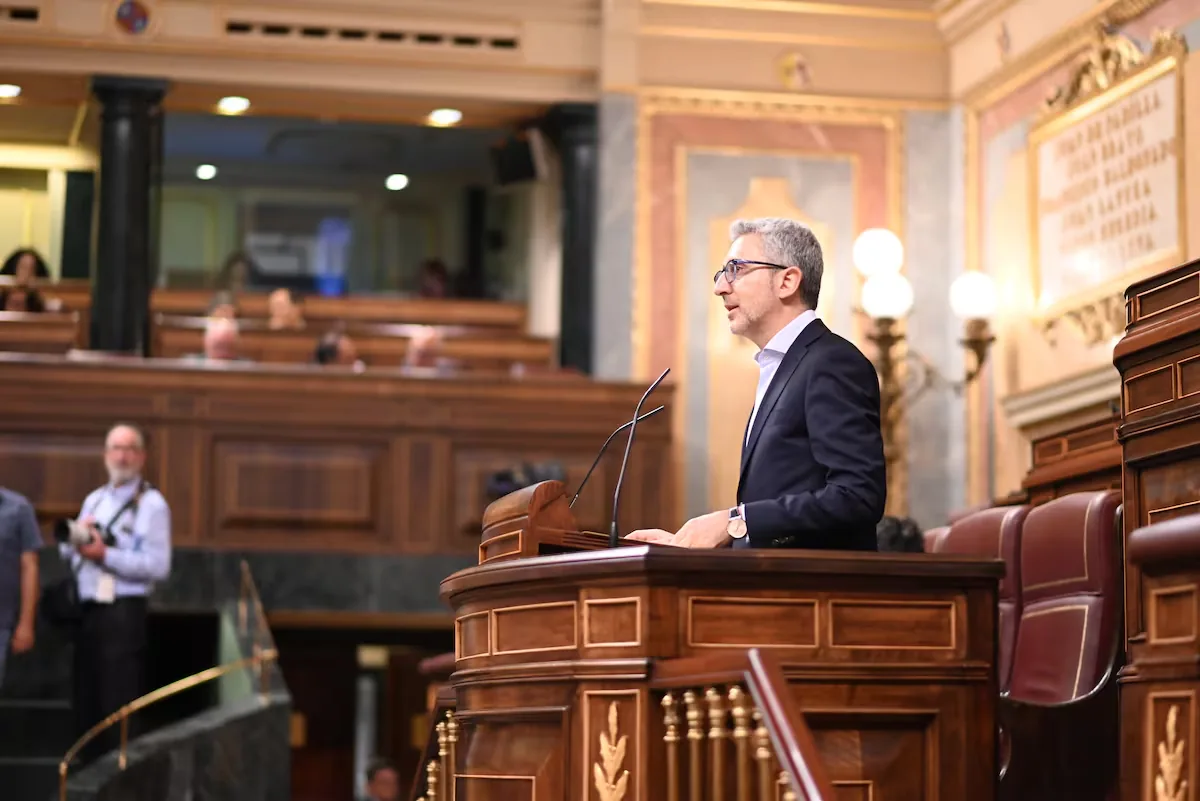






Breaking with years of budgetary paralysis requires more than just good words and a statement of intent. Especially when the Government has assured on three occasions that it would present new accounts and, for one reason or another, the promises ended up being empty words. The Minister of Finance, Arcadi España, appeared this Thursday in Congress with the mission of convincing a skeptical room that this time, after a prolonged drought, the Government is serious. He did so with a proposal that breaks the usual liturgy by assuring that he intends to negotiate the 2027 General State Budget (PGE) project with parliamentary groups even before the text officially enters the Congress register. It is a maneuver that seeks to overcome the ghost of perpetual extension that the Executive has been dragging since 2023, in a climate where partners’ trust is low and opposition reproaches offer no respite.
Read more Chapter 5: From parents to children
Since the last Budgets were approved, more than three years ago, the country has navigated a kind of exceptionality. The Government justifies this void as a response to what the minister defines as an unprecedented concatenation of adversities. The latest, the geopolitical conflict open in the Middle East and the energy crisis. Faced with this panorama, and amidst the scandals surrounding the judicial siege of the Government, President Pedro Sánchez wanted to make a statement and surprisingly announced on Wednesday that the budgetary machine would start rolling with a view to 2027, definitively burying the possibility of accounts for 2026.
A day after Sánchez’s words, it was the minister’s turn to defend the move in the Congress Finance Committee. “We are going to immediately launch the preparation of the Budgets,” España assured, confirming that this Friday the Official State Gazette (BOE) will publish the drafting order. The Treasury also wants these accounts to “be born from dialogue, agreement, and shared responsibility” beforehand. It is not just about presenting, but about agreeing on the foundations with the partners who then have to greenlight the project.
The minister attended his debut in the committee with the idea of conveying that willingness to dialogue from the very first intervention. It was an attempt to attract parliamentary groups who, from the outset ―both regular partners and those in the opposition― made it clear that they were wary of the Government’s announcement. The PNV spokesperson, Idoia Sagastizabal, voiced the sentiment of the investiture majority by reproaching the Government that “announcing is not negotiating and negotiating is not executing.” For the Basque nationalists, the pace of the ministry’s announcements far exceeds the reality of the facts, and they recalled that the Treasury has been making promises for too long. Is this latest one “a déjà vu of 2019″ or is it done to “stretch the legislature”?, the spokesperson asked.
It was not the only criticism. From ERC, Pilar Vallugera called the move a “pre-campaign announcement” to “relieve tension” in the current situation, while Néstor Rego, from BNG, received the news with “great caution,” recalling that it is the fourth consecutive year that the Government announces Budgets that, in the three previous years, remained unfulfilled. Other essential formations to push through potential accounts, such as Junts and Bildu, were not present in the debate.
Opposition forces, with a constructive tone that the minister acknowledged and that kept the debate in a climate of constant cordiality, ironized about the Government’s plan. Pablo Sáez Alonso-Muñumer, from Vox, challenged the minister to resign if the 2027 Budget turns out to be another broken promise. From the ranks of the Popular Party, Pedro Puy reproached that after three-quarters of the legislature, the Government continues to “repeat the same priorities” that the previous minister of the branch, María Jesús Montero, launched years ago, without having been able to approve accounts in three years.
Read more What heat awaits the pilgrims? Temperatures up to 34° during Pope Leo XIV’s visit to Spain
At the center of the debate was not only the calendar, but also content that the Executive wants to focus on social issues. The Government has set housing as the “absolute priority” of future accounts, promising the largest public investment effort in history. It is a commitment that seeks to attract left-wing groups, but Sumar, a coalition partner, has already warned that it will not settle for headlines. Its spokesperson, Carlos Martín Urriza, asked that the project be accompanied by the complete fiscal path and a greater deficit margin for the autonomous communities, rejecting a “two-stage” processing that would further delay the process.
The financing wall
At this moment, the major stumbling block hindering any agreement is the reform of the financing model, a topic that monopolized a large part of the session. “These Budgets will also address one of the great pending tasks: the reform of the autonomous financing system,” España explained. The Treasury has presented a model that would inject almost 21 billion additional euros from the central administration to the communities by 2027, but it has done so amidst a political firestorm with the territories governed by the PP, who reject the proposal because it was initially negotiated with Catalonia.
The minister sees it differently. He believes that the scheme proposed by the Government serves as a starting point, making it an open approach oriented towards agreement. He vehemently defended the “multilateralism” of the process, despite having called immediate individual meetings with the ministries. “The model is decided by the entire Chamber. Whether one wants it or not, it is multilateral because it is decided in Congress,” España concluded in response to criticism from the communities and the PP spokesperson regarding the bilateral meetings that the Treasury intends to hold before the Fiscal and Financial Policy Council, and which several PP territories have said they will not attend.
“They can consider whether they like it better or worse, but I ask them not to refuse to dialogue, not to refuse to sit down with the Government to try to reach an agreement beneficial for everyone,” España pleaded, aware of the great challenge involved in aligning the autonomous communities to shape the system that distributes the resources that then pay for public services.
In España’s first appearance before the committee, the minister extended his hand to the entire parliamentary spectrum and conveyed a willingness to work constructively. “Some will say I am naive, but I trust, and I will strive for it, that we are capable of overcoming the ‘with me or against me’ logic,” he said after exchanging opinions on other tax and macroeconomic issues such as the nature of taxes themselves, tax cuts, dumping, or support measures for businesses and households in the face of the energy crisis.
Read more They denounce the alleged police kidnapping of Zeynab Javadli, former sheikha of Dubai