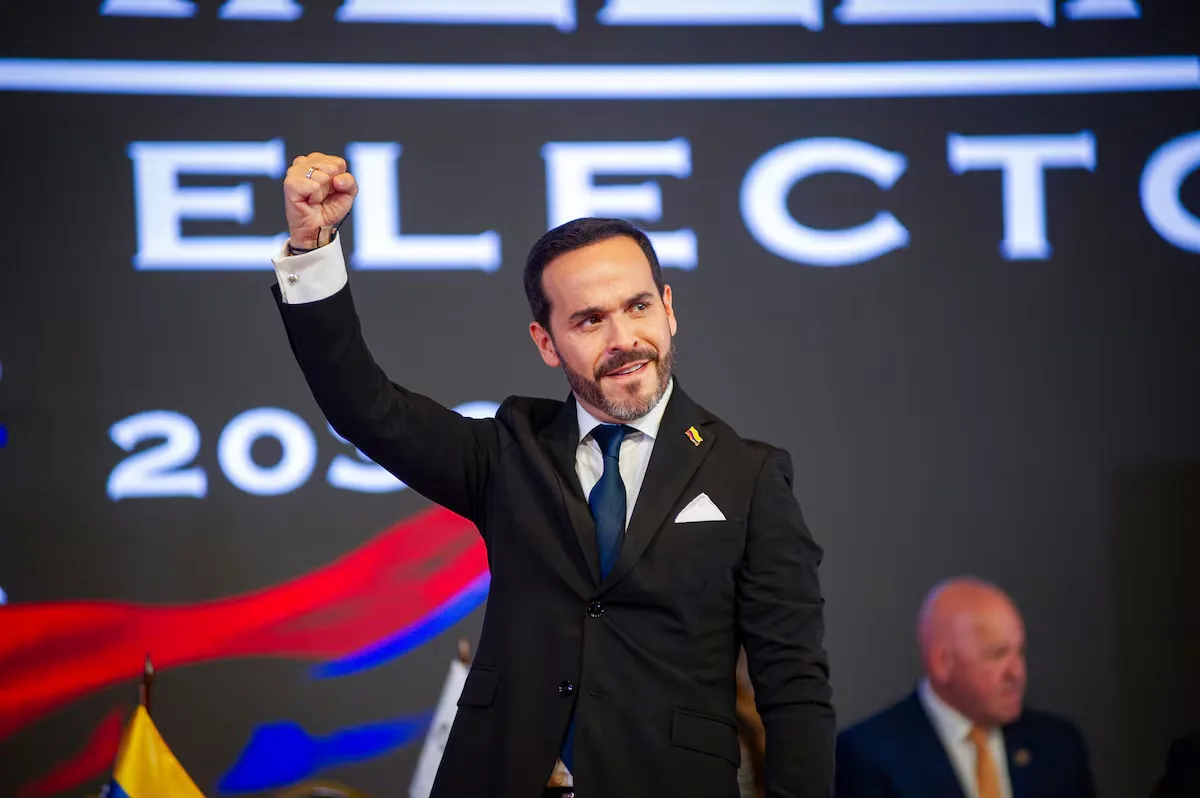


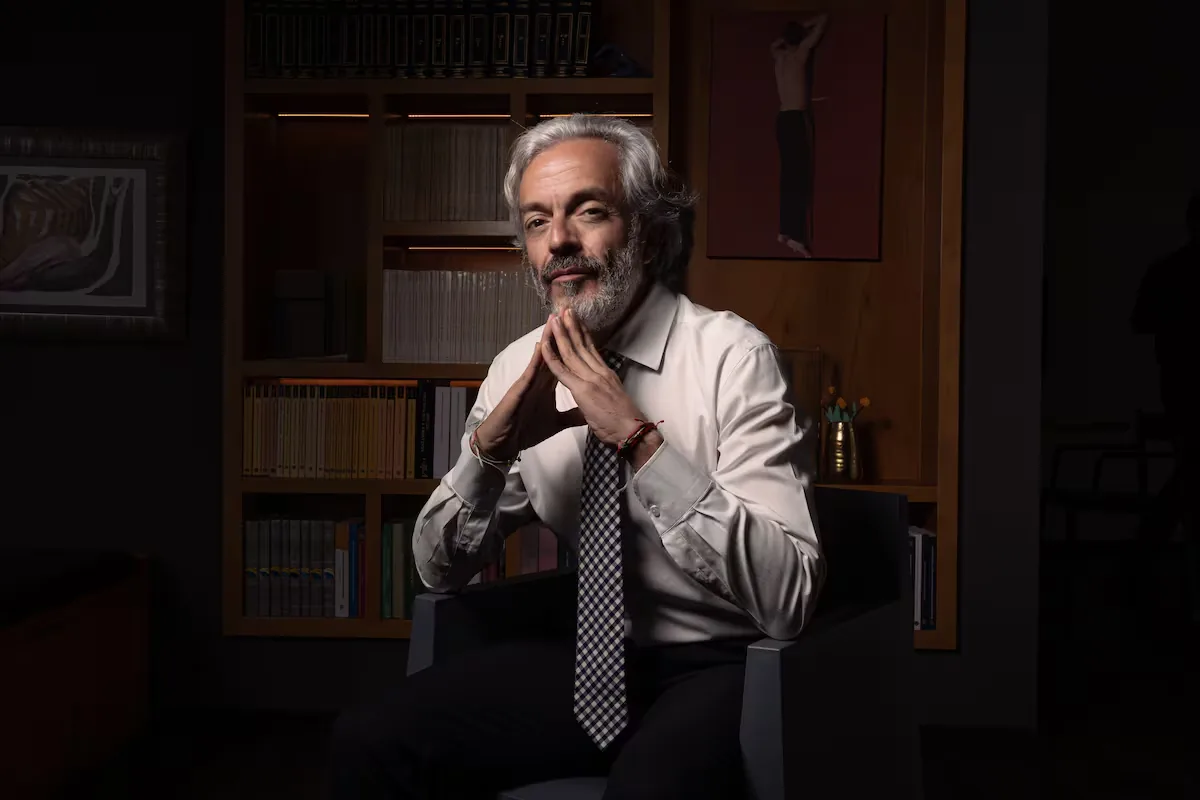
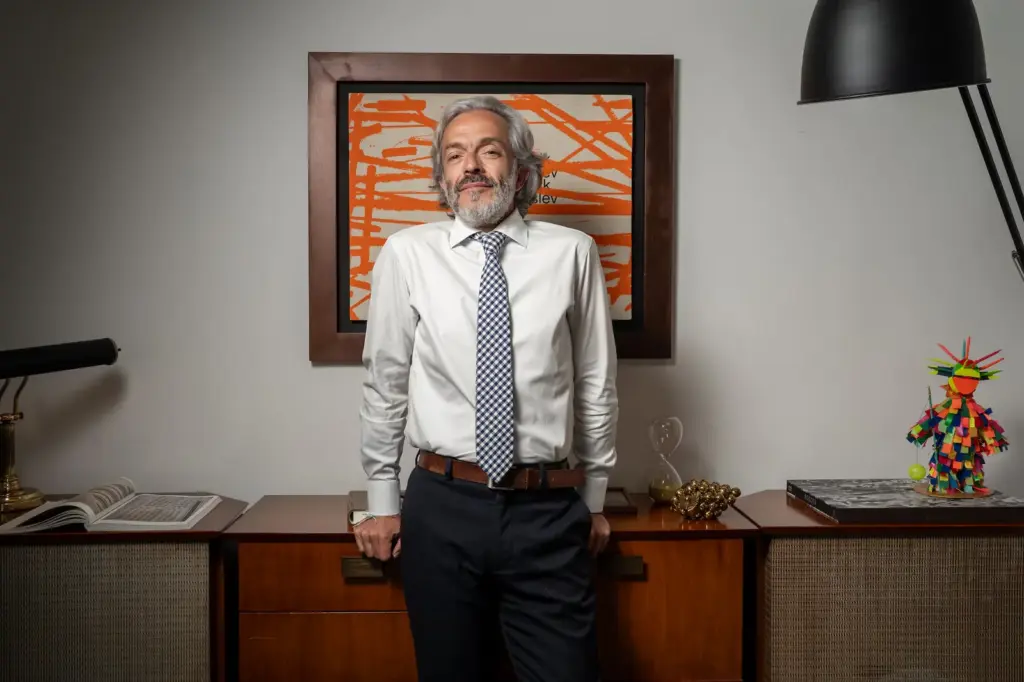
Former vice-presidential candidate Juan Daniel Oviedo (Bogotá, 49 years old) doesn’t beat around the bush when asked how he is. “Good. Although, what a tremendous blow we received on Sunday!” he replies. His ticket with Paloma Valencia suffered a resounding defeat in the first round: they barely obtained 6.9% of the votes, compared to 43.7% for the far-right Abelardo de la Espriella and 40.9% for the leftist Iván Cepeda. The electorate turned its back on their proposal for a “union among different people” — he identifies as centrist; she is a Uribista. “Now I understand that the country is not yet ready to amalgamate a conversation between the institutional right and my ideals,” Oviedo points out.
Read more Cepeda distances himself from Petro’s burdens
Valencia announced on election night her support for De la Espriella to defeat “neo-communism.” Her running mate looked at her with a stern face. He has avoided defining himself. In his office in downtown Bogotá, a whiteboard hangs where his team has summarized his dilemma. “Not palatable: ADLE – Dignity, IC – Constituent threats,” it reads. Next to it, “authenticity.” The economist celebrates that this Thursday the main red line against the left has disappeared: Cepeda and President Gustavo Petro have given up on promoting a constituent assembly. But he clarifies that he has not yet made up his mind. “We have to see if De la Espriella says he will protect the populations who felt violated by his discourse,” comments Oviedo, who is openly gay and suffered homophobic comments from the ultra during the campaign.
Question. You acknowledged in a video that your message of “uniting different people” failed. What does that tell us about Colombia?
Answer. Yes, we failed. Gustavo Petro’s government turned politics into a disease: people are affected by waking up and knowing what the president wrote on X. So they didn’t go out to vote for a politician, but for a doctor who would cure them of that illness. They didn’t care if the doctor was unfaithful at home or where the money came from. Second, the government extinguished Colombia’s future: people didn’t vote for a proposal for the future, like the one we made to reduce informality or inequality, but for a present supremely contaminated with the hatreds of the past. It was difficult to dissociate ourselves from that.
Q. You already knew that, but you still bet on that message.
A. We were in a scenario where Colombia had asked for it. The media said a year ago why so many candidates, that there were like 105, that we should unite. And that’s what we did. The result of that whole process was La Gran Consulta, which defined that Paloma Valencia should lead and I should accompany her as vice president. I believed that bringing together two scars, with Paloma with the ‘no’ to the peace agreement and Oviedo with the ‘yes’, would be a criterion for reconciliation.
Q. Academic Yann Basset commented a few days ago to this newspaper that the collapse of the center shows that Colombians like polarization, the confrontation between extremes.
A. He’s right, they like it because our past is violent: it’s been 70 years of killing each other for thinking differently. But perhaps, more than liking it, we have internalized polarization as a decision criterion. The government wanted us to watch the soap opera that the rich also cry, something many people like. And another one came out, Abelardo’s, that everything is solved with a miracle. The phobia of Petro gave space to the populist right.
Q. Some Uribistas criticize you for publicly questioning Valencia during the campaign and point to you as responsible for the leakage of votes to De la Espriella. What is your response?
A. It’s tremendous how, in Colombia, disagreeing means becoming “anti.” Disagreeing with Álvaro Uribe being Minister of Defense made me anti-Uribista. It can’t be like that. I learned that uniting different people in Colombia is still very difficult. The left took advantage of us having included Uribe in this duo to say that we were going back 20 years.
Q. So, in your next candidacy, you won’t get involved with Uribe?
A. It’s already clear that if uniting different people is difficult, we first have to scale our political capital. That’s why we will surely participate in next year’s territorial elections. If we want to regain people’s trust, we have to do it with actions: show them the capacity to govern. Attitudes of seriousness and respect are not enough.
Q. Were the votes that leaked Valencia’s or yours?
A. Our internal polls did not foresee this scenario four days before the campaign; the Uribistas ultimately went to Abelardo. And there are analyses that some centrist voters who supported me in the consultation later went with [Sergio] Fajardo. They copied his moralizing stance, that he would never sit down with certain politicians, and they also empathized with it being his last aspiration.
Q. What was your biggest campaign disagreement with Valencia?
A. That she thought I was contradicting her when I opposed her bringing Uribe into the Cabinet. Her reaction was: “Don’t contradict me, I’m the president.” Everyone thought we were fighting, it created doubt among centrists about whether we would have a voice. And then the coffee with Fajardo. She wanted us to make a joint invitation, and I didn’t agree. It wasn’t the time to open up a vindicating space for him. I already knew, from conversations we had last year, that he would never team up with Uribismo. It hurt me a lot how he treated her, although she was very good and I think, in reality, it turned out badly for him.
Q. How is your relationship with Valencia now? Are you friends?
A. Always, a personal relationship was built here: she trusted me and I trusted her. I will continue to go out to eat with her, seeing Amapola [her daughter] and Tomás [her husband]. The political relationship may break because now I understand that the country is not yet ready for the amalgamation between the institutional right of the Democratic Center and my ideals. For them, immediately supporting Abelardo does not imply the cost of risking the rights of historically discriminated minorities. For me, it does.
Q. You still avoid defining whom to support in the second round…
A. We have to try to de-radicalize this in the coming weeks, see what each one does. I will define myself. I want to tell the country, when I define it, which of the three options [De la Espriella, Cepeda, blank] I will vote for on June 21.
Q. If you emphasize the defense of minority rights, are there three options or really only Cepeda or blank?
Read more More security and inclusion elements: this is the new INE voter ID
A. There are three. The question of whether we go against the Constitution or against rights is already beginning to be resolved; Cepeda and Petro have renounced the idea of a constituent assembly, which was a very significant risk for the country’s stability. Now we have to wait to see if De la Espriella says he will protect the populations who felt violated by his discourse until now. He could say that he will preserve the principles of the Ministry of Equality.
Q. Your main barrier to voting for Cepeda fell this Thursday. What is missing to define your support for him?
A. There are other barriers, such as the issue of our mining-energy capital. If we don’t take advantage of it, we won’t have the money to solve the social infrastructure debt: tertiary roads, aqueducts, sewage systems. I would also like a commitment to de-Uribize the next four years. In the first round, Cepeda only talked about Uribe. We have to give signs of greatness for a youth that wants to be able to vote for something that responds to their needs.
Q. Are you not at least a little closer to voting for Cepeda?
A. No. It’s great that the shadows of the constituent assembly are gone, Colombia wins, but we need to hear more, for them to go to debates and speak frankly. We need something more than voting to get rid of Petro’s illness or to prevent the rich from returning to power, which is what people say on the street.
Q. Do you think De la Espriella will commit to protecting minority rights, as you ask?
A. I hope he does, for Colombia. If Cepeda extinguished the populist extreme of a constituent assembly, we must be able to listen to Abelardo: for him to explain how he will protect women, peasants, black people, indigenous people, migrants, victims, the LGBTI population. This government leaves many open crises: security, health, corruption.
Q. And would you believe De la Espriella?
A. We have to believe, just as we have to believe Cepeda about the constituent assembly. Although the difference is that forming a constituent assembly takes a long time. If they withdraw the promoting committee today, they will no longer be able to pull the wool over our eyes and convene it in the next government. It would have to be in the one after that.
Q. You pointed out De la Espriella’s homophobia and machismo…
A. Everyone thinks I’m resentful, that my vote will be out of hatred, that I’m going to vote for Cepeda because Abelardo treated me badly as a queer person. And no, that’s not my feeling. I wrote to Paloma when she invited me for coffee to convince me not to vote for Cepeda and I told her: “Love, who told you I was going to do that?”
Q. With Valencia, you did agree to run on a ticket despite her being against adoption by same-sex couples…
A. Because eliminating it was not her cause, she was not going to convene a constitutional referendum to prohibit adoption. Abelardo, on the other hand, wants to take us out of the United Nations, which implies losing protections for women, sexual diversity, the trans population.
Q. Most of your colleagues from La Gran Consulta have opted for De la Espriella, without waiting for any commitment. What do you think?
A. Good for them, I respect them. Perhaps they are an expression that Petro is the most serious illness, and I share the risk that continuing with that institutional drift implies. But Colombia is not in a position to put respect for the Constitution and economic progress against the rights of minorities on the same scale. It’s a very strong, very costly dilemma. Colombians don’t deserve that.
Q. You and your team have studied the profile of your voters, as you said after La Gran Consulta. What would they prioritize?
A. My voter is pro-rights. And I love that voter, and I won’t fail them, because I won’t fail myself.
Read more Rain ruins the first day of Primavera Sound
Q. So you won’t support De la Espriella…
A. He can still make commitments, like not withdrawing us from the UN.