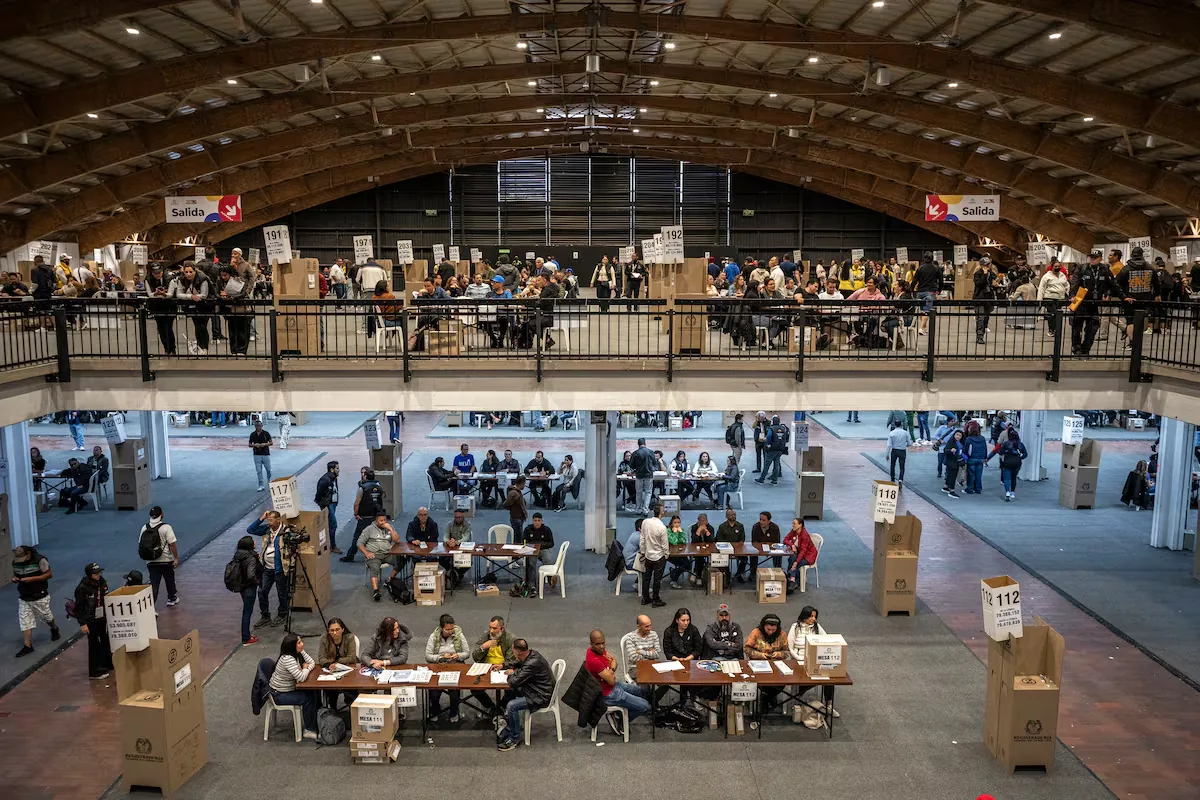

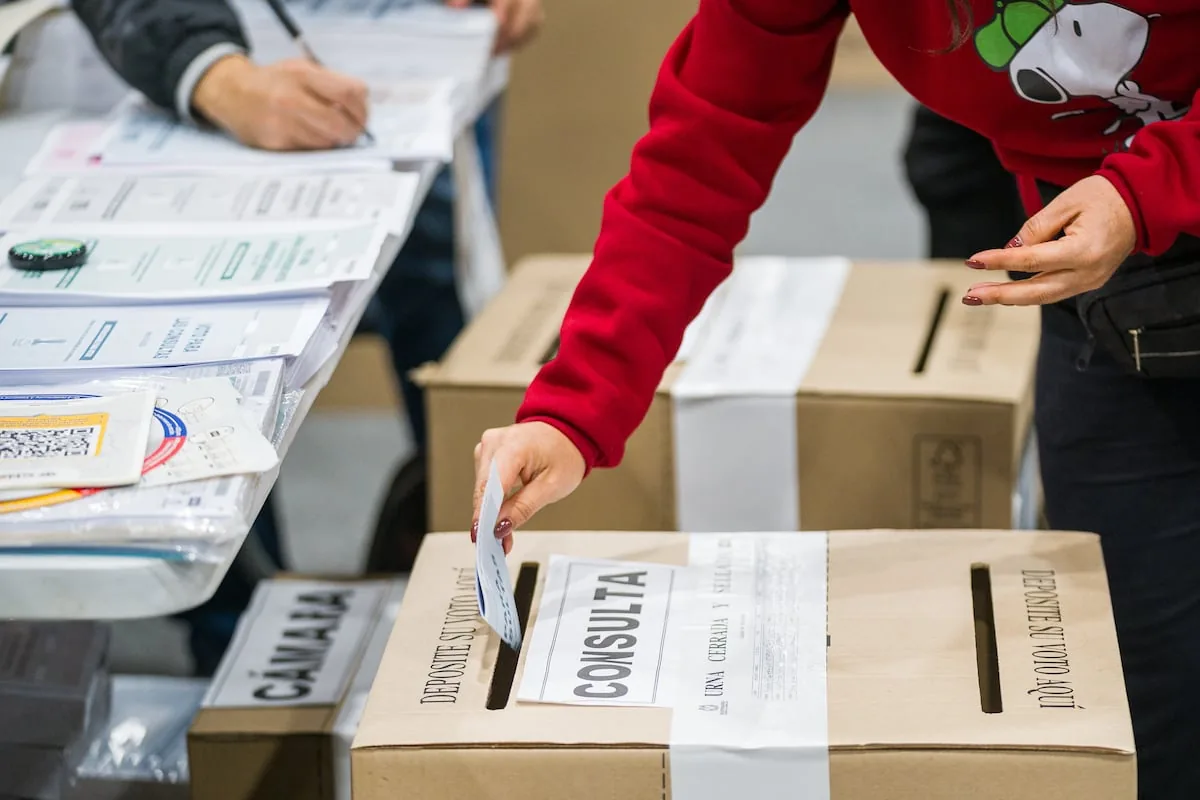
“This law aims to create an electoral organization free from the influences of political parties, whose operation does not allow any party or political group to gain advantages over others in obtaining the citizenship card for their members, nor in the formation of electoral rolls, nor in voting and counting; and whose regulations guarantee the full responsibility and political impartiality of the officials assigned to it.” This was established by Article 1 of Law 89 of 1948, approved after the Bogotazo, with the support of the Liberal and Conservative parties, as a response to a shared concern about the credibility of the electoral system.
Read more Organize the garden in one day with the best-selling storage shed on Amazon
A long time has passed since then; however, one of the issues that remains a subject of debate is how to guarantee trust in elections and the free democratic process. The 1991 Constitution sought to advance in that direction and designed an electoral organization with the status of an autonomous and independent body. Nevertheless, the 2003 constitutional reform granted political parties a power that ended up compromising the autonomy and independence of one of the two electoral authorities: the National Electoral Council (CNE).
For several years, the CNE has been the target of repeated criticism for its alleged partiality and lack of transparency, criticisms that have intensified recently. Improvement proposals are also not new. However, in this scenario, it is relevant to revisit those proposed by various authors who advocate for rethinking its institutional design in order to consolidate a truly independent electoral authority.
Simply put, the CNE regulates, inspects, monitors, and controls the electoral activity of parties and political movements, ensuring compliance with the principles and duties that correspond to them. In addition to this central function, it performs other high-responsibility tasks, such as collaborating in the conduct of internal consultations, safeguarding the rights of the opposition and minorities, and ensuring that electoral processes are carried out with full guarantees. Despite this, Legislative Act 01 of 2003 politicized the origin and composition of the CNE by modifying the appointment system of its magistrates.
The history of the Colombian electoral system shows that it has been marked either by direct government control or by partisan control, without the country having had a fully independent electoral body, except for brief periods. In 1916, for example, Law 85 allowed the then Great Electoral Council to be composed of members elected by the Senate and the House of Representatives.
A significant change occurred in 1948 with the aforementioned Law 89, which created the Electoral Court (predecessor of the CNE) and the National Civil Registry, separating the functions of material organization from those of scrutiny and oversight. This division sought to ensure impartiality vis-à-vis the Executive power. Later, after the fall of the Rojas Pinilla dictatorship, Decree 399 of 1957 stipulated that the Supreme Court of Justice appoint some delegates to the Electoral Court, ensuring parity between liberals and conservatives and consolidating a model of judicial mediation that deepened with Law 23 of 1979, establishing that its members would be elected directly by the Supreme Court according to the electoral results of the last parliamentary elections.
Before 1991, the system shifted from a government-led model to one controlled by political parties. However, the judicial filter in the appointment of members of the electoral body remained between 1948 and the 1980s, providing a moderating element against partisan influence. The 1991 Constitution initially preserved that logic of judicial mediation, transferring the nominating power from the Supreme Court to the Council of State. Legislative Act 01 of 2003 eliminated this intervention and gave Congress the direct election of the CNE magistrates.
Since 2003, those who make up the CNE are elected by the full Congress, but retaining party nomination. As Juan Fernando Jaramillo warned, this major change—and what constitutes the current structural problem of the CNE—lies in that the controlled subjects began to choose their own controllers. In colloquial terms, the situation can be described as “the mouse choosing the cheese guardian.” A constitutional reform that seemed to have forgotten the institutional memory of the country: a regression.
The CNE magistrates are elected for a four-year term through the “proportional representation system.” The result is that the magistracies are distributed proportionally according to the number of seats that the different political groups have obtained in Congress. Without going into further mathematical calculations, this change in the appointment method delegitimizes the role of the CNE as an autonomous and independent body for at least three reasons.
Read more The compact shoe organizer that saves space at home: holds up to 12 pairs
First, the dependence of the magistrates on the legislative caucuses. Several functions of the CNE relate to the internal activity of parties and political movements. The distribution of contributions for electoral campaigns or the recognition or revocation of the legal status of these organizations are some examples. This “origin flaw,” which replaced judicial mediation with a predominantly political election, facilitates that the groups divide the nine available seats and that those who make up the CNE acquire commitments with the organizations that supported their nomination and election. Autonomy and independence cannot be spoken of when the decisions of this body may be motivated by political loyalties.
Second, political and partisan interference in the CNE can delegitimize the objectivity and impartiality of its decisions. It is no coincidence that various sectors today question that the body adopts decisions perceived as partisan rather than objective and neutral. The proportional representation system can lead to the major parties dividing the magistracies as spoils or party quotas. This composition makes the CNE function more as a possible arena for political trend negotiation than as a neutral technical authority. Being a reflection of the forces in Congress, there is a risk that decisions are not based on law but on loyalty to the party.
Third, the possibility of re-election can subject magistrates to the interests of the politicians in power. Although the Constitution allows only one re-election, this option can lead those who make up the CNE to adjust their behavior to the political forces that, at any given time, have the capacity to ensure their permanence in office. It is not necessarily about fixed loyalties to the majorities that initially elected them, as these may vary, but the risk that the magistrate, aware of the need to obtain Congress’s support again, modulates their decisions to avoid affecting those who could influence their continuity. In a fully technical and depoliticized body, re-election could be desirable due to accumulated experience and institutional learning curve. However, in the current scenario, this possibility tends to reinforce the political dependence of those who should exercise control over the parties themselves.
As long as the CNE retains this original design, its legitimacy, impartiality, and autonomy will remain in question. Regarding solutions, the has proposed a restructuring in which magistrates are elected by the high courts, from shortlists formed by themselves and in a staggered manner, avoiding that the nominator is the one who chooses. It also suggests extending the term to eight years and prohibiting re-election. Pedro Vanegas proposes the creation of an electoral jurisdiction and a supreme electoral court, oriented towards greater judicialization. Juan Fernando Jaramillo, for his part, proposes abolishing the CNE, transferring its administrative functions to the Registry and the jurisdictional ones to a specialized judicial body.
A reform to Article 264 of the Constitution would be a first step to correct the main problem: political appointment. It would be enough to restore a judicial appointment model both in nomination and election, similar to what existed before 2003. If this discussion teaches anything, it is that electoral bodies, precisely because they do not belong to any of the three traditional branches of power, must be kept at a real distance from political interventions. Experiences like those of Uruguay, Costa Rica, or Brazil demonstrate that it is desirable and possible to have autonomous and independent electoral authorities.
Moments of crisis in an institution can constitute opportunities to rethink designs that strengthen the fulfillment of its functions. In the Colombian case, the country’s complex trajectory in the search for reliable elections that guarantee political peace and the consolidation of democratic openness must not be forgotten.
The 1991 constitutional project strengthened democracy and political rights; it is now time to settle the pending institutional debt and improve one of the bodies most called upon to make them effective.