









“Solidaridad was born to fight against the unions that have usurped the representation of workers.” This is how Vox titled a press release published on September 14, 2020, which reported on Santiago Abascal’s participation in the founding event of this union. The far-right leader said that Solidaridad was launched “in response to the helplessness caused by corrupt and extremist unions.” Five and a half years after that day, the unions he referred to (CC OO and UGT) still dominate collective bargaining in Spain representing the workers, while Solidaridad remains irrelevant in dialogue with employers. According to data provided by the Ministry of Labor to this newspaper, the union associated with Vox only participated in the signing of two out of a thousand collective agreements signed in Spain in 2025. The Labor statistics do not detail the names of the companies that sign the agreements.
Read more Has Venezuela changed since Maduro’s departure?

The agreement statistics include information on 1,017 agreements signed throughout last year. The unions that participated in the most negotiations and signed the most agreements were UGT (628 agreements) and CC OO (619), followed by the Basque unions ELA (149) and LAB (99). Also notable in the statistics are USO (94), the Galician CIG (59), and CGT (54). Below that representation, Labor groups the rest of the unions under “other unions,” participants in 220 agreements. Solidaridad, Vox’s union, is among them.
The public registry does not allow disaggregation of that catch-all category, but at this newspaper’s request, the ministry has checked how many agreements bear Solidaridad’s signature. In 2025, it participated in two of those 220 agreements. Moreover, in the entire historical dataset, only 14 agreements signed by this union are recorded. The information comes from the Registry and Deposit of Collective Agreements, where the unions themselves complete the information and specify which unions participate in signing each agreement.
This newspaper has asked Solidaridad to comment on these agreement data, but it has not responded. It also does not specify its number of delegates in companies nor its membership figures. The major class unions and regional ones do provide this: CC OO has one million members and 116,800 delegates; UGT, 984,000 members and 110,000 delegates; USO, 149,300 and 13,100; CGT, 100,000 and 5,500; ELA, 104,000 and 9,800; CIG, 88,000 and 5,500; and LAB, 50,000 and 5,500. Other important sectoral unions in Spain include the civil servants’ CSIF (261,300 members and 12,700 delegates) and the nurses’ SATSE (138,000 and 2,100).
The first general secretary of the union, Rodrigo Alonso, is a deputy in the Andalusian Parliament for Vox and will run again as the lead candidate for the province of Almería in the May 17 elections. He was succeeded a year ago by Jordi de la Fuente, a representative of the Barcelona Provincial Council for Vox. Previously, he was a leader of the neo-Nazi party Movimiento Social Republicano and also organizational secretary of the xenophobic formation Plataforma per Catalunya.
Why doesn’t Solidaridad have more presence?
Steven Forti, professor of Contemporary History at the Autonomous University of Barcelona and specialist in far-right movements, believes that among the reasons explaining Solidaridad’s limited success is that “class unions in Spain remain rooted in the territory and demonstrate resilience.” He also emphasizes that UGT and CC OO have achieved “important victories in the last seven years, with the approval of laws that have improved workers’ living conditions.”
Furthermore, Forti directly points to Vox’s ideological positions: “Although Vox has tried, at least rhetorically, to add some social touches to its discourse, its policies are ultra-liberal in nature, even praising Milei’s chainsaw: how can a worker think that a union linked to Vox can defend their interests? Let’s say it’s not credible, and this obviously complicates Solidaridad’s work.” Thus, although Vox is increasingly penetrating the working-class electorate, for now its union does not replicate that strength.
For his part, Francisco Fernández-Trujillo, professor at the Complutense University of Madrid, believes that Vox is disadvantaged by “its nature as a satellite organization of a party.” Although CC OO and UGT ideologically coincide in many positions with the political left, they have been formally detached from the main parties for decades (CC OO from the PCE and UGT from the PSOE). “Their discourse is individualizing and stirs up ideas of the Spanish far right. It is hard for me to see how someone wanting to protect their labor conditions would find reliability in this organization in that regard,” he adds.
Fernández-Trujillo knows the case of Solidaridad closely because the sector on which his doctoral thesis focused (From Precariousness to Conflict. The Case of Digital Food Delivery Platforms in Spain) is one of the most relevant for the union.
This specialist argues that Solidaridad’s “intervention niche” lies in “those sectors that represent a neoliberal reformulation of work, tending toward the individualization of labor relations, or sectors that for various reasons have been exposed to and challenged by reactionary and authoritarian positions.” Among them, he cites security, labor sectors with “competition from migrant workers,” where traditional unions’ practice “has left aside part of the workforce as temporary and outsourced” and where minority unionism “has not been able to reach.”
The union elections at Glovo (ongoing in recent months due to the labor formalization the company has been forced into) included several of these elements, and Solidaridad strove to fight in them. In January, Solidaridad’s own website dedicated a specific tab to “riders” — now removed — right in the midst of these union elections.
Read more Inflation and the strength of the labor market drive taxation on wages and pensions to record levels
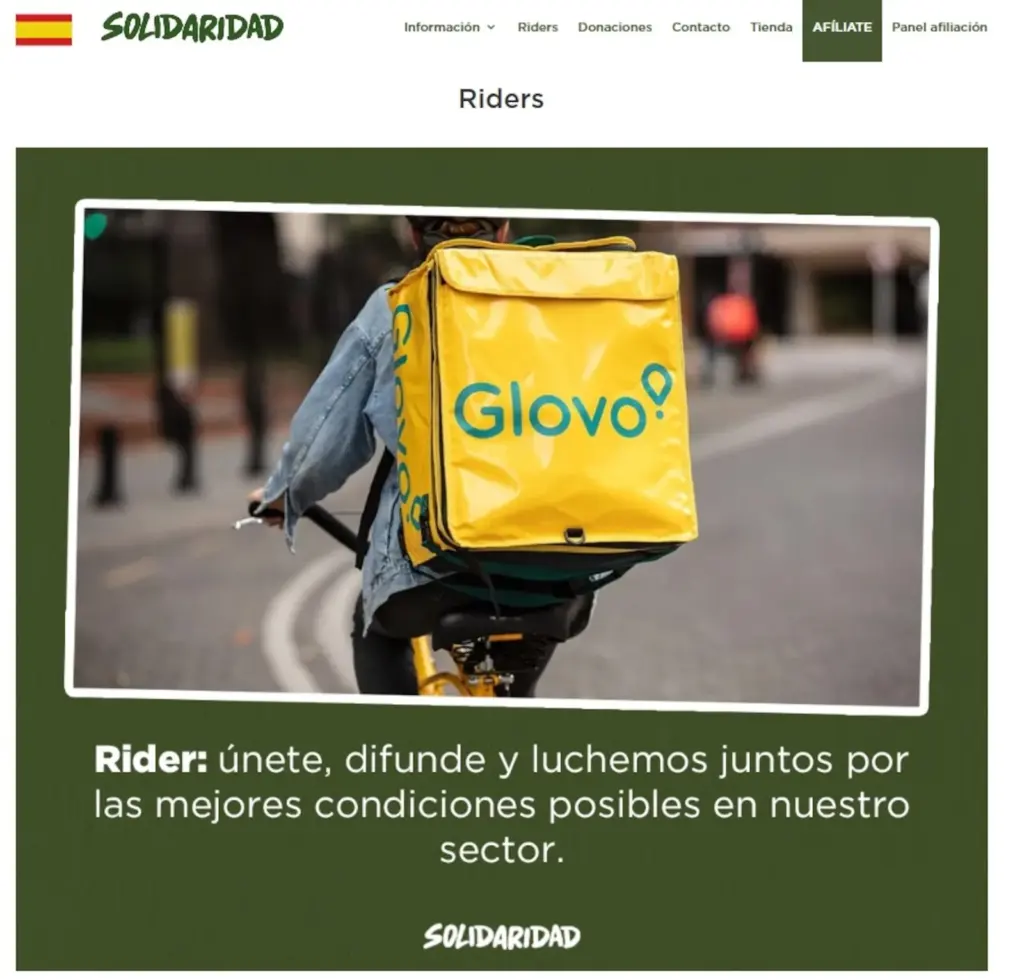
Then, a few days before the elections in the province with the most delivery workers, Madrid, a WhatsApp channel of the union with 900 members was buzzing. “We are not here to guide lambs, we are here to awaken lions. A different company is impossible with the same old ones. It’s time for those who live off subsidies and your effort to tremble!” Solidaridad said in a message on January 21, four days before the Madrid elections.
Despite these efforts, they barely win representatives at Glovo. In the main elections held so far, those in Madrid, they won three delegates out of 25 at stake. In other provinces, CC OO and UGT have also won very clearly, and Solidaridad has not obtained any more representatives than the three from Madrid, despite its efforts to gain representation in the sector. Of the 137 delegates elected in total, CC OO has secured 80, UGT 33, and other unions 24, among which are Solidaridad’s only three Madrid delegates.
The European landscape
Forti indicates that the European far right uses two strategies to penetrate the union world: “Either they create their own union as in the case of Solidaridad and the Italian General Labor Union (UGL), or they try to penetrate existing unions as, for example, in France.”
In the Italian case, Forti points out that UGL is “the transformation of the neo-fascist union CISNAL, linked to the Italian Social Movement, which after 1945 defended fascist corporatism.” He indicates it remains a “minority” union with little presence in companies, “nothing comparable to the three major unions: CGIL, CISL, and UIL.” “The Meloni government has given it much visibility and support, so it has scored some victories,” adds the Autonomous University of Barcelona specialist. The UGL general secretary participated in the 2020 founding event of Solidaridad.
Dominique Andolfatto, professor of Political Science at the University of Burgundy and specialist in unionism, holds that French unions “are today very autonomous and no longer have links — beyond ideological ones — with political parties.” “There are no relations between them and far-right organizations, particularly the National Rally [Marine Le Pen’s party]. However, the various union organizations are more or less permeable to certain far-right ideas,” adds this specialist. Nonetheless, he emphasizes that the country’s two main unions (CGT and CFDT) “systematically exclude their militants or members who publicly position themselves in favor of the far right.”
“National Rally,” Andolfatto continues, “develops a very social discourse, even a kind of discourse inspired by what could be considered a primitive Marxism.” Forti believes that vocation is very different from Vox’s and, at the same time, from Solidaridad’s. “All far-rights defend the neoliberal model, but in other countries, like Italy or France, both in the past and present, the far rights have shown more social sensitivity. This is not the case with Vox,” he opines.
In October 2024, Solidaridad announced the launch of the Confederation of Patriotic Unions, “with the aim of defending the sovereignty of nations as a fundamental pillar for the protection of workers,” the union’s press release stated. Neither that statement details which other European workers’ associations are part of this confederation nor does Solidaridad specify it when asked by this newspaper.
Ludovic Voet: “They are not authentic unions”
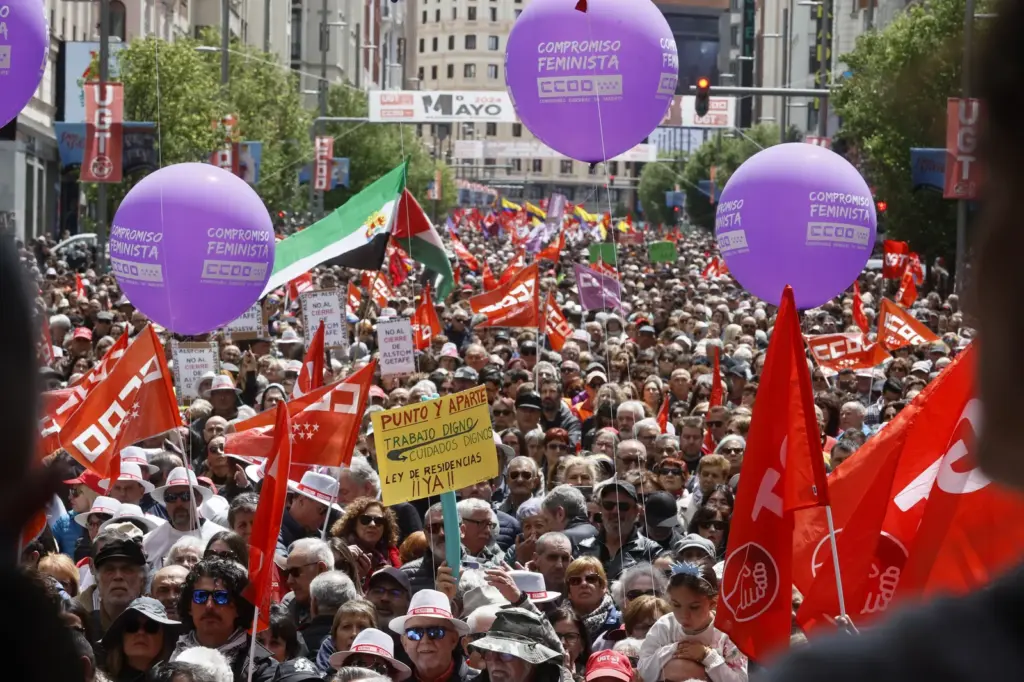
The major European unions organize themselves in the European Trade Union Confederation (ETUC), which includes UGT and CC OO along with 92 other unions representing about 45 million European workers. Ludovic Voet, confederal secretary of the organization, considers that unions linked to the far right “are not authentic unions.” “A union exists to unite workers in order to improve their working conditions, wages, and rights. What we see in organizations linked to the far right is the opposite. They divide workers, spread hatred, and weaken collective organization,” Voet opines, answering EL PAÍS’s questions by email. He directly points to Solidaridad, “created in Vox’s orbit, with a very explicit goal: to compete with traditional unions, introduce far-right ideas into workplaces, and act as a transmission belt for a political project.”
Voet emphasizes that these organizations “often have difficulties consolidating as real unions” because “workers are not naive.” “That is why many of these organizations, even when they claim to have many members, struggle to win union elections or build real influence. We see this, for example, with initiatives like Zentrum in Germany, which have had limited success in labor representation,” Voet adds, before qualifying: “On the other hand, we must not underestimate them. Their role is not only organizational but also ideological. They try to shift debates within workplaces, spread narratives, and divert attention from employers’ responsibility.”