









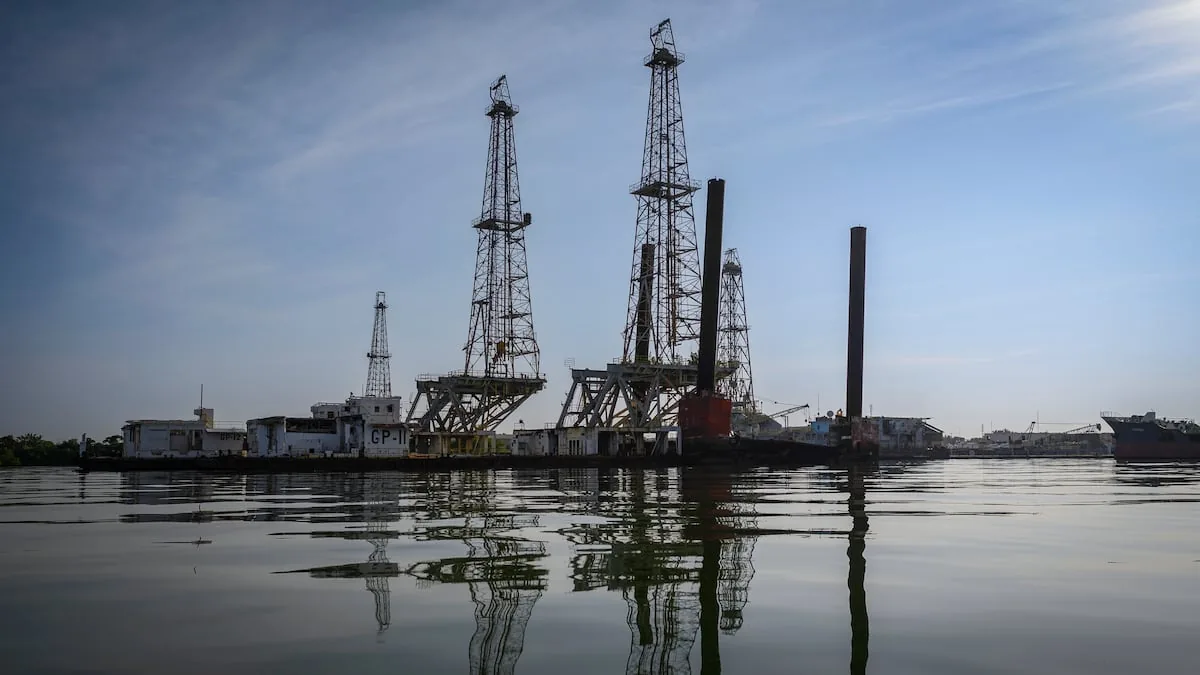
The global energy market is facing what economists call a demand destruction, which is a persistent contraction in oil consumption caused by a sharp increase in prices and resource scarcity. The International Energy Agency (IEA) has already adjusted its forecasts this week, anticipating an imminent contraction in black gold consumption. In the current situation, marked by the war in Iran and the closure of the Strait of Hormuz, the agency estimates that demand could contract by 80,000 barrels per day this year, indicating a structural adjustment in response to an environment of scarcity and high costs.
Read more The Vox union has not managed to penetrate companies more than five years after its founding
This scenario is explained, first of all, by the depletion of the inventory cushion that until now had masked the severity of the shock; while the world was using reserve crude, the impact was theoretical, but the drop of 205 million barrels in stocks outside the Persian Gulf during March indicates that industry and households will soon be forced to face a market where physical crude — the real barrel, not the brent, which is a price reference in the markets — has reached 150 dollars per barrel.
As Inés Cardenal, spokesperson for the Spanish Fuel Industry Association (AICE), explains, the market not only reacts to price but “to a severe supply crisis where the fear of product shortage — especially of derivatives like kerosene — drives governments to recommend saving measures and teleworking,” as Brussels has proposed this week. The fear of scarcity is fueled by a change in the refining system. While Europe was losing capacity, mega-refineries were being built in the Middle East which now, due to the conflict with Iran and the strangulation of the Strait of Hormuz, stop supplying the world with critical products like kerosene or diesel.
The second factor explaining the drop in demand is the disconnection between crude prices and those of its derivatives, where pressure on the industry is more intense. Refining margins have temporarily widened, driven by the rising cost of products like LPG or aviation fuel, whose costs have exceeded the increase in the barrel itself. For industrial consumers, however, the most important value is not crude but these inputs. In regions like Asia, petrochemical producers have already begun to cut their operating rates due to prohibitive prices, representing an adjustment that could extend to the entire industrial chain.
Adding to this dynamic is the uncertainty itself. In highly volatile environments like the current war, the price elasticity of demand tends to decrease, as companies and consumers delay their purchasing decisions due to lack of certainty. When the purchase finally occurs, it does so more abruptly, amplifying the impact of prices on economic activity. Raymond Torres, director of economic analysis at Funcas, adds that this scenario encourages efforts in efficiency and energy substitution which, although requiring time and investment to consolidate, may displace the use of fossil fuels with more competitive alternatives, such as renewable energies.
The last time the economy experienced a similar episode of demand destruction was in 2020, but for very different reasons, as it was a consequence of a forced halt in activity due to the pandemic. During that period, mobility stopped, but oil supply was so abundant that prices actually fell. Currently, on the contrary, the adjustment responds to a real physical scarcity, with more than 13 million barrels per day of exports off the market. Regarding this, Cardenal insists that even if the war ends now, supply recovery would not be instantaneous due to infrastructure destruction and the logistical complexity of the energy system.
Read more Has Venezuela changed since Maduro’s departure?
In the case of Spain, the situation is a bit different. Cardenal details that thanks to the strong investment carried out between 2008 and 2012, the national refining system has an uncommon flexibility in Europe, allowing it to process crude from multiple origins — from America to Africa — and partially mitigate dependence on the Middle East. Additionally, the facilities enable maximizing the production of middle distillates, covering a good part of the domestic demand for products like kerosene. This relative advantage does not eliminate the risks of the global environment but does provide greater room for maneuver compared to other more exposed European countries.
Analysts insist it is too early to know how long this demand adjustment will last. However, Manuel Hidalgo, economist at EsadeEcPol, insists that it is not a definitive loss but a strategic decision by buyers who have reserves. In his opinion, it makes no financial sense for a company or government to acquire large volumes of crude at the peak of a geopolitical shock if there is an expectation that the conflict will end soon and the barrel can be bought cheaper.
When analyzing the magnitude of the crisis, Hidalgo reduces the tension by placing prices in a historical context adjusted for inflation. He argues that current prices do not represent an extreme emergency situation since, in real terms, they are approximately equivalent to values from five years ago. “From this perspective, the market has not been driven by a kind of speculative madness but shows a moderate and reasonable rise given the current uncertainty,” he specifies.
Furthermore, the Persian Gulf has lost strategic importance in recent years compared to the emergence of energy producers like the United States and Canada, or Venezuela’s return to the international stage. This implies that, although the Strait of Hormuz remains vital, the world no longer depends on that single artery for oil supply.
Read more Inflation and the strength of the labor market drive taxation on wages and pensions to record levels