







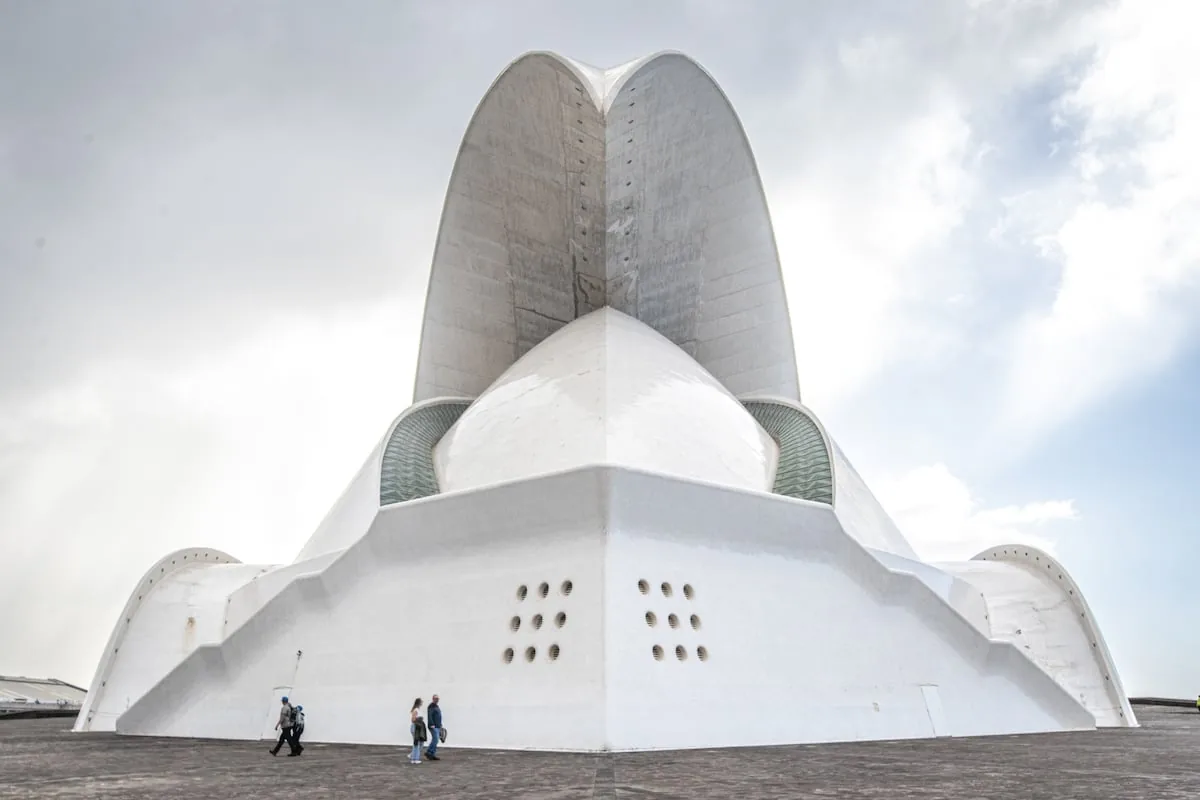
The most popular and international Spanish architect sees his work questioned again. The Adán Martín Auditorium in Santa Cruz de Tenerife by Santiago Calatrava, inaugurated in 2003 after six years of construction and costing 72 million euros, needs a repair that will cost 17.6 million euros in a project that will take 32 months, according to the project published in the Official Bulletin of the Province. This rehabilitation has become necessary due to construction errors that have caused chronic leaks due to failures affecting the cladding, which cause water infiltration and dampness. The Tenerife Council assures that “it is subject to negotiation” who should bear these costs.
Read more The Republic as a promise
The building is considered one of the architectural jewels of the island. Located at the southern exit of the city, the building has a symphony hall with a capacity for 1,616 people and a chamber hall with 422 seats. And, above all, its most characteristic element: a curved wing 60 meters high made of reinforced concrete that rises over the building from the rear and tapers to a point facing the sea, wrapping the entire structure longitudinally. The structure brings to mind the Sydney Opera House. The complex is covered with a mosaic of white tiles characteristic of the modernist architecture of eastern Spain (known as trencadís). The construction difficulties were numerous from the time the works were awarded in 1997 until its inauguration in 2003. The works tripled the initial budget.
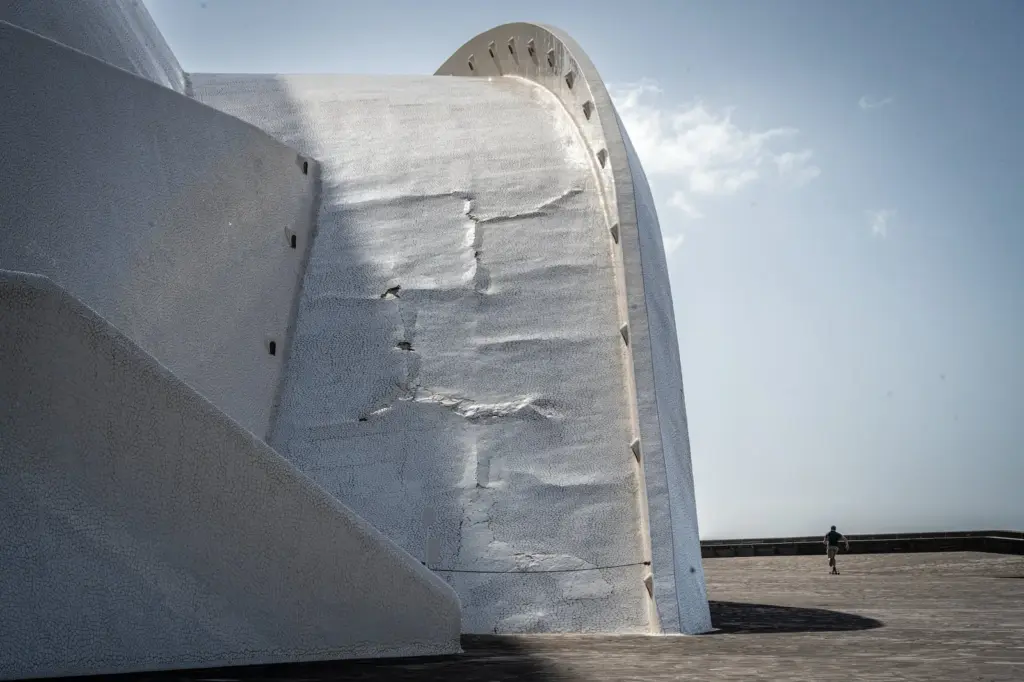
In 2015, the Tenerife Council Government sent an “urgent” letter to Calatrava’s team and the temporary union of companies formed by Acciona and Dragados to fix the leaks affecting the building and to seek a solution “as soon as possible.” The claim filed by the island corporation demanding the repair of the damages led to several legal appeals. A judge urged the parties in 2019 to explore an agreement to avoid prolonging this conflict. Negotiations were reactivated in September 2023, when a new deadline was granted for the submission of a revised technical proposal.
The socialist party recalled that in June 2022, with the PSOE in the island government, responsibilities were demanded for the hidden defects detected in the infrastructure both from the architect and the construction companies, setting a 19-month deadline for the submission of the technical project, which expired in January 2024. The party, in opposition since 2023, has requested that Calatrava assume the repair. “The Council,” explains a spokesperson for the institution, “has promoted in recent years a complex technical and legal process to demand responsibilities from the agents involved in the construction of the building and to reach a solution that allows the works to be carried out without further prolonging the judicial conflict.” And concludes: “This government has assumed the responsibility of facing a complex situation, marked by technical and judicial conflicts” and that “had been blocked for years.” This newspaper has asked if this means that the Corporation will advance the money for the remodeling, pending an agreement. The Institution’s spokesperson has limited herself to responding that this matter “is subject to a negotiation process.”
Initially, Calatrava even refused to assume the direction of the remodeling work. Moreover: according to journalist Llàtzer Moix in the book Queríamos un Calatrava (Anagrama), published in 2016, tensions exploded between the architect and the Tenerife Council technicians when construction failures in the opera house surfaced. “To make it clear to you, you are talking to me from your island, which is at the ass end of Europe, and I am talking to you from Zurich, which is in its heart. Your island does not deserve me,” he said to engineer Enrique Amigó, from the Tenerife Council, when he tried to redirect the multiple problems of the auditorium.
Intervention
The planned intervention will cover facades, roofs, terraces, stairs, skylights, and enclosures. The project includes the complete removal of the current trencadís, the repair and consolidation of concrete and metal supports, the execution of new multilayer waterproofing systems, and the subsequent replacement of the ceramic cladding. It also includes the replacement of gutters, correction of slopes for proper rainwater drainage, and the recovery of unique elements such as skylights and natural stone pavements.
Manufacturing defects have plagued Calatrava in recent decades (in addition to being under scrutiny for the Pandora Papers): the glass bridge in Venice, the Athens stadium, the movable roof of the Oviedo Congress Palace, the roof of the Domecq wineries in Laguardia, among other scandals. The Valencian also used trencadís in the Palau de les Arts Reina Sofía in Valencia, inaugurated in 2005. At the end of 2013, this tile began to detach because the adhesive necessary to fix the tesserae was improperly used during installation. In 2015, this cladding was restored. The City of Arts and Sciences (CACSA), owner of the opera building, then assured that the works, in compliance with the agreement between the parties (CACSA, the Valencian architect’s office, and the Palau construction UTE), “did not entail any cost to the citizens.”
In 2014, the Valencian architect had defended the works at El Palau in an interview granted to this newspaper (“various factors occurred, all of them unrelated to the architect’s work as designer and project manager,” he said then) and cited the Tenerife case as a defense: “In the Tenerife Auditorium it was used brilliantly, and more than 12 years later it still gives shine to a unique work exposed to the sun, winds, and Atlantic storms,” he maintained.
The harsh report prepared by the company Intercontrol Levante is not so flattering in its diagnosis. According to its technicians, the causes of the pathologies of the Adán Martín Auditorium are due to “inadequate execution of the trencadís,” in which environmental conditions were not taken into account” nor were “the waiting times between layers” respected.
Regarding the leaks, faults have been detected in the placement of materials, as well as defects in the design of downspouts, “poor execution of construction details” in gutters, skylights, and joints, the absence or incorrect resolution of joints, poorly replanned slopes, and ineffective seals in carpentry and enclosures.
Read more ERC of Barcelona seeks to break the deadlock one year before the municipal elections